
English can be tricky. Even native speakers often stumble over verbs like “froze” and “frozen.” Are they interchangeable?
When should you use one instead of the other? This guide dives deep into the grammar, rules, history, and usage of froze or frozen, giving you clarity and confidence.
By the end, you’ll never hesitate when writing or speaking about freezing anything—from ice cubes to panic moments!
Understanding the Verb “Freeze”
The verb “freeze” is more versatile than it seems. At its core, it refers to turning a liquid into solid because of cold, but it also conveys figurative meaning—like fear or sudden inactivity.
Forms of “Freeze”:
| Form | Example | Usage |
|---|---|---|
| Present | freeze | I freeze water in the winter. |
| Simple Past | froze | Yesterday, I froze the leftovers. |
| Past Participle | frozen | The lake has frozen over completely. |
Notice how each form serves a distinct function. Using the wrong one can make sentences grammatically incorrect or awkward.
When to Use “Froze”
“Froze” is the simple past tense of freeze. You use it when talking about a completed action in the past.
Rules and Notes:
- Only use “froze” for past events, not ongoing actions.
- Avoid pairing it with auxiliary verbs like “have” or “had.”
Examples:
- Correct: “I froze the vegetables yesterday.”
- Correct: “She froze when she saw the spider.”
- Incorrect: “I have froze the chicken.” ❌
Tips for remembering “froze”:
- Think of action that happened already.
- Picture a snapshot of the moment something became frozen.
When to Use “Frozen”
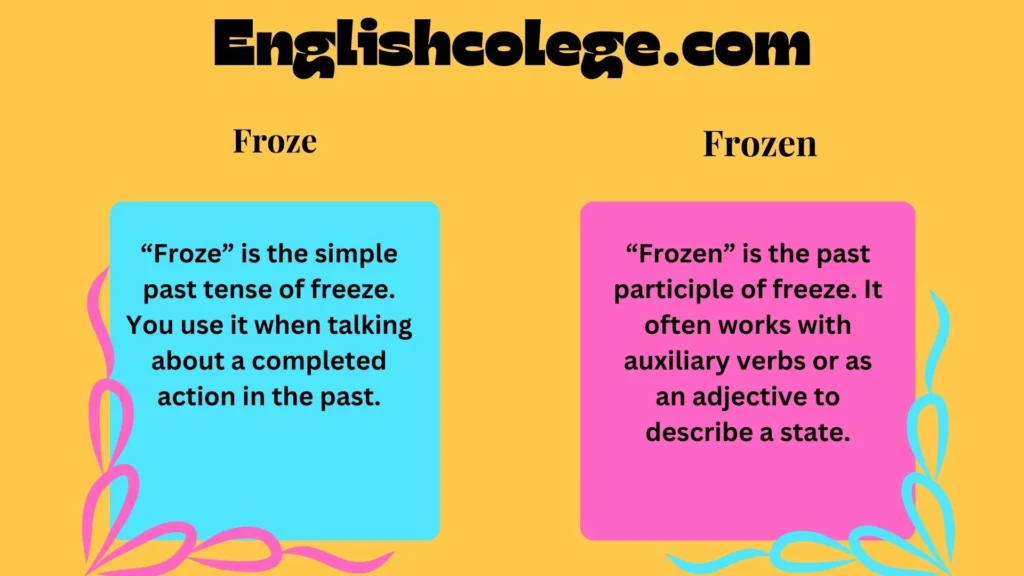
“Frozen” is the past participle of freeze. It often works with auxiliary verbs or as an adjective to describe a state.
Uses of Frozen:
- Perfect tenses: “I have frozen the water.”
- As an adjective: “I bought frozen pizza.”
- Passive voice (sometimes): “The lake was frozen by morning.”
Examples in Context:
- Present perfect: “The pond has frozen over.”
- Past perfect: “By the time he arrived, the lake had frozen.”
- Future perfect: “By next week, the ice will have frozen.”
Using “Frozen” in Perfect Tense Constructions
Perfect tenses are where “frozen” shines. Pair it with auxiliary verbs to indicate completed action with relevance to another time.
| Tense | Example | Notes |
|---|---|---|
| Present Perfect | I have frozen the leftovers. | Shows action completed recently or affecting present |
| Past Perfect | By 9 a.m., the lake had frozen. | Shows action completed before another past event |
| Future Perfect | By tomorrow, the pond will have frozen. | Predicts completed action in future |
Tip: If your sentence has “have/has/had”, you almost always use “frozen,” not “froze.”
Common Mistakes With “Froze” and “Frozen”
Even seasoned writers slip up. Here are the most frequent mistakes:
- Using “froze” with auxiliary verbs:
❌ Incorrect: “I have froze the chicken.”
✅ Correct: “I have frozen the chicken.” - Using “frozen” in simple past statements:
❌ Incorrect: “Yesterday I frozen the vegetables.”
✅ Correct: “Yesterday I froze the vegetables.” - Overgeneralizing the verb: treating “frozen” as all-purpose past tense.
Quick Fix: Remember “froze = action, frozen = result/state.”
Practical Tips to Remember the Past Tense of “Freeze”
- Visual cue method: Picture water turning to ice. Action = froze. State = frozen.
- Mnemonic: “Froze shows the moment; frozen shows the aftermath.”
- Practice: Write 5 sentences daily using both words in different contexts.
Case Study Example:
- Emily froze when the dog barked. (Action)
- Later, she noticed the frozen pond outside. (State)
The Grammatical Rules Behind “Freeze” Conjugations
“Freeze” is irregular and follows a pattern known as ablaut, where vowels change across tenses.
Compare with other irregular verbs:
| Verb | Present | Past | Past Participle |
|---|---|---|---|
| Freeze | freeze | froze | frozen |
| Speak | speak | spoke | spoken |
| Choose | choose | chose | chosen |
Notice the vowel shift in each form. Learning these patterns helps prevent common mistakes.
Historical Origins of “Freeze”
The word “freeze” comes from Old English frēosan, meaning “to become stiff with cold.” Over centuries, it evolved to modern English while retaining both literal and figurative meanings:
- Literal: Ice formation, food preservation.
- Figurative: Freezing in fear or surprise.
Understanding origins can help you remember its irregular conjugation.
Related Grammar Clarifications
English is tricky beyond “froze” and “frozen.” Here are other common pitfalls:
- Integratable vs. Integrable: Correct term is integrable in tech/business contexts.
- Simpler vs. More Simple: Use simpler for comparisons: “This method is simpler than the old one.”
- Piece vs. Peace: Common homophone mistake.
- Awaiting Approval vs. Pending Approval: Business nuance: “pending” is formal; “awaiting” is conversational.
- 12 Alternatives for “Just a heads up”:
- FYI
- For your information
- Take note
- Please note
- Attention
- Reminder
- A quick note
- Alert
- Keep in mind
- Be aware
- Notification
- Quick update
- Comradery: Means fellowship or camaraderie among people. Use in professional or casual contexts.
Two-Minute English Tips
- Always pair “frozen” with have/has/had.
- Use “froze” for past actions without auxiliary verbs.
- Think state vs. action: frozen = condition, froze = event.
Example mini-exercise:
- Fill in the blank: “Yesterday, I ____ the soup before leaving.” → Answer: froze
FAQs About Froze and Frozen
What’s the difference between froze and frozen?
Answer: Froze = simple past (action completed). Frozen = past participle (result or perfect tense).
Can I say “I have froze the ice”?
Answer: No. Correct: “I have frozen the ice.”
Is frozen only used for ice and cold?
Answer: No. It’s also figurative, like “She froze in fear.”
How do I remember which is which?
Answer: Action in the past = froze. Result/state = frozen. Visualize the freeze process.
Can frozen be an adjective?
Answer: Yes. Example: “I bought frozen vegetables.”
Conclusion
Mastering froze or frozen is simpler than it seems once you understand action vs. state, simple past vs. past participle, and perfect tense rules.
By remembering key examples, visual cues, and the ablaut pattern, you can confidently write and speak without hesitation.
Pro Tip: Practice daily, use tables or lists to compare forms, and read your writing out loud to catch mistakes. Soon, using froze and frozen will feel completely natural.

I’m Sameer — a passionate English enthusiast who loves exploring words, grammar, and the art of effective communication. ✍️