
Language evolves, but confusion often follows. Few examples show this better than the ongoing debate between “verbage” and “verbiage.”
You’ve seen both words used online, in workplaces, even in marketing materials. But here’s the truth: only one is correct in American English, and using the wrong one can instantly undermine your credibility.
This article breaks down everything — from origins and meanings to pronunciation, examples, and when to use (or not use) verbiage. Let’s clear the fog once and for all.
Why This Confusion Matters
Words carry weight. In writing and speech, one misplaced letter can change how your audience perceives you.
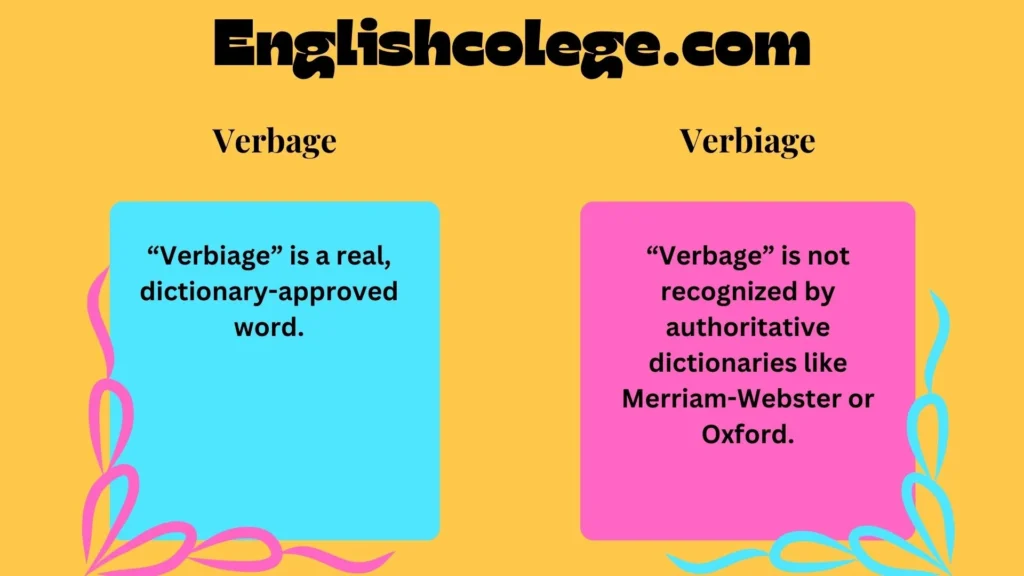
- “Verbiage” is a real, dictionary-approved word.
- “Verbage” is not recognized by authoritative dictionaries like Merriam-Webster or Oxford.
Still, the misspelling verbage has crept into everyday communication, partly because it sounds right. Understanding the distinction isn’t about being a grammar snob; it’s about communicating clearly and professionally.
“Precision in language reflects precision in thought.”
— Anonymous
The Origin of the Confusion
Let’s start with why people mix them up.
- Both verbiage and verbage sound similar, especially when pronounced quickly.
- English spelling rules are full of inconsistencies, leading to phonetic mistakes.
- The internet amplifies errors. Once a misspelling gains traction online, it spreads like wildfire.
Historically, verbiage came from French “verbiage” and Latin “verbum” (meaning “word”). It entered English around the 15th century, describing either “style of expression” or “excess of words.”
So where did verbage come from?
It’s a nonstandard variant, born from phonetic simplification — people writing what they hear. It’s similar to how words like “irregardless” or “supposably” emerged through mishearing.
While some modern dictionaries may list “verbage” due to frequent misuse, they label it “nonstandard.” That means: people say it, but professionals shouldn’t.
What “Verbiage” Really Means
Verbiage has two main meanings depending on context:
| Sense | Meaning | Tone | Example |
|---|---|---|---|
| Neutral | Style or manner of expression | Neutral or positive | “The legal verbiage was precise and formal.” |
| Negative | Overly wordy or inflated language | Negative | “His speech was full of unnecessary verbiage.” |
In Simple Terms
- If you’re describing word choice or phrasing, “verbiage” fits.
- If you’re criticizing wordiness, “verbiage” still fits — but in its pejorative sense.
Tip: You can think of verbiage as “words about words.” It’s all about expression — how language is used, well or poorly.
Why “Verbage” Isn’t a Real Word (Yet)
Although verbage pops up often in casual speech or online writing, it remains nonstandard.
Here’s why:
- No major dictionary officially accepts “verbage” as correct English.
- Style guides (APA, Chicago, MLA) explicitly discourage its use.
- Linguists classify it as a spelling error, not a dialectal variation.
However, verbage has a unique cultural story. It appears in corporate and tech slang to describe complicated jargon — phrases like:
“We need to simplify our marketing verbage.”
This informal use doesn’t make it correct in formal contexts, but it explains why many native speakers think it’s valid.
So could “verbage” ever become accepted?
Possibly — language shifts through popular usage, not decree. Words like “selfie,” “google,” and “impactful” once faced resistance too.
But for now, if you care about clarity, correctness, and professionalism, stick with “verbiage.”
Verbiage in Practice: Good vs. Bad Use
Let’s look at verbiage in real-world writing.
✅ Good Verbiage (Effective Language)
- “The proposal’s verbiage was persuasive and to the point.”
- “He admired the poetic verbiage in her essay.”
❌ Bad Verbiage (Overly Wordy Language)
- “Due to the fact that” instead of “Because.”
- “At this point in time” instead of “Now.”
- “In order to” instead of simply “To.”
Comparison Table: Concise vs. Wordy Sentences
| Concise Sentence | Wordy Sentence (Poor Verbiage) |
|---|---|
| “We’ll meet tomorrow.” | “A meeting will be scheduled to take place tomorrow.” |
| “Please reply soon.” | “Kindly respond at your earliest convenience.” |
| “She quit her job.” | “She decided to tender her resignation from her current employment position.” |
Rule of Thumb: If you can say something in fewer words without losing meaning, do it.
The Fine Line Between Rich Language and Overload
Good writing walks a tightrope between brevity and eloquence.
Too few words can sound blunt; too many drown the message.
Balance Brevity and Richness by:
- Prioritizing clarity over decoration.
- Using specific verbs and nouns instead of filler adjectives.
- Avoiding corporate or academic jargon unless necessary.
- Editing ruthlessly — cut 20% of your first draft.
Example:
“The project aims to facilitate interdepartmental communication for enhanced efficiency.”
becomes
“The project helps teams communicate better.”
See the difference? The second sentence keeps your reader awake.
Pronunciation Guide: Saying “Verbiage” Correctly
Here’s where many trip up.
The correct pronunciation is:
/ˈvɜːr.bi.ɪdʒ/ — VER-bee-ij.
Common mispronunciations include:
- “VERB-age” ❌
- “VERB-ij” ❌
- “ver-BEE-age” ❌
Quick Memory Trick
Think of “herb” + “bee” + “ij” → “herb-ee-ij.”
Fun Fact
“Verbiage” once had several regional pronunciations in the 18th century, but modern American English standardized it to “VER-bee-ij.”
Remembering the Difference
| Term | Status | Meaning | Use in Formal Writing |
|---|---|---|---|
| Verbiage | ✅ Correct | Style of wording; sometimes excessive words | Yes |
| Verbage | ❌ Incorrect | Nonstandard misspelling | No |
Mnemonic
“Verbiage = words. Verbage = garbage.”
Visualize verbage as linguistic trash — an easy way to remember what not to use.
Broader Lesson: Precision in Language Matters
Language reflects thought. The more precise your word choice, the sharper your communication.
Whether you’re crafting a business report, academic paper, or marketing copy, accuracy builds trust.
A single error like verbage might seem harmless, but it signals carelessness — the last impression you want to leave.
“Good grammar is credibility, especially on the internet.”
— Amanda Gorman
Case Study: The Corporate Email Slip
A real-world example makes the point clear.
In 2023, a corporate training firm sent a national press release titled “Simplifying Company Verbage.” The error went viral for the wrong reasons.
Readers mocked the title on LinkedIn, and language professionals chimed in to explain the difference. The company later corrected it to “Simplifying Company Verbiage,” but the damage was done — credibility suffered.
Lesson learned: Proofread before publishing.

Related Language Confusions Worth Knowing
Let’s look at other word pairs that cause similar headaches.
Explicit vs. Implicit
- Explicit: Directly stated.
- Implicit: Suggested, not said outright.
“The teacher’s instructions were explicit, leaving nothing implicit.”
In Development vs. Under Development
- In development → informal, common in creative industries.
- Under development → more formal, used in business and construction contexts.
Whiny vs. Whiney
- Whiny is correct.
- Whiney is an incorrect variant — similar to verbage.
Will Resume vs. Will Be Resumed
- Will resume: active; you’re doing the action.
- Will be resumed: passive; the action happens to something.
“The meeting will resume after lunch” (active).
Being vs. Been
- Being refers to something ongoing.
- Been refers to something completed.
“I’m being patient” vs. “I’ve been patient.”
What Is a Skort?
A fun example of language innovation.
A skort = skirt + shorts — a portmanteau that started as slang but became a legitimate dictionary word.
Who knows? Maybe verbage will one day follow a similar path.
FAQs About Verbage vs. Verbiage
Is “verbage” ever acceptable?
Not in formal English. It’s considered a misspelling of verbiage, though it occasionally appears in informal business jargon.
Why do people say “verbage” instead of “verbiage”?
It’s a phonetic mistake — the way the word sounds leads people to spell it wrong.
Can “verbiage” have a positive meaning?
Yes. When referring to style or diction, verbiage can be neutral or positive — only context decides if it’s critical or not.
Is “verbiage” the same as “wordiness”?
Not exactly. Wordiness always implies excess. Verbiage can mean “word choice” in a neutral sense.
How can I remember the correct spelling?
Use the mnemonic: “Verbiage has the word ‘verb’ in it — verbs are words.”
Conclusion: Speak Clearly, Write Smart
Language shapes perception.
Using “verbiage” instead of “verbage” may seem minor, but it separates careful communicators from careless ones.
In a world of rapid digital communication, where every post or email represents your professionalism, accuracy matters more than ever.
Here’s the takeaway:
- Verbiage = correct, professional, meaningful.
- Verbage = incorrect, casual, best avoided.
Be precise. Speak clearly. Write smart — your readers will thank you.

I’m Sameer — a passionate English enthusiast who loves exploring words, grammar, and the art of effective communication. ✍️