
When it comes to reading, writing, or creating content, the terms informational and informative often get tossed around like they mean the same thing.
But they don’t. Understanding the difference can improve how you write, learn, or even engage with content online.
In this guide, we’ll break down everything you need to know about informational vs informative texts, why they matter, and how to use them effectively.
Understanding the Basics: Informational vs Informative Texts
At first glance, informational texts and informative texts seem identical—they both give information. But the purpose, tone, and structure often differ.
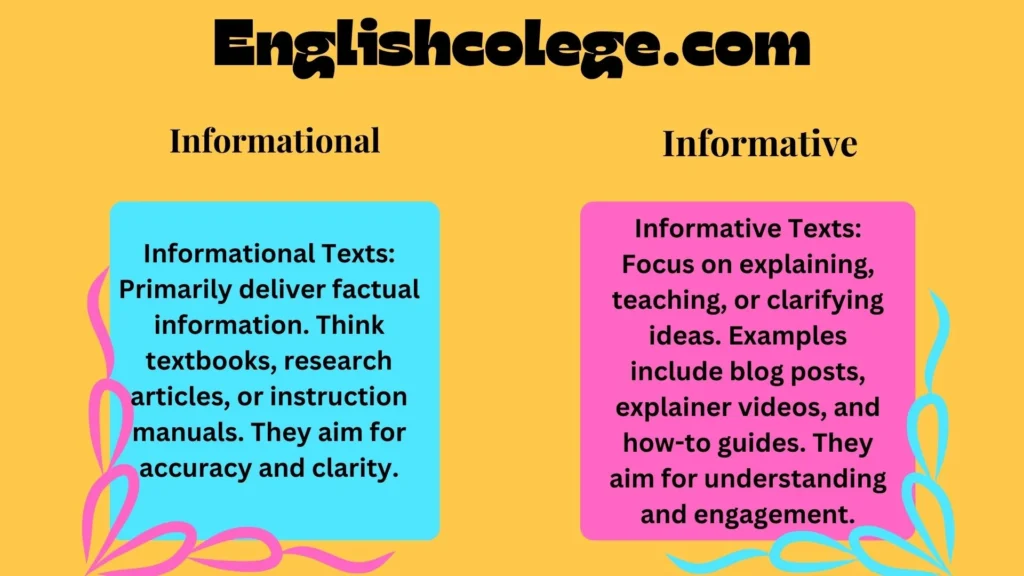
- Informational Texts: Primarily deliver factual information. Think textbooks, research articles, or instruction manuals. They aim for accuracy and clarity.
- Informative Texts: Focus on explaining, teaching, or clarifying ideas. Examples include blog posts, explainer videos, and how-to guides. They aim for understanding and engagement.
Here’s a quick comparison table:
| Feature | Informational Text | Informative Text |
|---|---|---|
| Purpose | Present facts | Explain or teach |
| Tone | Objective, formal | Conversational, engaging |
| Examples | Textbooks, manuals, reports | Blogs, tutorials, explainer posts |
| Structure | Structured, headings, bullets | Flexible, narrative with examples |
Fact: Students who can identify the type of text they’re reading improve comprehension by over 30%. That’s why this distinction isn’t just academic—it’s practical.
Characterizing Informational Text
Informational texts have unique characteristics that make them recognizable and effective:
- Objective tone: Facts speak for themselves; opinions are minimal.
- Clear structure: Headings, subheadings, bullet points, and numbered lists guide the reader.
- Use of visuals: Charts, tables, and diagrams make complex data easier to grasp.
- References: Credible sources and citations add authority.
Example: A science textbook might explain photosynthesis with a diagram, labeled steps, and supporting data—everything is factual, verifiable, and organized.
Tip: When creating informational text, avoid flowery language or opinions. Stick to facts, clarity, and readability.
The Purpose and Style of Informative Writing
Informative writing focuses less on raw data and more on understanding. Its style is designed to engage the reader while teaching them something new.
Key elements include:
- Active voice: “The student analyzes the graph,” instead of “The graph is analyzed by the student.”
- Conversational tone: Use “you” to directly involve the reader.
- Supporting examples: Concrete examples make abstract ideas clear.
- Short, digestible paragraphs: Easier to read and remember.
Example: A blog post explaining blockchain might use analogies like comparing blocks to “digital Lego bricks” to simplify a complex concept.
Types of Informative Texts
Informative content comes in many forms, each suited to a different audience or purpose:
- Expository Essays: Explains a concept clearly and logically.
- How-to Guides: Step-by-step instructions, often found on blogs or tutorials.
- News Articles: Present recent facts and updates.
- Educational Resources: Textbooks, handouts, and lecture notes.
- Social Media Infographics: Quick, visually digestible snippets for fast learning.
Table: Informative Text Types and Uses
| Type | Example | Best Used For |
|---|---|---|
| Expository Essay | “The History of Internet” | Students, academic readers |
| How-to Guide | “How to Bake Sourdough Bread” | DIY enthusiasts, learners |
| News Article | “NASA Launches New Satellite” | General audience |
| Educational Resource | Science textbook | Schools, universities |
| Social Media Infographic | “5 Facts About Climate Change” | Quick learning, social media |
Fact: Visual content increases retention by 42% compared to text-only content.
Utilizing Visual Aids: Graphics and Illustrations
Visual aids aren’t just decoration—they enhance comprehension. Here’s how:
- Charts: Show trends, patterns, and comparisons.
- Diagrams: Simplify complex processes like the water cycle or electrical circuits.
- Infographics: Combine text, visuals, and data for quick understanding.
Pro Tip: Keep visuals simple, relevant, and clearly labeled. Overcomplicated diagrams confuse readers rather than inform them.
Visual Aids in Education: The Path to Better Learning
Research shows that visuals improve learning for all types of students:
- Visual learners: Grasp concepts through diagrams or images.
- Auditory learners: Benefit when visuals accompany explanations.
- Kinesthetic learners: Engage through interactive visual tools like apps or models.
Case Study: A high school biology class using labeled diagrams of the human heart scored 20% higher on exams than a class using text-only explanations.
Tip for educators: Use visuals alongside bullet points, short paragraphs, and analogies to reinforce learning.
Real-World Examples of Informative Content on Social Media
Social media isn’t just for memes; it’s full of informative content that educates at a glance. Examples include:
- Instagram Carousels: Step-by-step guides or mini-tutorials.
- TikTok Explainers: Short, engaging video breakdowns of topics like science experiments.
- YouTube Educational Channels: Mini-lessons that combine visuals, narration, and text.
Fact: Short, visually engaging content often sees 2x more engagement than plain text posts.
Keywords and Intent: Tailoring Content for Information-Seeking Audiences
When writing informative content online, understanding reader intent is crucial. People search for answers, not filler.
Tips for keyword optimization:
- Use keywords naturally in headings and subheadings.
- Focus on long-tail keywords like “difference between recur and reoccur” for specific queries.
- Answer questions clearly and concisely.
Example Table: Keyword Intent for Informative Texts
| Keyword | User Intent | Recommended Format |
|---|---|---|
| Informational vs Informative | Learn differences | Blog post, explainer video |
| Recur vs Reoccur | Correct word usage | Short article, dictionary |
| Machiavellian Meaning | Definition & examples | Blog post with examples |
| Dam vs Damn | Grammar check | Table, infographic |
| Social Media Infographics | Learn quick facts | Carousel or infographic |
Common Confusing Words Explained
English is tricky, and small word differences can change meaning entirely. Here are some frequent troublemakers:
- Bloc vs. Block:
- Bloc = a group or alliance (political or business).
- Block = a solid piece or to obstruct.
- Recur vs. Reoccur:
- Recur = happens repeatedly in a pattern.
- Reoccur = happens again, without a pattern.
- Present vs. Presents:
- Present = here, or to give something.
- Presents = plural of a gift.
- Heard vs. Herd vs. Hurd:
- Heard = past tense of hear.
- Herd = group of animals.
- Hurd = (less common) used in names, e.g., “Hurd Barrier.”
- Dam vs. Damn:
- Dam = barrier that holds water.
- Damn = curse word or expression of frustration.
- Machiavellian:
- Describes someone cunning, strategic, and often unscrupulous.
- Example: “The CEO’s Machiavellian tactics ensured market dominance.”
Tip: Use tables or bullet points for quick reference—readers love fast clarity.
Two-Minute English: Quick Tips
Sometimes, all you need is two minutes to improve your English:
- Spot the difference between similar words in a sentence.
- Create a mini-table for confusing grammar rules.
- Use examples from your daily life: e.g., “I saw a herd of cows yesterday” vs. “I heard the news yesterday.”
Fun Fact: Small daily habits like this can improve retention of tricky words by 50% over a month.
FAQs
What is the main difference between informational and informative texts?
Informational texts focus on facts; informative texts aim to explain or teach concepts in an engaging way.
Can social media posts be considered informative texts?
Yes! Short videos, carousels, and infographics often serve to explain concepts clearly and quickly.
Are visuals essential in informative writing?
While not mandatory, visuals significantly improve understanding and retention of complex information.
How do I know if a text is informational or informative?
Check the purpose: Is it purely presenting facts (informational) or explaining them in a way you can understand (informative)?
How can I make my informative content engaging?
Use active voice, relatable examples, visuals, and short paragraphs to make content digestible and memorable.
Conclusion
Understanding informational vs informative texts is more than academic—it’s a skill that helps you read, write, and create content effectively.
By identifying text types, using visuals, choosing the right style, and optimizing for reader intent, you can make information clear, engaging, and actionable.
Whether you’re a student, educator, or content creator, mastering these differences is a small change with a big impact.

I’m Sameer — a passionate English enthusiast who loves exploring words, grammar, and the art of effective communication. ✍️