
English is full of words that seem similar but carry subtle differences in meaning. Words like incoming, upcoming, and oncoming can confuse even native speakers if you don’t understand their nuances.
Using the wrong term might make your sentences awkward or even change the meaning completely.
In this article, we’ll break down these three terms, explore how they’re used in daily conversation, compare them side by side, and give you tips for mastering their usage.
We’ll also cover some related words that often trip people up. By the end, you’ll be confident using them correctly.
Understanding “Incoming”: A Matter of Arrival
The word incoming is all about something actively arriving toward you. Whether it’s a message, an object, or even a warning, incoming signals immediacy and direction.
Key Features of “Incoming”:
- Implies motion toward the speaker or a location.
- Often carries a sense of urgency.
- Can be used literally or figuratively.
Examples:
- Literal: “The soldiers prepared for incoming fire.”
- Figurative: “I have an incoming email from my manager.”
- Urgency: “Incoming call! Answer it quickly!”
Notice how incoming is often paired with active verbs like “arriving,” “hitting,” or “sending.” It conveys action rather than just scheduling.
Tip: Use incoming when you want to highlight that something is on its way and needs attention now.
Diving into “Upcoming”: Events on the Horizon
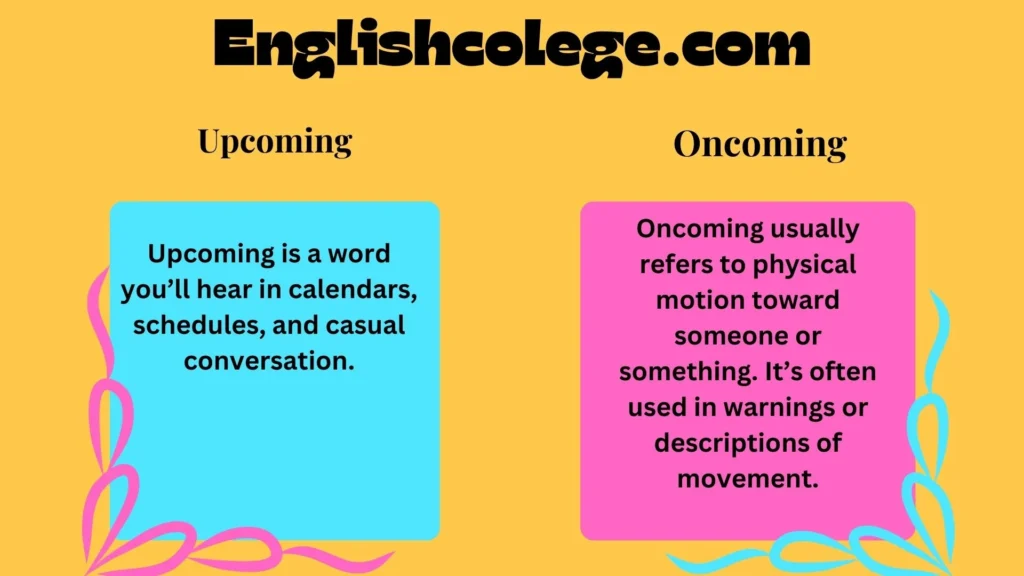
Upcoming is a word you’ll hear in calendars, schedules, and casual conversation. Unlike incoming, it focuses on future events, not immediate arrivals.
Key Features of “Upcoming”:
- Refers to events or moments that are planned or scheduled.
- Often neutral, without implying urgency.
- Works well for both professional and casual contexts.
Examples:
- “The upcoming meeting is scheduled for Friday at 3 PM.”
- “Are you attending the upcoming concert this weekend?”
- “The upcoming exam will cover chapters 5 through 8.”
Think of upcoming as pointing toward the horizon—something you can see ahead but isn’t hitting you immediately.
Pro Tip: You can safely use upcoming in emails, calendars, and social media posts to indicate future events.
Typical Uses of “Upcoming” in Daily Language
Upcoming shows up everywhere in everyday English. Here’s a quick guide to its most common uses:
| Context | Example Phrase | Notes |
|---|---|---|
| Work | Upcoming project deadline | Professional, formal usage |
| School | Upcoming test or assignment | Neutral, academic usage |
| Social/Events | Upcoming party or festival | Informal, casual usage |
| Media/Entertainment | Upcoming movies or concerts | Informative, promotional |
Collocations: “upcoming event,” “upcoming schedule,” “upcoming session,” “upcoming changes.” These are phrases that sound natural to native speakers.
Quick Tip: If you’re unsure between incoming and upcoming, remember that incoming hits you soon, upcoming is just on the calendar.
Anticipating “Upcoming” Moments: A Closer Look
The word upcoming can also carry a sense of anticipation. For example, when you say, “I’m excited about the upcoming festival,” it conveys positive expectation, not just a neutral fact.
Subtle Differences:
- Future: “There will be a festival in June.” (neutral, factual)
- Upcoming: “The upcoming festival in June is highly anticipated.” (engaging, draws attention)
Using upcoming in writing or conversation often makes your language feel lively and connected to real life. It’s especially useful in newsletters, announcements, and blogs because it signals relevance.
“Oncoming”: When Things Move Towards You
Unlike incoming, which can be abstract, oncoming usually refers to physical motion toward someone or something. It’s often used in warnings or descriptions of movement.
Key Features of “Oncoming”:
- Refers to physical motion, not time.
- Usually implies danger or the need for awareness.
- Common in traffic, sports, or physical action contexts.
Examples:
- “Watch out for the oncoming car!”
- “The cyclist avoided the oncoming runner on the track.”
- “The football player dodged the oncoming tackle.”
Think of oncoming as an alert that something is approaching you directly and usually fast.
Quick Memory Tip:
- Incoming = arriving soon (any context)
- Upcoming = scheduled in the future
- Oncoming = moving toward you physically
Comparing “Incoming,” “Upcoming,” and “Oncoming”
To make things crystal clear, here’s a side-by-side comparison:
| Word | Focus | Common Usage | Example |
|---|---|---|---|
| Incoming | Arrival, immediacy | Emails, calls, missiles, alerts | “I have an incoming message.” |
| Upcoming | Future, scheduling | Meetings, events, tests, projects | “The upcoming conference is next week.” |
| Oncoming | Physical motion | Traffic, sports, physical threats | “The oncoming train is fast.” |
Key takeaway: Always consider whether your sentence is about timing, arrival, or physical motion.
The Significance of Context
Context is everything when choosing the right word. Using incoming for a meeting could feel odd:
- ❌ “I have an incoming meeting at 3 PM.”
- ✅ “I have an upcoming meeting at 3 PM.”
Similarly, using oncoming for abstract events doesn’t work:
- ❌ “The oncoming festival is exciting.”
- ✅ “The upcoming festival is exciting.”
A single misused word can confuse readers, so always ask:
- Is it happening soon or scheduled? → Upcoming
- Is it arriving now? → Incoming
- Is it moving toward me physically? → Oncoming
Everyday Conversation Examples
Here are some realistic scenarios:
Scenario 1 – Office:
- Correct: “I have an upcoming client call at 2 PM.”
- Incorrect: “I have an incoming client call at 2 PM.” (unless the call is literally arriving now)
Scenario 2 – Street:
- “Look out for the oncoming car!” – perfect usage.
Scenario 3 – Messaging:
- “You have an incoming email from HR.” – right because it’s actively arriving.
These examples highlight how using the right word keeps your meaning clear and natural.
Common Mistakes to Avoid
Many learners and even native speakers make mistakes with these terms. Here’s what to watch for:
Mistakes with Incoming:
- Using it for scheduled events: “I have an incoming meeting tomorrow.” ❌
- Confusing it with oncoming: “Watch out for the incoming car!” ✅ (correct only in some contexts)
Mistakes with Upcoming:
- Using it for immediate arrivals: “I have an upcoming email.” ❌
- Forgetting it’s neutral: “The upcoming storm is dangerous.” (use imminent instead for urgency)
Mistakes with Oncoming:
- Using it metaphorically for events: “The oncoming election is next month.” ❌
- Confusing with incoming: “Incoming traffic is fast.” ✅ (only if referring to traffic moving toward you)
Enhancing Your Vocabulary: Tips for Remembering the Differences
Here are some practical strategies:
Memory Tricks:
- Incoming = Now/Arriving → think “IN” as in “into your space.”
- Upcoming = Future/Scheduled → think “UP” on the calendar.
- Oncoming = Toward you/Physical → think “ON YOUR PATH.”
Practice Exercises:
- Write 5 sentences daily using each word.
- Highlight these words when reading English news articles.
- Speak them aloud in real-life conversations to reinforce usage.
Pro Tip: Make a small table of collocations for your reference:
| Word | Common Collocations |
|---|---|
| Incoming | incoming call, incoming email, incoming attack |
| Upcoming | upcoming event, upcoming project, upcoming session |
| Oncoming | oncoming traffic, oncoming player, oncoming train |
Bonus: Related Confusing Words & Phrases
English is full of words that trip people up. Here’s a quick reference:
- Expiry vs. Expiration: Expiry is more common in UK English, expiration in US English. Both mean the end of validity.
- Doozy: Refers to something remarkable, either good or bad. Example: “That exam was a real doozy!”
- Beck and Call vs. Beckon Call: Correct phrase: “beck and call” – meaning ready to serve.
- Smooth vs. Smoothe: Smooth = texture or manner; smoothe = rare variant for smoothing.
- Avant-Garde: Innovative, experimental in arts. Example: “The movie was avant-garde in style.”
- Innuendo: A subtle or indirect hint, often suggestive. Example: “The comedian’s joke was full of innuendo.”
These short clarifications help learners avoid embarrassing mistakes.
FAQs
What’s the difference between incoming and upcoming?
Answer: Incoming refers to something arriving now, upcoming refers to something planned in the future.
Can oncoming be used for events?
Answer: No. Oncoming is typically used for physical motion toward someone.
Is “upcoming” formal or informal?
Answer: It’s neutral. Suitable for professional, casual, and academic contexts.
Can “incoming” be used metaphorically?
Answer: Yes, e.g., “incoming information” or “incoming feedback,” but usually signals immediacy.
How do I remember the difference easily?
Answer: Think Incoming = Now, Upcoming = Future, Oncoming = Toward you physically.
Conclusion
Choosing between incoming, upcoming, and oncoming is all about context, timing, and motion.
- Incoming emphasizes something arriving now.
- Upcoming signals something scheduled for the near future.
- Oncoming warns of physical motion toward you.
By understanding these subtle differences, paying attention to context, and practicing daily, you’ll sound confident and precise in English.
Using the right word can make your communication clearer, more professional, and natural.

I’m Sameer — a passionate English enthusiast who loves exploring words, grammar, and the art of effective communication. ✍️