
Language evolves like a living organism — flexible, expressive, and ever-changing.
Two phrases that often appear interchangeable, yet subtly distinct, are “throughout the years” and “over the years.”
At first glance, they both describe time passing. But the truth? Each phrase carries its own emotional tone, grammatical rhythm, and contextual purpose.
Understanding these differences can elevate your English writing from good to natural, from correct to compelling.
This guide explores the real differences between these expressions, shows how they’re used in American English, and helps you choose the right one every time.
What Makes These Phrases Important?
You’ve probably used both phrases without thinking much about them. Yet, the way you describe time shapes how readers or listeners feel.
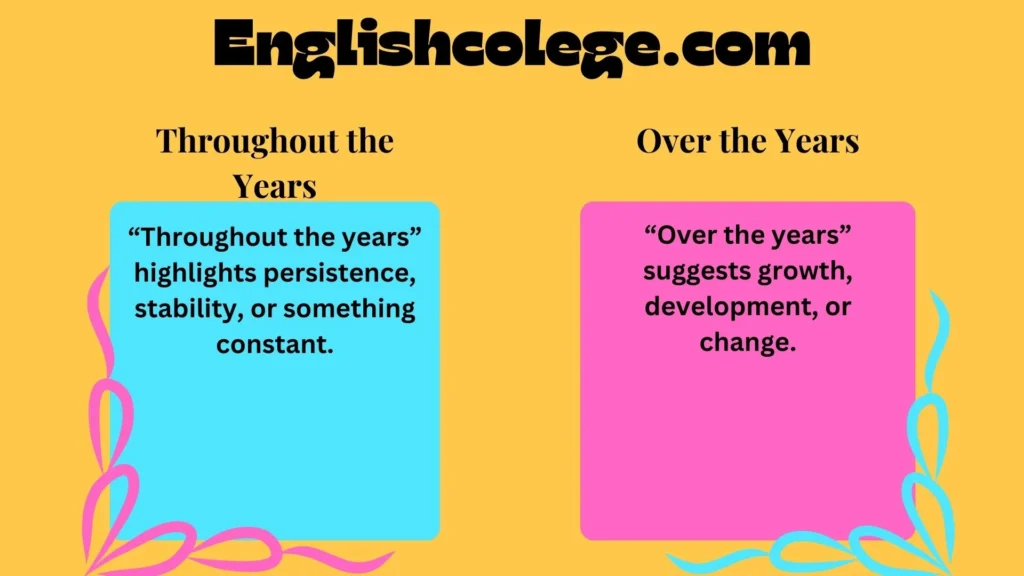
- “Over the years” suggests growth, development, or change.
- “Throughout the years” highlights persistence, stability, or something constant.
Mastering the difference helps you sound more fluent, intentional, and emotionally precise.
“Over the Years” — The Story of Change
Meaning and Tone
“Over the years” refers to a process unfolding through time — a series of changes, lessons, or experiences that accumulate. It implies progress or transformation.
“I’ve learned a lot over the years.”
That single sentence conveys growth and evolution — the speaker changed through time.
Characteristics
| Feature | Description | Example |
|---|---|---|
| Tone | Reflective, dynamic | “Our methods improved over the years.” |
| Function | Describes gradual change | “Over the years, I became more confident.” |
| Emotional weight | Progress-oriented | “Over the years, technology has reshaped our lives.” |
| Common use | Spoken English, essays, storytelling | “Over the years, they’ve built a loyal audience.” |
Typical Contexts
- Talking about learning or evolution
“Over the years, I’ve grown as a teacher.” - Describing social or cultural shifts
“Fashion has changed over the years.” - Reflecting on memories or journeys
“Over the years, we traveled to so many places.”
The phrase brings motion to your writing — a timeline that moves from past to present.
“Throughout the Years” — The Thread of Continuity
Meaning and Tone
“Throughout the years” captures something unchanged or consistent across time. It’s often used in sentimental, emotional, or formal contexts.
“She supported me throughout the years.”
The sentence expresses loyalty and enduring presence rather than change.
Characteristics
| Feature | Description | Example |
|---|---|---|
| Tone | Nostalgic, emotional | “Their friendship endured throughout the years.” |
| Function | Highlights continuity | “The family tradition stayed alive throughout the years.” |
| Emotional weight | Stability and endurance | “The company’s values remained intact throughout the years.” |
| Common use | Letters, tributes, formal writing | “He remained humble throughout the years.” |
Typical Contexts
- Expressing loyalty or consistency
“Our friendship has been strong throughout the years.” - Reflecting tradition or long-lasting values
“Throughout the years, their craftsmanship never declined.” - Showing emotional gratitude or permanence
“She stood by me throughout the years.”
Unlike “over the years,” this phrase paints stillness within time — something that stays the same while years pass by.
Grammatical and Functional Differences
Both are prepositional phrases, but they differ in emphasis and grammatical function.
| Aspect | Over the Years | Throughout the Years |
|---|---|---|
| Preposition meaning | “Over” = across time, movement | “Throughout” = during every part of a period |
| Implied focus | Gradual change or process | Constant presence or continuity |
| Sentence tone | Reflective or progressive | Nostalgic or enduring |
| Example | “Over the years, habits evolve.” | “Throughout the years, habits stayed the same.” |
Visual diagram:
Over the Years → Passage → Change → Progression
Throughout the Years → Continuity → Stability → Endurance
Both deal with time but travel different emotional paths — one dynamic, one steady.
Real-World Usage in American English
Native speakers choose between these two instinctively, depending on context and tone.
Everyday Speech
- “I’ve made a lot of friends over the years.”
- “You’ve always been kind throughout the years.”
In conversation, “over the years” feels lighter and more flexible. “Throughout the years” sounds slightly formal or sentimental.
Writing and Media Examples
- Journalism: “Over the years, the city’s skyline has transformed dramatically.”
- Advertising: “Trusted by millions throughout the years.”
- Speeches: “You’ve supported us throughout the years, and for that, we thank you.”
Writers pick one over the other based on tone. Brands often prefer “throughout the years” for emotional connection, while reporters and essayists lean toward “over the years” for factual progression.
Data and Trends: What Corpus Analysis Shows
To confirm usage patterns, we can look at linguistic data. Using the Google Ngram Viewer, “over the years” clearly appears more frequently than “throughout the years.”
| Phrase | Usage Trend (approx.) | Notable Observation |
|---|---|---|
| Over the years | More common since 1950s | Used widely in everyday writing |
| Throughout the years | Less common but steady | Favored in formal and emotional contexts |
Why?
“Over the years” fits modern English’s preference for brevity and neutral tone. “Throughout the years,” on the other hand, resonates in writing that emphasizes feeling, memory, or appreciation.
When to Use Each Phrase
Here’s a quick decision chart for clarity:
| Situation | Recommended Phrase | Why |
|---|---|---|
| Describing growth or change | Over the years | Suggests evolution or improvement |
| Emphasizing constancy | Throughout the years | Highlights stability or loyalty |
| Storytelling or memoirs | Over the years | Sounds conversational and natural |
| Speeches, tributes, or letters | Throughout the years | Adds sentiment and formality |
| Business and advertising | Throughout the years | Conveys legacy and trust |
| Academic or factual tone | Over the years | More neutral and precise |
Example Sentences:
- Correct: “Over the years, her art style evolved beautifully.”
- Correct: “He remained generous throughout the years.”
- Incorrect: “Throughout the years, technology advanced rapidly.” (Better: Over the years — because it implies change.)
Cultural and Emotional Layers
Language reflects culture, and these two phrases show how English captures emotion through time expressions.
- “Over the years” mirrors the American mindset of growth, progress, and self-improvement.
- “Throughout the years” resonates with the values of loyalty, gratitude, and remembrance.
Both connect to how Americans view time — not just as passing moments, but as a narrative of experiences and emotions.
“Over the years, we change; throughout the years, what matters stays.”
This balance between movement and memory explains why both phrases endure in modern English.
Synonyms and Related Expressions
English offers several alternatives depending on your tone and intent:
| Expression | Meaning | Best Used For |
|---|---|---|
| Over time | Gradual change | General contexts |
| Through the ages | Across historical periods | Historical writing |
| As time went on | Narrative flow | Storytelling |
| All along | Continuity | Informal speech |
| Across the years | Similar to “throughout” | Poetic or creative writing |
Example comparisons:
- “Technology improved over time.”
- “Their love endured through the ages.”
- “He stayed loyal all along.”
Avoid redundancy like:
❌ “Over the years throughout the years” — choose one based on intent.
Practical Writing Tips
How to Choose the Right Phrase
- Focus on meaning: Are you describing change or constancy?
- Match tone to purpose: “Over” fits reports or essays; “throughout” fits speeches or tributes.
- Read aloud: Does the rhythm feel natural? “Over the years” flows more easily in conversation.
- Stay consistent: Don’t switch phrases mid-article unless contrast is intentional.
Editing Checklist
- Replace generic time phrases (“for years”) with more expressive options.
- Check emotional tone — “throughout” softens, “over” energizes.
- Avoid using both phrases back-to-back.
- Vary sentence length to maintain rhythm.
Case Study: The Power of Word Choice
Case 1 — Advertising
“Trusted by families throughout the years.”
This line conveys legacy, trust, and emotional connection. Imagine replacing it with “over the years.” The warmth fades; it feels more transactional.
Case 2 — Storytelling
“Over the years, the town rebuilt itself after each storm.”
Here, the phrase paints progress, showing change and resilience. If you used “throughout,” it would wrongly suggest the town stayed the same.
Lesson:
Each phrase changes the emotional angle of your message — even when the time frame is identical.
Famous Quotes Using These Phrases
“I’ve made mistakes over the years, but I’ve learned from every one of them.” — Oprah Winfrey
“Your love and support throughout the years have meant more than words can say.” — Unknown
Writers and speakers instinctively select the phrase that matches their emotional purpose. The same instinct can sharpen your writing too.
FAQs
What’s the main difference between “throughout the years” and “over the years”?
“Over the years” highlights change or progress, while “throughout the years” emphasizes constancy or endurance.
Can both phrases be used interchangeably?
Sometimes, yes — but doing so can shift tone. Use “throughout” when stressing continuity, and “over” when emphasizing development.
Which phrase is more common in American English?
“Over the years” is more frequent in both spoken and written American English, according to corpus data.
Is “throughout the years” too formal for daily use?
Not too formal, but it carries a sentimental or reflective tone, making it better suited for letters, speeches, or nostalgic writing.
Can I use either phrase at the beginning of a sentence?
Absolutely. Both work well at the start of a sentence, but remember their tone:
- “Over the years, technology changed.”
- “Throughout the years, their bond never broke.”
Conclusion: Choosing the Right Expression
Language is a craft of precision and emotion.
Use “over the years” when you want to highlight change, growth, or learning.
Use “throughout the years” when you want to express loyalty, consistency, or endurance.
Both are timeless, but knowing when to use each transforms your writing from average to articulate.
So next time you write, pause for a second — are you talking about what changed or what stayed the same? The phrase you choose will tell the story.

I’m Sameer — a passionate English enthusiast who loves exploring words, grammar, and the art of effective communication. ✍️