
Have you ever paused mid-sentence and thought, “Should I say taken or taking?” You’re not alone.
These two forms of the verb “take” often confuse English learners because they look similar but serve different grammatical purposes.
In this complete guide, you’ll learn everything you need to know about taken vs taking—including definitions, grammar rules, real-world examples, and quick memory tips to make sure you never mix them up again.
The Verb “Take” and Its Forms
Before diving into “taken” and “taking,” it helps to understand their root: take.
The verb take is irregular, meaning it doesn’t follow the usual “-ed” pattern when changing tenses. Instead, it changes form entirely:
| Base Form | Past Simple | Past Participle | Present Participle / Gerund |
|---|---|---|---|
| take | took | taken | taking |
👉 Example progression:
- I take my bag to school every day. (Present)
- I took my bag yesterday. (Past simple)
- I have taken my bag already. (Past participle)
- I am taking my bag now. (Present participle)
Each form has its role. The difference between taken and taking becomes clear when you understand tense and voice.
What Does “Taken” Mean?
Taken is the past participle of take. It’s used in two main ways:
1. Perfect Tenses
It appears in perfect tenses to show that an action is complete or finished.
Examples:
- She has taken the test.
- They had taken the wrong road before turning back.
- By tomorrow, we will have taken all the exams.
✅ Key takeaway:
Use taken when the action is done, not happening now.
2. Passive Voice
Taken also appears in passive constructions — when something is done to the subject.
Examples:
- The picture was taken by my friend.
- His wallet has been taken.
- The hostages were taken during the raid.
Tip:
If you see “was,” “were,” “been,” or “has/have had” before taken, it’s probably a passive or perfect construction.
What Does “Taking” Mean?
Taking is the present participle of take. It’s used in three key ways:
1. Continuous (Progressive) Tenses
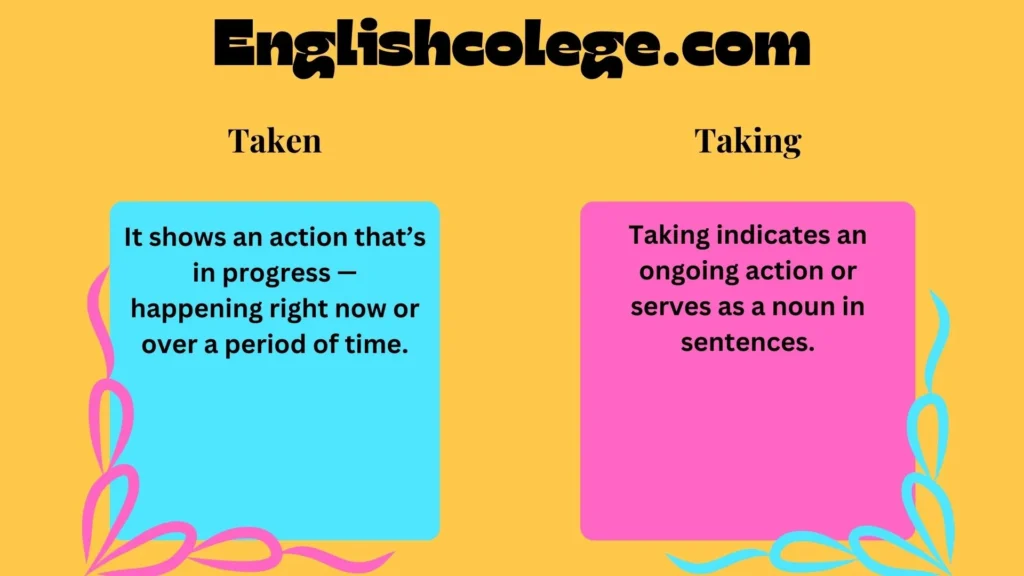
It shows an action that’s in progress — happening right now or over a period of time.
Examples:
- She is taking her medicine.
- I was taking notes during the lecture.
- They will be taking the train tomorrow.
✅ Key takeaway:
Use taking when the action is ongoing, repeated, or in motion.
2. As a Gerund (Noun Form)
Sometimes taking acts like a noun, representing the action itself.
Examples:
- Taking risks is essential for growth.
- I enjoy taking long walks.
- Her taking of the prize surprised everyone.
Here, taking describes an activity rather than a verb action.
3. Adjective Use (less common)
Taking can occasionally describe something charming or captivating.
Example:
- She gave me a taking smile. (Meaning: an attractive smile)
‘Taken’ vs ‘Taking’: Core Differences at a Glance
| Feature | Taken | Taking |
|---|---|---|
| Verb Form | Past Participle | Present Participle / Gerund |
| Used In | Perfect & Passive Constructions | Continuous Tenses & as Nouns |
| Expresses | Completed action | Ongoing or repeated action |
| Time Reference | Past (finished) | Present or continuing |
| Example | “The photo was taken yesterday.” | “She is taking photos now.” |
👉 In short:
Taken = finished action.
Taking = action in progress.
How Context Changes Meaning
Let’s compare both words in context.
Example 1:
- ✅ He has taken a break. → The break is finished or recently completed.
- ✅ He is taking a break. → The break is happening right now.
Example 2:
- ✅ The company has taken steps to improve safety.
- ✅ The company is taking steps to improve safety.
➡ In the first, the steps are already completed. In the second, the process is ongoing.
Example 3:
- ✅ All the tickets were taken before we arrived.
- ✅ People are taking the tickets quickly.
Here, the first sentence is passive and completed, while the second is active and continuous.
Context defines timing, and timing defines which form fits.
Passive Voice and Perfect Tenses with “Taken”
Taken appears often in passive and perfect grammatical structures.
Passive Voice with “Taken”
Use when the subject receives the action.
Structure:subject + be (is/was/been) + taken + by + doer
Examples:
- The child was taken to the hospital.
- The money has been taken by the accountant.
- The package was taken yesterday morning.
This structure shifts focus from who did it to what happened.
Perfect Tenses with “Taken”
Use to show an action completed before another point in time.
| Tense | Structure | Example |
|---|---|---|
| Present Perfect | has/have + taken | She has taken her medicine. |
| Past Perfect | had + taken | He had taken the exam before moving. |
| Future Perfect | will have + taken | They will have taken off by noon. |
🟢 Tip:
In perfect tenses, taken follows have, has, or had.
Continuous Tenses and Gerund Forms with “Taking”
Taking indicates an ongoing action or serves as a noun in sentences.
Continuous Tenses with “Taking”
| Tense | Structure | Example |
|---|---|---|
| Present Continuous | am/is/are + taking | I am taking a shower. |
| Past Continuous | was/were + taking | We were taking notes. |
| Future Continuous | will be + taking | They will be taking exams next week. |
🟢 Tip:
If you see am, is, are, was, were, or will be before taking, it’s usually a continuous tense.
Gerund Use of “Taking”
As a gerund, taking becomes a noun, referring to an activity.
Examples:
- Taking deep breaths helps calm your nerves.
- I love taking photos while traveling.
- Her taking of the initiative impressed the team.
Case Study: Common in Business English
In corporate communication, taking often appears in phrases like:
- “Taking responsibility for results.”
- “Taking the lead in innovation.”
- “Taking steps to ensure quality.”
These express action-oriented mindsets and ongoing efforts.
Common Mistakes and How to Avoid Them
English learners often confuse “taken” and “taking” due to their visual similarity. Here’s how to fix that.
Frequent Errors
❌ I am taken my lunch now.
✅ I am taking my lunch now.
❌ She has taking a nap.
✅ She has taken a nap.
❌ He was taken the train when I saw him.
✅ He was taking the train when I saw him.
Quick Memory Tips
- Think “taken” = done. Action is complete.
- Think “taking” = doing. Action is happening.
Mini Mnemonic
“If it’s finished, it’s taken.
If it’s in motion, it’s taking.”
Keep this line in mind, and you’ll rarely make the mistake again.
Quick Grammar Recap
| Grammar Feature | Taken | Taking |
|---|---|---|
| Verb Type | Past participle | Present participle / Gerund |
| Tense | Perfect, Passive | Continuous |
| Meaning | Completed | Ongoing |
| Example | “She has taken notes.” | “She is taking notes.” |
| Keywords | has, had, been | am, is, are, was, were |
Visual Analogy:
Imagine taken as a checkmark ✅ — job done.
Imagine taking as a spinning wheel 🔄 — work in progress.

Real-Life Usage Examples
Let’s see how both words appear in real contexts — movies, literature, and daily English.
From Movies:
- “I will find you, and I will kill you.” — Taken (2008 film).
(Here, taken means abducted — the action is complete.) - “She’s taking control of her destiny.” (In-progress action — ongoing empowerment.)
From Everyday Speech:
- “All the seats are taken.”
- “I’m taking the day off tomorrow.”
- “He has taken too many chances.”
- “They are taking steps to reduce pollution.”
From Academic Writing:
- “Data were taken from multiple studies.” (Passive use)
- “Researchers are taking a new approach to testing.” (Continuous use)
These examples highlight how subtle grammatical shifts change meaning entirely.
Common Phrases with “Taken” and “Taking”
Popular Collocations with “Taken”
- Taken for granted – undervalued or unappreciated
- Taken aback – surprised or shocked
- Taken seriously – treated with importance
- Taken into account – considered carefully
Popular Collocations with “Taking”
- Taking care of – looking after someone or something
- Taking advantage of – exploiting a situation or opportunity
- Taking notes – writing information down
- Taking part in – participating
5 Frequently Asked Questions (FAQs)
What’s the main difference between taken and taking?
Taken shows a completed action (past participle). Taking shows an action in progress (present participle or gerund).
Can “taken” be used in the present tense?
Not directly. It appears in the present perfect tense, such as “She has taken the test,” which links past action to the present result.
Is “taking” always an action word?
No. Sometimes taking acts as a noun (gerund), e.g., “Taking risks leads to success.”
Can I use both in the same sentence?
Yes! Example: “After she had taken the course, she started taking new classes online.”
Which is correct: ‘I have taken’ or ‘I am taking’?
Both are correct, but they express different meanings:
- I have taken = finished action.
- I am taking = ongoing action.
Final Takeaway
The difference between taken and taking lies in time and state.
- Taken = completed, finished, or received (used in perfect or passive forms).
- Taking = happening, continuous, or ongoing (used in progressive forms or as a noun).
In short:
If it’s already done — it’s taken.
If it’s still happening — it’s taking.
Practice spotting these forms in your favorite shows, books, or daily conversations. The more you see them used naturally, the easier they’ll stick.

I’m Sameer — a passionate English enthusiast who loves exploring words, grammar, and the art of effective communication. ✍️