
Language is alive. It bends, shifts, and evolves as people move, write, and speak across borders.
One of the simplest yet most debated examples is the pair “swap” and “swop.”
Both words look nearly identical. Both mean “to exchange.” Yet, depending on where you live — the UK, the US, or Australia — you might never use one of them.
So, what’s the real story? Why does “swop” even exist, and which spelling should you use today? Let’s break it down step by step — from etymology to modern usage — to finally settle the swap vs. swop debate.
Why “Swap” vs. “Swop” Confuses Writers
If you’ve ever read a British children’s story and stumbled upon swop, you’re not alone.
It looks like a typo, but it isn’t. Both swap and swop have deep linguistic roots. The confusion arises because modern English users expect one correct spelling for each word — but English doesn’t play by those rules.
Here’s the quick summary:
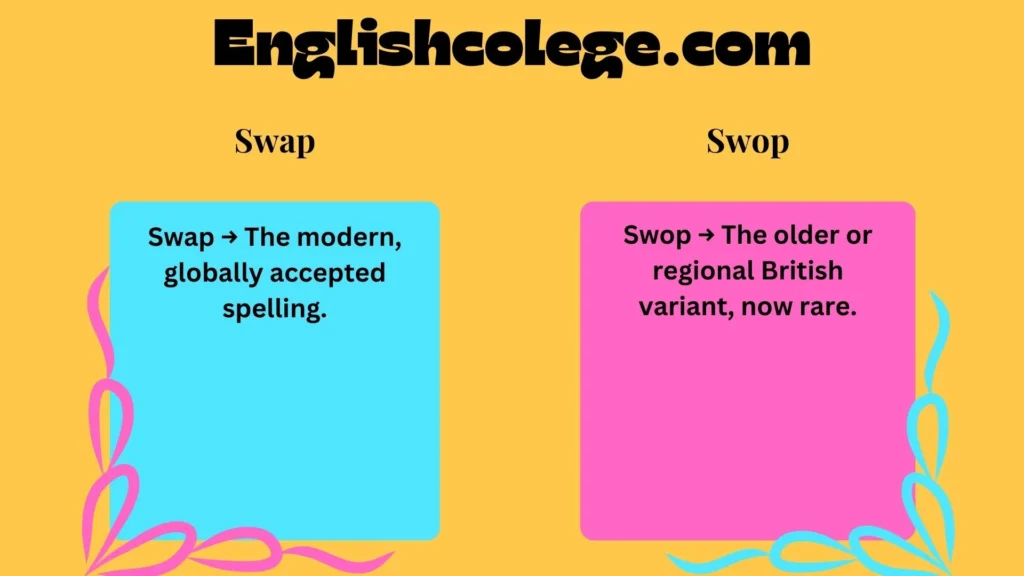
- Swap → The modern, globally accepted spelling.
- Swop → The older or regional British variant, now rare.
Still, that’s just the surface. To truly understand why “swop” still pops up occasionally — especially in older British writing — we need to go back several centuries.
Etymology: Where “Swap” and “Swop” Came From
Every English word tells a story, and this one begins in the Middle Ages.
The word swap comes from swappen, a Middle English verb meaning “to strike” or “to hit.” Around the 14th century, this meaning broadened into “to exchange blows,” and by the 1500s, it evolved into “to exchange things.”
So “swap” originally meant to swap blows before it meant to swap items.
The spelling swop appeared later as a phonetic variant, most likely because of dialectal pronunciation. People in certain regions of England pronounced the “a” in swap as an “o,” so printers and writers began spelling it swop to match speech.
Quick historical facts:
- Swap first recorded: circa 1300 (Middle English).
- Swop first recorded: around 1780, in regional texts.
- By the 1900s, swap had overtaken swop in all major publications.
Quote: “Spelling is a reflection of time, not truth. The forms that survive do so because people kept using them.” — Dr. Simon Horobin, Oxford Linguist
So, “swop” wasn’t wrong — it just fell out of favor when spelling became standardized during the printing revolution.
Regional Preferences and Modern Usage
Even though “swap” and “swop” mean the same thing, regional preferences tell a different story. Let’s see how each variant survives — or doesn’t — across the UK, the US, and Australia.
United Kingdom: “Swop” Survives, But Barely
In the UK, both forms have existed for centuries. But by the late 20th century, swap became dominant.
Older generations, however, still recognize swop as a “British classic.” You’ll spot it in vintage literature, wartime letters, or Enid Blyton’s books for children.
Examples from British English:
- ✅ Let’s swap seats before the movie starts.
- ⚠️ Let’s swop seats before the movie starts. (Feels old-fashioned today.)
British publications like The Guardian, The Times, and BBC News all prefer swap. Their in-house style guides treat swop as an obsolete form.
Fact:
Even the Oxford English Dictionary (OED) marks swop as a chiefly British variant spelling of swap.
Usage trend:
If you run a Google Ngram search from 1900–2020, swop peaks in mid-century and then collapses. Swap rises steadily, reflecting how British media and education modernized spelling.
United States: “Swap” Reigns Supreme
Across the United States, there’s no argument — swap is the only accepted spelling.
American English favors simplified, phonetic spellings. “Swop” has never been common in the US and is viewed as a misspelling.
Example:
- We swapped gifts during the holidays.
You’ll never find swop in American newspapers, style guides, or dictionaries. Merriam-Webster doesn’t even list swop as an active entry.
Why?
American English dropped many older British variants (colour → color, honour → honor, gaol → jail), and swop fell with them. Simplicity and consistency drive American spelling choices.
Australia: British Roots, Modern Clarity
Australia’s spelling conventions originally followed British English, but globalization changed that.
In the early 1900s, swop appeared occasionally in Australian newspapers and children’s books. Today, the Macquarie Dictionary lists swop as informal and nonstandard.
Modern examples:
- Australians often swap weekend shifts for beach trips.
- Swop might pop up in vintage magazines or nostalgic writing, but it’s no longer mainstream.
Australian writers, teachers, and editors prefer swap because it fits with international communication standards and avoids confusion in digital content.
“Swap” vs. “Swop” in Real Sentences
Let’s look at real-world sentence comparisons. Notice how both words mean exactly the same thing, yet one feels more natural today.
| Sentence | Preferred in UK | Preferred in US | Meaning |
|---|---|---|---|
| Let’s swap/swop books for the week. | Swap | Swap | Exchange books |
| They swapped/swopped seats before takeoff. | Swap | Swap | Changed seats |
| We should swap/swop ideas for better results. | Swap | Swap | Share or exchange ideas |
| I’ll swap/swop you my sandwich for your apple. | Swap | Swap | Trade items |
Observation:
Readers in the UK might recognize swop, but most modern readers find swap easier to process and less distracting. Even in casual writing, swop risks looking like a typo.
Dictionary Consensus: Which Is Correct Today?
The best way to settle a spelling debate is to ask the authorities — the dictionaries. Here’s what the major ones say:
| Dictionary | Definition of “Swap” | Note on “Swop” | Region |
|---|---|---|---|
| Oxford English Dictionary | “Exchange one thing for another.” | “Variant spelling (chiefly British).” | UK |
| Cambridge Dictionary | “To give something and get something in return.” | “Old-fashioned spelling of swap.” | UK |
| Merriam-Webster (US) | “To make an exchange.” | Not recognized as a current word. | US |
| Macquarie Dictionary (AUS) | “To give something in return for something else.” | “Informal or rare variant.” | Australia |
✅ Verdict:
“Swap” is the global standard.
“Swop” remains historically valid but regionally limited.
Writer’s tip: Unless your audience is specifically British and you’re quoting older text, stick with swap. It’s universally understood and stylistically modern.
How Language Evolution Shapes Spelling Choices
Why did “swap” win while “swop” faded away? The answer lies in how English evolves.
Language isn’t controlled by grammar police or committees. It shifts through habits — how people write, what printers prefer, and which words travel faster through media.
Why “Swap” Took Over
- Phonetic clarity – “Swap” matches how most English speakers pronounce it.
- Printing standardization – As dictionaries and publishing houses unified English spelling, simpler forms prevailed.
- American influence – Global media (TV, internet, technology) cemented “swap” as the expected spelling.
- Digital dominance – Spell checkers and language tools flag “swop” as incorrect, reinforcing its decline.
A Useful Analogy: “Color” vs. “Colour”
Think of “swap” and “swop” like “color” and “colour.” Both are correct, but one has wider reach.
“Color” dominates international media because it’s easier to spell, while “colour” remains part of British identity. The same happened here — swap went global, while swop stayed local.
Example:
Google Books data shows swap overtook swop globally by the 1960s and never looked back.
Summary Table: Swap vs. Swop at a Glance
| Region | Preferred Form | Frequency | Notes |
|---|---|---|---|
| UK | Swap | Very common | “Swop” appears in old British literature |
| US | Swap | Exclusive | “Swop” treated as misspelling |
| Australia | Swap | Common | “Swop” rare or informal |
| Canada | Swap | Common | Matches US pattern |
| Global English | Swap | Standard | Universally accepted form |
Quick Usage Tips for Writers
Here’s how to handle these two in your writing:
- ✅ Always use “swap” in professional or digital writing.
- ⚠️ Use “swop” only in quotes, dialects, or historical British contexts.
- 🖋️ Keep consistency — don’t mix both in one text.
- 📚 Follow your region’s style guide (Oxford, APA, Chicago).
- 🌍 For international reach, always default to swap.
Example:
If you’re a content writer, journalist, or student, swap ensures clarity for global readers and better SEO visibility.
Case Study: British Children’s Literature (1950s–1980s)
A great case study for swap vs. swop lies in mid-20th-century British children’s books.
Writers like Enid Blyton often used swop in dialogue:
“Let’s swop marbles!” cried Jack.
This spelling matched the spoken dialects of southern England during that period. However, as British publishing globalized in the late 20th century, editors modernized older works.
When The Famous Five series was reprinted in the 1990s, swop was replaced with swap for international editions. The reasoning was simple — children learning English worldwide might find swop confusing.
Outcome:
By the early 2000s, swop had nearly vanished from mainstream British publications. Only reprints of classic editions still feature it.
Historical Snapshot: Swap vs. Swop in Literature
| Author | Work | Year | Spelling Used | Region |
|---|---|---|---|---|
| Geoffrey Chaucer | Canterbury Tales | 1387 | Swap (Old English variant) | England |
| Enid Blyton | The Secret Seven | 1952 | Swop | UK |
| George Orwell | Animal Farm | 1945 | Swap | UK |
| Mark Twain | Huckleberry Finn | 1884 | Swap | US |
| Modern British Authors | – | 2000–present | Swap | UK |
The table shows swop had a short-lived cultural moment but never crossed global borders.
FAQs About Swap vs. Swop
Is “swop” still correct in the UK?
Technically yes, but it’s considered outdated. Modern British dictionaries label it as a variant or nonstandard spelling.
Is there any situation where “swop” sounds more natural?
Only in nostalgic, dialectal, or historical writing. You might use it for stylistic authenticity in period fiction.
Are “swap” and “swop” pronounced differently?
No. Both share the same pronunciation:
- British English: /swɒp/
- American English: /swɑːp/
Which spelling should I use for international readers?
Always choose swap. It’s recognized across all English varieties and accepted by every major dictionary.
Has “swop” disappeared completely?
Not entirely. You’ll still find it in old British books or private letters, but in modern writing and media, it’s nearly extinct.
Conclusion
Both swap and swop tell the same story — one of exchange, trade, and linguistic evolution. They sound identical, share the same roots, and mean exactly the same thing.
The difference lies in time and geography.
- Swap is the global, modern spelling.
- Swop is a charming relic of British English history.
When clarity, professionalism, or global reach matter, swap is your best choice.
Yet, understanding swop reminds us that every word carries echoes of how people once spoke and wrote.
“The words we keep and the ones we lose tell us who we are — and who we were.”
So go ahead, swap your doubts for certainty: use swap, and you’ll always be right.

I’m Sameer — a passionate English enthusiast who loves exploring words, grammar, and the art of effective communication. ✍️