
Language can twist and coil like the creatures it describes. Few words illustrate this better than “serpent” and “snake.”
They look similar, sometimes mean the same thing, yet evoke wildly different emotions. One feels ancient and mystical; the other, direct and biological.
So, are they the same—or do they slither along separate linguistic paths?
This article uncoils the truth behind “serpent vs. snake”, tracing their roots, symbolism, and usage across time, science, and storytelling.
Understanding “Serpent” and “Snake”: Origins and Etymology
Language history often reveals how words shape thought. The difference between serpent and snake begins long before modern English.
| Word | Origin | Language Path | Meaning Over Time |
|---|---|---|---|
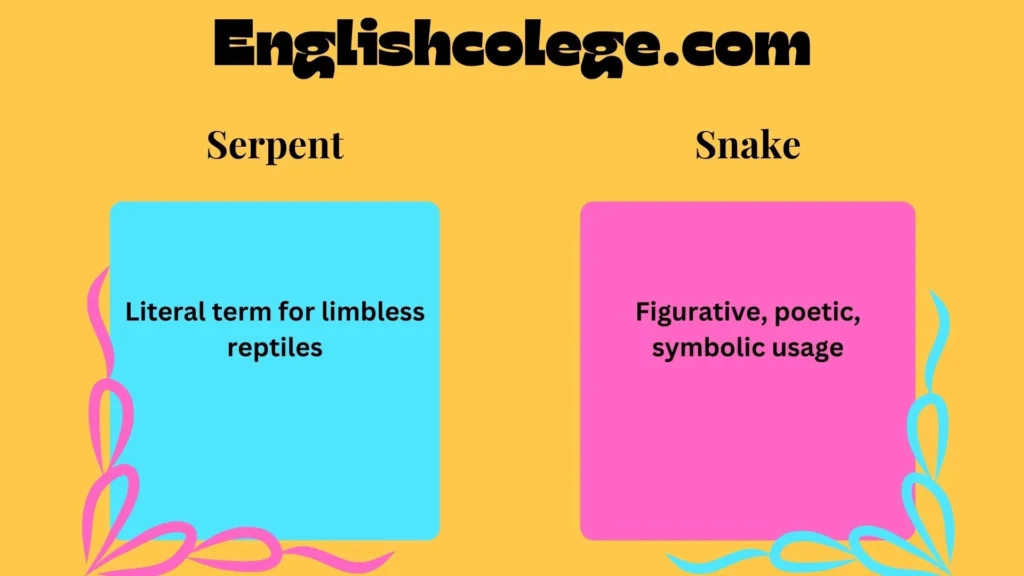
| Snake | Old English snaca | Germanic → Proto-Indo-European sneg- (“to crawl”) | Literal term for limbless reptiles |
| Serpent | Latin serpens / serpentem | Latin → Old French → Middle English | Figurative, poetic, symbolic usage |
- “Snake” emerged from everyday speech in northern Europe. It’s short, strong, and grounded—used to describe real, physical reptiles.
- “Serpent”, with Latin roots, entered English through religion and literature. Its early meaning wasn’t just the animal—it often symbolized evil, wisdom, or transformation.
Example:
“The serpent beguiled me,” said Eve in Genesis.
Here, serpent conveys more than biology—it represents deceit, temptation, and moral downfall.
In contrast:
“A snake crossed the path.”
Simple, factual, observational.
That’s the first clue: same creature, different connotation.
The Literal Difference: “Snake” in Science and Nature
When biologists talk about snakes, they mean something specific—members of the suborder Serpentes, a branch of reptiles within Squamata (the same order as lizards).
Key Facts about Snakes
- There are over 3,900 recognized snake species worldwide.
- Snakes are ectothermic (cold-blooded) vertebrates.
- They shed their skin several times a year through ecdysis, a symbol of rebirth in many cultures.
- Some snakes are venomous (e.g., cobras, vipers, mambas), while others rely on constriction (like pythons and boas).
Interesting statistic:
Around 600 snake species are venomous, but only about 200–250 pose significant risk to humans.
Biological Highlights
| Feature | Snakes (Scientific Facts) |
|---|---|
| Skeleton | Over 200 vertebrae with flexible ribs |
| Limbs | Absent (vestigial pelvic bones in some species) |
| Eyes | No eyelids; covered by a clear scale (spectacle) |
| Senses | Heat-sensing pits (in vipers, pythons, boas) |
| Reproduction | Oviparous (egg-laying) or viviparous (live birth) depending on species |
So scientifically, the snake is the real animal, the biological truth. The serpent? That’s where language, myth, and metaphor enter the picture.
“Serpent”: Between Reality and Myth
Unlike the scientific “snake,” “serpent” often carries symbolic or poetic weight.
When “Serpent” Means More Than an Animal
- In older texts, “serpent” often described giant or mythological creatures, not real reptiles.
- The term conveys a sense of grandeur or menace, suggesting intelligence, danger, or divinity.
Examples:
- The sea serpent—a legendary marine monster.
- The fiery serpent in the Bible—divine punishment or temptation.
- The Feathered Serpent (Quetzalcoatl)—a god of creation, wisdom, and wind in Aztec mythology.
So while all serpents can be snakes, not all snakes are serpents in the cultural sense.
Symbolism and Cultural Significance of Serpents and Snakes
Few animals carry such deep and contradictory meanings. From ancient temples to modern tattoos, serpents have slithered through human imagination for millennia.
Common Symbolic Meanings
| Symbolism | Culture/Context | Meaning |
|---|---|---|
| Rebirth & Renewal | Ancient Egypt, Greece, India | Shedding skin = renewal of life |
| Wisdom | Greek mythology, Hinduism | Knowledge, enlightenment |
| Deceit / Evil | Christianity | The devil in serpent form |
| Healing | Greek (Rod of Asclepius) | Medicine, rejuvenation |
| Infinity | Norse (Ouroboros) | Cycle of death and rebirth |
Quote:
“The snake, which cannot cast its skin, perishes. So do those minds which are prevented from changing their opinions.” — Friedrich Nietzsche
This dual symbolism—creation and destruction, wisdom and deception—makes serpents uniquely powerful across civilizations.
Serpents in Mythology and Religion
The Biblical Serpent
- In Genesis, the serpent tempts Eve, marking the creature as a symbol of deceit.
- Yet in Numbers 21:9, Moses uses a bronze serpent to heal—showing its dual nature.
Ancient Egyptian Mythology
- The cobra symbolized divine authority, often appearing on pharaohs’ crowns as the uraeus.
- The serpent Apep represented chaos and darkness, forever battling the sun god Ra.
Norse & Aztec Mythology
- Jörmungandr, the Midgard Serpent, encircles the world and signals the end times when he rises.
- Quetzalcoatl, the Feathered Serpent, symbolizes wisdom, wind, and creation.
Hinduism & Buddhism
- Nāga are semi-divine serpent beings—both protectors and destroyers.
- Buddha was once shielded from rain by a Nāga named Mucalinda.
Across faiths, serpents reveal humanity’s deepest paradoxes: fear of the unknown and respect for transformation.
Modern Interpretations of Serpents and Snakes
Today, the imagery of serpents has evolved. While ancient cultures viewed them as sacred, modern society tends to associate them with treachery or danger.
Yet in fashion, art, and pop culture, the serpent has returned as a symbol of elegance, resilience, and power.
Examples in Modern Media
- The Caduceus (two snakes entwined): medical emblem worldwide.
- Ouroboros (a serpent eating its tail): used in psychology and design to represent cycles.
- Films and literature: from Harry Potter’s Nagini to Marvel’s serpent-inspired villains, serpents still embody transformation and danger.
The duality remains timeless.
How “Serpent” and “Snake” Diverge in Language and Literature
Writers choose words not just for meaning but for tone. The choice between snake and serpent reveals intent.
| Context | Preferred Word | Why |
|---|---|---|
| Scientific writing | Snake | Accuracy and neutrality |
| Poetry or religion | Serpent | Symbolism, gravitas |
| Everyday speech | Snake | Simplicity, familiarity |
| Myth or fantasy | Serpent | Mystical or dramatic effect |
Example comparison:
- “He found a snake in his boot.” → factual, simple.
- “The serpent coiled in the darkness of his heart.” → metaphorical, emotional.
Stylistic Use in Literature
Authors like Milton, Shakespeare, and Tolkien favored serpent for its poetic rhythm and mythic associations.
Shakespeare wrote:
“You spotted snakes with double tongue.” (A Midsummer Night’s Dream)
Milton’s Paradise Lost calls Satan “the serpent,” elevating evil into an art form of persuasion and beauty.
So, while “snake” informs, “serpent” transforms.
Myths and Misconceptions: Serpent vs. Snake in Nature
Some believe serpents and snakes are different species. Let’s clarify: they’re the same animal, but “serpent” is a stylistic term, not a taxonomic one.
Common Myths
- Myth 1: Serpents are venomous, snakes are not.
- Fact: Venom has no link to the word choice. Both can refer to venomous or non-venomous species.
- Myth 2: Serpents are larger or mythical only.
- Fact: The term serpent can describe real or mythical beings depending on context.
- Myth 3: “Serpent” is a separate species.
- Fact: All snakes (order Serpentes) fall under the same biological category.
Quick Table: Language vs. Biology
| Term | Scientific Relevance | Common Use |
|---|---|---|
| Snake | Biological classification (Serpentes) | Everyday, zoological |
| Serpent | None (figurative) | Literary, religious, poetic |
Understanding this helps prevent confusion, especially for non-native speakers learning nuanced English.
When to Use “Snake” vs. “Serpent”
Here’s a quick guide for writers, students, and language enthusiasts:
| Situation | Use “Snake” | Use “Serpent” |
|---|---|---|
| Talking about real reptiles | ✅ | |
| Writing poetry or myth | ✅ | |
| Describing deceitful behavior | ✅ (“a snake in the grass”) | ✅ (Biblical tone) |
| Academic or zoological paper | ✅ | |
| Religious, symbolic, or dramatic context | ✅ | |
| Casual conversation | ✅ |
Tip:
If your goal is clarity, use snake.
If your goal is emotion, mystery, or symbolism, choose serpent.
Visual and Descriptive Identification
Since “serpent” isn’t a scientific classification, identification focuses on snakes themselves.
Identifying Features of Snakes
- Long, limbless body covered in scales
- Forked tongue for sensing chemicals in the air
- Movement by muscular contractions (serpentine motion)
- Variety of habitats—from deserts to oceans
Fun Fact:
The smallest known snake, Leptotyphlops carlae, is only 4 inches long. The largest, the green anaconda (Eunectes murinus), can exceed 29 feet!
When authors describe serpents, they often exaggerate these traits—longer, more menacing, or imbued with supernatural power.
Language Evolution and Fun Facts
Over time, “snake” replaced “serpent” in daily use. By the 18th century, “serpent” sounded archaic and literary, though it remained powerful in poetry and religion.
Related Words
- Serpentine: twisting or winding like a snake.
- Ouroboros: serpent eating its own tail, symbol of infinity.
- Snake-like idioms: “snake in the grass,” “to snake through traffic,” “to shed one’s skin.”
Linguistic Note:
Both words trace back to roots meaning to creep or crawl, reflecting the creature’s movement and humanity’s timeless fascination with it.
Key Takeaways
- Scientifically: There’s no difference—both refer to reptiles in the suborder Serpentes.
- Linguistically: Snake = modern, direct; Serpent = poetic, symbolic.
- Culturally: Serpents carry deep meaning across myth, religion, and literature.
- Usage Tip: Choose serpent for symbolism, snake for realism.
In essence, serpent slithers through imagination, snake through nature.
FAQs
What is the main difference between a serpent and a snake?
They refer to the same animal, but “serpent” is used in literary, religious, or symbolic contexts, while “snake” is used in everyday or scientific language.
Are serpents real animals?
Yes, the word “serpent” can describe real snakes, but it’s mostly used figuratively or mythologically.
Why do religious texts use “serpent” instead of “snake”?
Because “serpent” conveys grandeur, mystery, and symbolic depth, fitting the tone of sacred literature.
Do serpents appear in all cultures?
Nearly all ancient civilizations had serpent myths—from Egyptian cobras to Norse sea serpents—representing power, wisdom, or chaos.
Can I use “serpent” in modern writing?
Yes, but use it intentionally. It adds poetic or symbolic flair. In casual writing, “snake” fits better.
Conclusion
“Serpent” and “snake” share skin yet shed vastly different meanings. One slithers through science, the other through story. Knowing when to use each word lets your language strike with precision—or poetry.
So next time you encounter one, ask yourself: Is it a snake in the grass, or a serpent in disguise?

I’m Sameer — a passionate English enthusiast who loves exploring words, grammar, and the art of effective communication. ✍️