
Have you ever written, “Let’s Segway into the next topic,” only to realize later that you might have rolled right into a spelling blunder?
You’re not alone. These two words—Segway and Segue—sound exactly the same, yet mean entirely different things.
Let’s clear the confusion once and for all. By the end of this guide, you’ll know exactly when to use each word, why the mix-up happens, and how to remember the right one every time.
Why These Two Words Keep Tripping Everyone Up
Every language has pairs of words that sound the same but carry different meanings—homophones. “Segway” and “Segue” are a classic example.
Here’s the catch: they’re pronounced identically, but only one refers to a smooth transition between ideas. The other? A self-balancing scooter invented in the early 2000s.
To make matters worse, autocorrect loves turning segue into Segway. And the tech brand’s fame doesn’t help either. The result? Writers, bloggers, and even journalists often “Segway” into new topics instead of “segueing.”
The Core Difference at a Glance
Let’s start simple. Here’s a quick comparison table that breaks down the essentials:
| Word | Pronunciation | Part of Speech | Meaning | Example |
|---|---|---|---|---|
| Segue | /ˈseɡ.wā/ or “SEG-way” | Verb / Noun | A smooth transition from one topic or section to another | “She segued from talking about grammar to storytelling.” |
| Segway | /ˈseɡ.wā/ or “SEG-way” | Proper Noun | A two-wheeled, self-balancing personal transporter | “They toured San Francisco on Segways.” |
👉 In short:
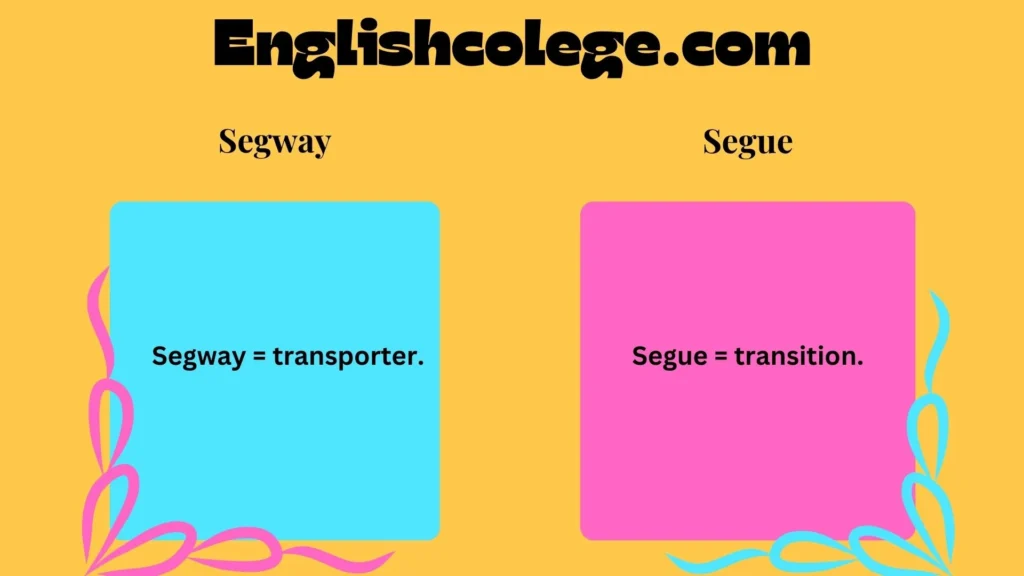
- Segue = transition.
- Segway = transporter.
They sound the same, but one’s linguistic; the other’s mechanical.
The Word “Segue”: The Smooth Linguistic Follower
Segue comes from the Italian seguire, meaning “to follow.” Its earliest use was in music, where it instructed musicians to move smoothly from one section to another without pause.
“Segue” literally means to follow without interruption — and that’s exactly what it does in speech and writing.
Over time, the word expanded beyond music. Today, we use it to describe a smooth shift between topics, scenes, or ideas.
Examples in Everyday Language
- “He segued from small talk to serious conversation effortlessly.”
- “The film segues beautifully from tragedy to hope.”
- “Let’s segue into the next chapter.”
Notice how it implies fluidity and flow—a graceful transition, not an abrupt jump.
The Musical Roots of “Segue”
The term first appeared in 18th-century Italian musical notation. Composers used it as a direction to musicians, meaning “continue directly into the next piece” without pause.
For example:
🎵 In a classical symphony, “segue” might tell a cellist to transition smoothly from one movement to another, maintaining rhythm and tone.
Over time, the idea of seamless movement resonated beyond music—eventually entering film editing, broadcasting, and speech.
In essence:
- In music, it means one section follows another smoothly.
- In language, it means one idea follows another smoothly.
Different fields, same concept—continuity.
Understanding “Segway”: The Self-Balancing Transporter
Now, let’s roll into the mechanical side of things.
Segway (capitalized) is a brand name, not a linguistic term. Invented by Dean Kamen and launched in 2001, the Segway PT (Personal Transporter) was hailed as a futuristic device that would revolutionize urban mobility.
The name was intentionally chosen to sound like “segue.” Why? Because both words symbolize smooth movement—one in language, one in motion.
Interesting Facts About Segway
- Launch year: 2001
- Inventor: Dean Kamen
- Company: Segway Inc. (acquired by Ninebot in 2015)
- Top speed: Around 12.5 mph (20 km/h)
- Purpose: Personal, electric, self-balancing vehicle
Segway devices were once seen as the future of commuting. Although they didn’t completely take over sidewalks as predicted, they remain iconic for city tours, police patrols, and short-distance travel.
Example sentence:
“Tourists zipped through Washington, D.C. on electric Segways, enjoying a breezy view of the monuments.”
Why the Confusion Happens
The confusion between Segway and Segue is surprisingly logical.
1. They Sound Identical
Both are pronounced SEG-way. English spelling often strays far from pronunciation, and “segue” is particularly deceptive because it looks like “seg-you” or “seg-gee.”
2. Brand Recognition
The Segway brand gained massive global attention in the early 2000s. Most people encountered the brand long before the musical term “segue,” so the wrong spelling stuck.
3. Autocorrect and Typing Habits
Autocorrect tools frequently suggest Segway because it’s the more common word in digital dictionaries.
4. Phonetic Bias
English speakers often spell words as they sound. Since “segue” doesn’t phonetically match its spelling, “Segway” feels more natural.
In short:
Fame, phonetics, and tech combined to blur the linguistic line.
Context Is King: When to Use Each Word
To keep it crystal clear, here’s a reference table for when to use which word:
| Situation | Correct Word | Example |
|---|---|---|
| Writing an essay or speech | Segue | “Now let’s segue into the next argument.” |
| Discussing electric vehicles | Segway | “He rode his Segway to the park.” |
| Musical performance notes | Segue | “The song segues into the next movement seamlessly.” |
| Technology review | Segway | “Segway introduced new models with advanced sensors.” |
💡 Quick Tip:
“If it’s about words or ideas, use segue.
If it’s about wheels or motion, it’s Segway.”
Another memory hack: Segway helps you move physically. Segue helps you move conversationally.
Mnemonics to Remember the Difference
Keeping these two straight doesn’t need to be tricky. Try these simple mnemonics:
- Segue → “Follow the flow.” (It follows ideas smoothly.)
- Segway → “Way to go!” (It’s a way to travel.)
- Picture it:
- Segue = smooth path between thoughts.
- Segway = smooth ride between places.
Visual Analogy
Imagine a road split in two:
- One side has a writer walking gracefully from one idea to another – that’s Segue.
- The other side has a tourist gliding on two wheels – that’s Segway.
Two paths, one sound.
Pop Culture Mix-Ups and Real-World Examples
Even major publications and celebrities have stumbled over this pair.
Common Misuse in Media
- A tech blogger once wrote: “Let’s Segway into the next topic.”
- ❌ Wrong spelling (should be segue)
- ✅ Corrected: “Let’s segue into the next topic.”
Famous Example
When the Segway vehicle was released, many headlines played on the pun:
“A smooth segue into the future of transportation: the Segway PT.”
This overlap cemented the confusion—but also gave us a memorable linguistic case study.
Today, you’ll still spot the wrong form on social media, especially on platforms like X (Twitter) and Reddit. But knowing the truth gives you an edge—it’s the mark of a careful writer.
Other Commonly Confused Homophones
“Segway vs. Segue” isn’t alone in the hall of confusion. Here are a few more that trip people up:
| Word Pair | Common Mistake | Correct Usage |
|---|---|---|
| While vs. Wile | “He waited wile she came.” | “He waited while she came.” |
| Pleural vs. Plural | “A plural effusion in the lungs.” | “A pleural effusion” (medical term) |
| Roil vs. Royal | “The sea turned royal.” | “The sea roiled with waves.” |
| Complement vs. Compliment | “That color compliments your eyes.” | “That color complements your eyes.” |
Learning these pairs builds your linguistic awareness—and prevents those subtle credibility slips.
How to Master the Art of Smooth Transitions (and Words)
To truly master segue, practice using it intentionally. Great communicators know how to transition gracefully between topics, just as good writers do between paragraphs.
Pro Tip:
When you’re shifting subjects in writing, use natural bridges:
- “That brings us to…”
- “On a related note…”
- “To build on that idea…”
Each one is a segue—a tool that keeps your reader engaged and connected.
In conversation, a good segue avoids awkward pauses and maintains rhythm, whether you’re hosting a podcast, giving a presentation, or writing dialogue.
“A perfect segue is invisible—it guides the audience without them even realizing it.”

Frequently Asked Questions (FAQs)
What does “segue” mean in simple terms?
It means a smooth transition from one topic, idea, or scene to another.
Is “Segway” ever correct in writing?
Yes, but only when referring to the brand of personal transporters. It’s a proper noun.
Why is “segue” spelled that way if it sounds like “Segway”?
It comes from Italian, where seguire means “to follow.” The original spelling carried over into English unchanged.
Can I use “segue” as a noun?
Yes! For example: “That was a perfect segue between topics.”
How do you pronounce “segue”?
It’s pronounced “SEG-way”—the same as the brand name, even though the spelling differs.
Conclusion
Now that you know the difference, you’ll never make the mistake again.
Remember:
- Segue follows ideas.
- Segway follows sidewalks.
Both involve smooth movement, but in completely different worlds—one linguistic, one mechanical. The next time you write or speak, let your words segue naturally, not Segway awkwardly.
Mastering tiny distinctions like these elevates your communication. It’s a small step—but a smooth one—toward precision and confidence in your writing.

I’m Sameer — a passionate English enthusiast who loves exploring words, grammar, and the art of effective communication. ✍️