
Ever mixed up “scrap” and “scrape” when writing or speaking? You’re not alone.
These two words look and sound nearly identical, yet their meanings couldn’t be further apart. Whether you’re describing a discarded item or rubbing something off a surface, knowing which one to use makes all the difference.
Let’s break it down clearly — definitions, origins, examples, and even a few fun visuals to help it stick.
Why “Scrap” vs. “Scrape” Confuses So Many People
English is full of pairs like “affect” vs. “effect” or “lose” vs. “loose.”
“Scrap” and “scrape” belong to the same tricky family.
They sound alike and both relate to removal or fragments. The confusion happens because we often use them in similar contexts — like “scraping off paint” or “scrapping a project.” But their meanings hinge on what’s being done.
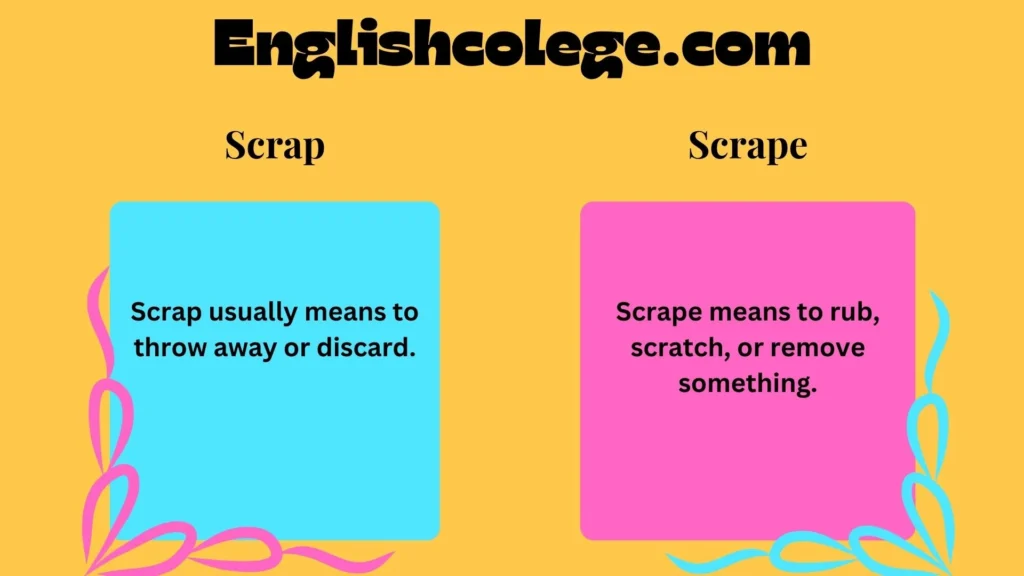
Scrap usually means to throw away or discard.
Scrape means to rub, scratch, or remove something.
Think of it like this:
You scrap what you no longer want, but you scrape what you want to clean or collect.
Understanding the Basics: Definitions and Distinctions
Before we dive deeper, here’s a quick reference:
| Word | Part of Speech | Meaning | Example |
|---|---|---|---|
| Scrap | Noun | A small piece or fragment of something left over | “A scrap of paper was left on the desk.” |
| Scrap | Verb | To discard or cancel something | “We scrapped the old website design.” |
| Scrape | Noun | A scratch, abrasion, or awkward situation | “He got a scrape on his knee.” |
| Scrape | Verb | To rub or remove by friction, or collect | “She scraped the paint off the wall.” |
Both are real words, both have nouns and verbs, and both are useful — but they’re not interchangeable.
The Key Difference: Action vs. Object
Here’s a simple way to remember:
- Scrap = Object or act of discarding.
- Scrape = Action involving friction or removal.
Let’s visualize it:
| Action Type | Scrap | Scrape |
|---|---|---|
| Core meaning | Throw away or abandon | Rub or remove |
| What it involves | Letting go of something | Applying pressure or friction |
| Example | “They scrapped the plan.” | “He scraped the ice off his windshield.” |
| Result | Something is gone | Something is cleaned, marked, or collected |
You scrap metal you no longer need.
You scrape metal to clean off rust.
Simple, right?
Memory Tip: Scrap = trash. Scrape = scratch.
Common Misuses and How to Avoid Them
Many people write “data scrap” when they mean “data scrape.” In technology, this difference is crucial.
Common Mistakes
- ❌ “We’re using a bot to scrap data from websites.”
✅ Correct: “We’re using a bot to scrape data from websites.” - ❌ “I scraped the project because it wasn’t working.”
✅ Correct: “I scrapped the project because it wasn’t working.”
The confusion often stems from pronunciation — they sound almost identical when spoken quickly.
Quick Fix Tips
- Ask yourself: Am I rubbing or removing something (scrape) or getting rid of something (scrap)?
- Visualize the motion: Scraping requires movement; scrapping requires decision.
- Double-check autocorrect: Even spell-check might not catch this one!
The Role of Technology: How Autocorrect Makes It Worse
Modern typing tools can be your friend — or your enemy. Because both “scrap” and “scrape” are valid English words, spell-check tools don’t always flag errors.
Example Scenarios
- Email mishaps: “We’ll scrap the paint tomorrow” — your contractor shows up ready to throw away your paint instead of scraping it off the walls.
- Business blunders: “We’re scrapping competitor data” might sound like you’re discarding it, not extracting it digitally.
How to Catch These Errors
- Read aloud. It forces you to slow down and hear the difference.
- Use grammar tools like Grammarly or Hemingway for context checks.
- Train your ear — the “p” in scrap sounds stronger, while scrape has a long vowel sound.
“Autocorrect doesn’t understand context — only spelling.”
— Language Tip for Writers
Origins and Etymology: Where Each Word Comes From
Understanding where these words come from helps you remember how to use them.
Scrap
- Origin: From Old Norse “skrap” meaning “a small piece.”
- Entered English in the 1300s describing leftover fragments.
- Over time, evolved into a verb meaning to discard or abandon.
Scrape
- Origin: From Middle English “scrapen”, influenced by Old Norse “skrapa”, meaning “to scratch.”
- Its sound even imitates the noise of scraping.
- Used for both physical action (“scraping mud”) and figurative sense (“scraping by in life”).
Evolution Summary
| Word | Historical Root | Original Meaning | Modern Meaning |
|---|---|---|---|
| Scrap | Old Norse skrap | Piece, small part | Leftover or to discard |
| Scrape | Middle English scrapen | Scratch, rub | Rub off, remove, or collect |
Language evolved — yet both still retain their original essence.
Usage in Modern English: From Everyday Speech to Tech Jargon
These two words appear in dozens of industries. Here’s where you’ll see them most:
Scrap in Modern Usage
- Manufacturing: Scrap metal, scrap paper, scrap yard.
- Business: “Let’s scrap this idea.”
- Everyday speech: “I don’t have a scrap of evidence.”
Scrape in Modern Usage
- Technology: Web scraping (collecting data from websites).
- Health: Scraped knee, scraped skin.
- Everyday speech: “He’s just scraping by on minimum wage.”
Idiom alert:
- “Scraping the bottom of the barrel” = using the last or worst parts.
- “A scrap of hope” = a small amount of optimism.
Regional Usage
- American and British English treat both the same, though “scrap metal” is more common in the US and “scrapheap” in the UK.
Visual Comparison: Scrap vs. Scrape in Action
Here’s a quick visual summary for clarity:
| Scenario | Correct Word | Description |
|---|---|---|
| Throwing away old notes | Scrap | Discarding paper |
| Cleaning frost off a windshield | Scrape | Removing something |
| Canceling a project | Scrap | Ending or abandoning |
| Getting a skin abrasion | Scrape | Surface injury |
| Extracting website data | Scrape | Collecting or removing data |
| Melting leftover metal | Scrap | Waste or recyclable fragments |
Think of scrap as the aftermath, and scrape as the action.
Real-World Case Studies
Let’s look at how professionals use each term correctly — and what happens when they don’t.
Case Study 1: Manufacturing Industry
A metal recycling plant deals with scrap metal, not scraped metal.
Scrap refers to leftover material after production, ready to be reused or melted.
If they said “scraped metal,” it would mean the surface of the metal was rubbed off.
Lesson: In industry, scrap = leftover material, not action.
Case Study 2: Tech Industry
A data engineer performs web scraping, not “web scrapping.”
Web scraping involves using bots or scripts to extract information from web pages.
Incorrect use: “We’re scrapping product data.”
That sounds like they’re deleting it, not collecting it.
Lesson: In digital contexts, scrape = collect, scrap = discard.
Case Study 3: Everyday Life
You fall off your bike and get a scrape, not a “scrap.”
A scrape describes a surface wound caused by friction.
Incorrect: “I got a scrap on my elbow.”
Correct: “I got a scrape on my elbow.”
Lesson: Scrape = abrasion; scrap = piece of something.
Quick Reference Table
| Use Case | Correct Word | Explanation |
|---|---|---|
| Cancel a plan | Scrap | Ending or rejecting |
| Remove rust | Scrape | Rubbing action |
| Waste material | Scrap | Leftover fragment |
| Skin injury | Scrape | Abrasion from friction |
| Collect data | Scrape | Extracting information |
| Discard files | Scrap | Throw away or delete |
Bookmark this table — it’ll save you from mixing them up again.
Related Word Confusions
These often appear in “word comparison” lists — useful for readers who love language nuance.
- Flack vs. Flak: “Flak” = criticism; “Flack” = publicist.
- Offense vs. Offence: American vs. British spelling.
- Function vs. Functionality: Function = purpose; Functionality = capability.
- Involved With vs. Involved In: “With” for people, “In” for activities.
- Reason vs. Purpose: Reason = cause; Purpose = intent.
FAQs About “Scrap” and “Scrape”
What does it mean to “scrap” something?
To scrap means to discard or abandon something no longer useful. Example: “The company scrapped its old software system.”
Can you “scrape” metal?
Yes. To scrape metal means to remove rust, paint, or dirt by rubbing the surface.
Is “web scrapping” correct?
No. The correct term is web scraping — it means collecting data from websites.
What’s a “scrap of paper”?
It’s a small leftover piece of paper — often used for notes or sketches.
Can “scrape” mean “barely manage”?
Yes. In idioms like “scrape by,” it means to survive or manage with difficulty.
Conclusion
If you only take one thing away from this article, make it this:
Scrap = discard. Scrape = remove.
“Scrap” is about getting rid of something.
“Scrape” is about rubbing or collecting something.
They may sound alike, but their meanings and actions differ sharply. Keep this guide handy, and you’ll never mix them up again — in writing, tech, or everyday speech.

I’m Sameer — a passionate English enthusiast who loves exploring words, grammar, and the art of effective communication. ✍️