
Words like response and respond often look and sound similar, so many people use them interchangeably without realizing they’re not the same.
The difference might seem small, but in writing, communication, and even medicine, that difference matters.
This guide breaks down the nuances between response and respond—their grammar roles, real-world applications, common mistakes, and practical ways to remember how to use each correctly.
Let’s dive in.
Why “Response” vs. “Respond” Confuses Many
Have you ever written, “Please response soon” in a hurry and later felt something was off? That’s because “response” and “respond” play very different grammatical roles.
Both words come from the same Latin root respondere, meaning to answer back, but they serve distinct purposes:
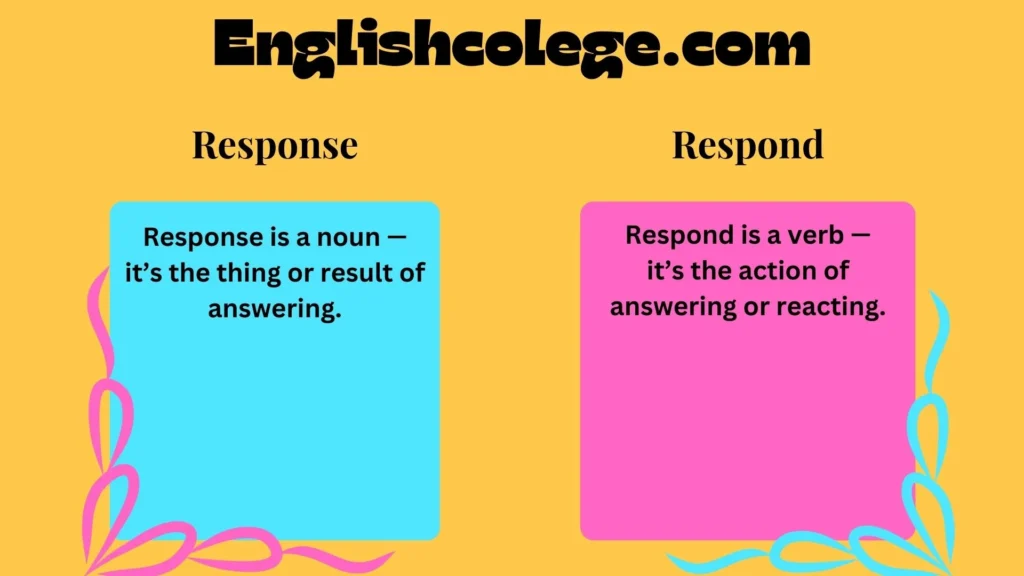
- Response is a noun — it’s the thing or result of answering.
- Respond is a verb — it’s the action of answering or reacting.
Understanding the difference is more than grammar trivia; it’s essential for writing and speaking clearly. Whether you’re drafting an email, writing a report, or speaking in a meeting, knowing which to use helps you sound confident and precise.
Core Definitions: What Each Word Really Means
Here’s a clear breakdown of both terms:
| Word | Part of Speech | Definition | Example Sentence |
|---|---|---|---|
| Response | Noun | A reaction, answer, or reply to something | “Her response was calm and thoughtful.” |
| Respond | Verb | To answer, reply, or react to something | “She didn’t respond to my text.” |
Quick Test
- If you can add “a” or “the” before the word, it’s likely a noun.
Example: the response ✅ - If you can put it after a subject like I, you, or they, it’s likely a verb.
Example: They respond quickly ✅
That simple trick saves you from most mix-ups.
Grammar Essentials: How to Choose Between Them
Let’s look at how grammar determines which word fits your sentence.
When to Use “Response”
Use “response” when referring to:
- A thing or result
- A noun phrase in your sentence
Examples:
- “I appreciated your quick response.”
- “The company’s response to the crisis was professional.”
- “He waited for her response, but she said nothing.”
When to Use “Respond”
Use “respond” when describing an action or reaction.
Examples:
- “Please respond to this message soon.”
- “The patient responded well to the new treatment.”
- “She didn’t respond to the feedback.”
Common Mistakes
| Incorrect | Correct | Why |
|---|---|---|
| Please response quickly. | Please respond quickly. | “Respond” is the action word here. |
| I liked his respond to the question. | I liked his response to the question. | “Response” names the thing he gave. |
| She didn’t response. | She didn’t respond. | “Respond” follows a subject to show action. |
Grammatically, think of “response” as the result of “respond.” One is a thing, the other is what creates that thing.
Real-World Usage: “Response” in Everyday Contexts
“Response” is a flexible noun that appears across fields—communication, business, medicine, and psychology.
Let’s see how it functions in real-world settings:
Customer Service
- “Thank you for your prompt response.”
- “We received an overwhelming response to our survey.”
Here, “response” measures engagement or feedback.
Email and Workplace Communication
- “I look forward to your response.”
- “Her response to the proposal was positive.”
Professional tone often prefers “response” because it feels formal and polished.
Emergency and Medical Contexts
- “The emergency response team arrived within minutes.”
- “A quick response can save lives.”
In medicine or crisis management, “response” signals outcome or reaction.
Psychology and Research
- “Participants showed a delayed response to stimuli.”
- “Emotional response varies from person to person.”
Here, “response” represents measurable reactions, either physical or emotional.
“Respond” in Motion: Verb Use in Action
“Respond” focuses on doing, not naming.
Examples in Communication
- “He didn’t respond to my email.”
- “She finally responded after three days.”
- “Please respond by Friday.”
The word highlights interaction, engagement, and timing.
Medical and Scientific Contexts
- “The patient responded well to treatment.”
- “Cells respond to environmental changes.”
In medical writing, “respond” often describes reactions to treatment or stimuli.
Social and Digital Media
- “Brands respond to user comments on social media.”
- “He rarely responds to online criticism.”
It emphasizes human or automated interaction.
Verb Forms of “Respond”
| Tense | Example | Usage |
|---|---|---|
| Base | respond | “I always respond quickly.” |
| Past | responded | “She responded within seconds.” |
| Continuous | responding | “They are responding to feedback.” |
Beyond Grammar: Subtle Differences in Tone and Meaning
Sometimes, both words appear in the same context but create different nuances.
Example:
- “His response was polite.” (focuses on the result)
- “He responded politely.” (focuses on the action)
Tone and Professionalism
Using “response” sounds slightly more formal:
- “We await your response” fits business writing.
- “Please respond soon” feels conversational and direct.
Both are correct; your choice depends on tone and context.
Examples from Real Sources
To see the distinction in natural settings, look at how literature and media use them.
From Literature:
“Her response was a whisper.” – This shows emotion through the noun.
“He didn’t respond when questioned.” – The action creates tension.
From News Headlines:
- “Government response to disaster under scrutiny.”
- “Experts respond to climate change data.”
Each usage tells a different story: one about reaction, the other about action.
Specialized Contexts
Medical and Scientific Fields
Precision matters here. The difference can change meaning entirely.
| Term | Example | Meaning |
|---|---|---|
| Immune response | “The body’s immune response fights infection.” | A measurable reaction. |
| Respond to treatment | “The patient responded positively.” | An action or outcome. |
| Adverse response | “Some patients experienced an adverse response.” | Negative result or side effect. |
Psychological and Emotional Contexts
Behavioral scientists often separate response (outcome) from responding (process).
- “Emotional response” refers to feelings after a trigger.
- “How we respond emotionally” focuses on the process or control of emotion.
Technology and AI
Even machines use these terms:
- “Server response time was 200ms.”
- “The chatbot didn’t respond to user input.”
The first is a metric, the second is an action.
Common Mistakes and How to Avoid Them
Frequent Errors
- Using response where respond is needed:
❌ “Please response quickly.”
✅ “Please respond quickly.” - Forgetting tense with respond:
❌ “She not respond.”
✅ “She didn’t respond.” - Using respond as a noun:
❌ “Her respond was cold.”
✅ “Her response was cold.”
Quick Fix Tip
If it follows “to,” check meaning:
- “to respond” (verb)
- “the response to” (noun)
Verb–Noun Test:
Try swapping both words:
- “Your respond was good” → wrong
- “Your response was good” → correct
- “Please response” → wrong
- “Please respond” → correct
Quick Reference: “Response” vs. “Respond” Comparison Chart
| Feature | Response | Respond |
|---|---|---|
| Part of Speech | Noun | Verb |
| Meaning | The act, answer, or result | The action of answering/reacting |
| Example | “Her response was delayed.” | “She didn’t respond on time.” |
| Common Phrases | quick response, immune response | respond quickly, respond appropriately |
| Typical Use | Formal writing, reports, analysis | Actions, dialogue, communication |
| Tip | “Response” = thing | “Respond” = do |
Historical Roots and Word Evolution
Both words stem from the Latin respondere, meaning to promise or answer back.
Over time:
- Respond entered English in the 14th century as a verb meaning “to reply.”
- Response appeared later as the noun form, describing the reply itself.
This separation mirrors English’s habit of pairing nouns and verbs with the same root—like decision/decide, advice/advise, speech/speak.
The two forms evolved side by side, each carving its role in both formal and informal communication.
How to Use Them Correctly in Writing and Speech
Here’s a checklist to guide you:
✅ Use “response” when:
- Referring to a result or outcome
- It fits after a/the/this
- You can describe it with adjectives: quick response, warm response
✅ Use “respond” when:
- Talking about an action or reaction
- It follows a subject: He responds fast.
- You can modify it with adverbs: respond politely, respond quickly
Editing Tip
If unsure, read the sentence aloud. If it sounds like an action, use respond. If it sounds like a thing, use response.
Practice Exercise
Fix the following:
- The company didn’t response to my complaint.
- We hope for a positive respond.
- He respond quickly to every email.
Answers:
- The company didn’t respond to my complaint.
- We hope for a positive response.
- He responds quickly to every email.
Case Study: Brand Communication
Let’s see how brands use both correctly in customer engagement.
Scenario: A company receives a product complaint on Twitter.
- The customer’s response was emotional and public.
- The brand responded within minutes, offering a refund.
Here, “response” describes the reaction from the customer, while “responded” shows the action taken by the company.
That quick, well-phrased response built trust and improved brand perception—proof that word choice directly shapes communication tone.
FAQs About “Response” and “Respond”
What’s the main difference between response and respond?
Response is a noun meaning an answer or reaction. Respond is a verb meaning to give that answer or reaction.
Can I use “response” as a verb?
No. “Response” can never be a verb. Always use “respond” when describing an action.
Is “response” pluralized?
Yes. The plural form is responses, as in “We received many responses.”
What’s the adjective form of “respond”?
It’s responsive, meaning quick to react or reply.
Example: “She’s a responsive customer service agent.”
How can I remember the difference easily?
Try this:
👉 Respond = do
👉 Response = thing you give
Final Takeaway
Choosing between response and respond doesn’t have to be confusing.
Remember:
- Respond = action (verb)
- Response = result (noun)
By keeping this in mind, you’ll avoid awkward phrasing and sound more natural in both speech and writing.
💡 Quick memory trick:
“You respond to give a response.”
Language mastery isn’t about memorizing rules; it’s about recognizing patterns. Once you internalize this one, you’ll never mix them up again.

I’m Sameer — a passionate English enthusiast who loves exploring words, grammar, and the art of effective communication. ✍️