

Have you ever paused mid-sentence and wondered whether you should write “recurring” or “reoccurring”?
You’re not alone. These two words may look similar, but they carry subtle differences that can change the meaning of your writing.
Whether you’re drafting an email, preparing a report, or just writing a personal journal, choosing the correct term matters.
In this post, we’ll dive deep into recurring vs. reoccurring, explore their definitions, origins, usage, and provide clear examples.
By the end, you’ll never mix them up again.
Decoding the Definitions: Recur vs. Reoccur
At first glance, recurring and reoccurring seem interchangeable. But the distinction lies in pattern and frequency.
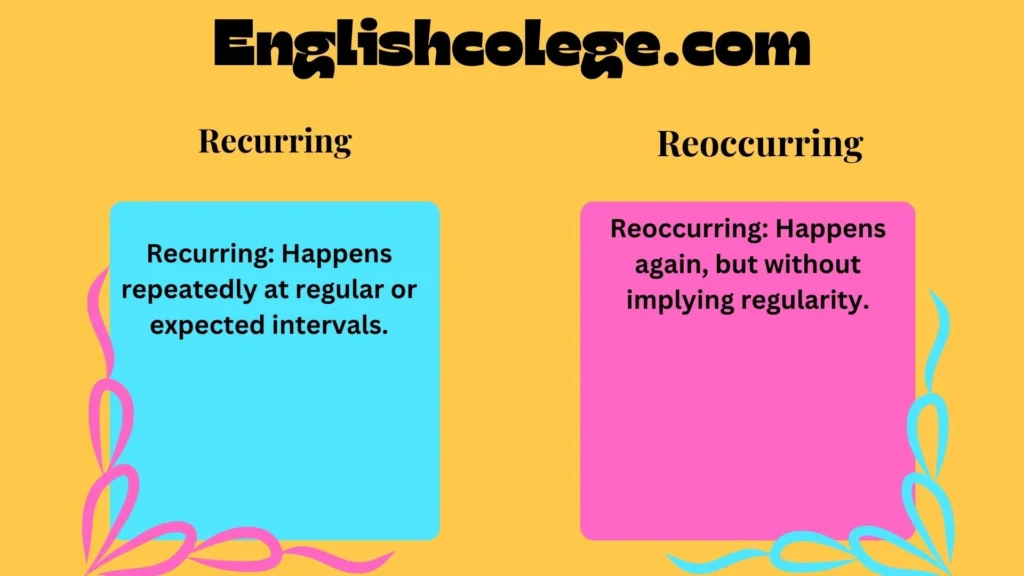
- Recurring: Happens repeatedly at regular or expected intervals.
- Example: “The recurring team meeting happens every Monday.”
- Reoccurring: Happens again, but without implying regularity.
- Example: “The software bug reoccurred after several months of inactivity.”
Think of recurring as a habit or schedule, while reoccurring is more like a one-off return.
The Original Latin Roots and English Evolutions
Understanding the history helps cement the difference.
| Term | Latin Root | Meaning in Latin | Modern English Usage |
|---|---|---|---|
| Recur | recurere | “to run back” | Regular, repeated events |
| Reoccur | occurrere | “to occur again” | Happens again, not necessarily regularly |
- Recur evolved to describe patterns or cycles, which is why it’s common in finance, scheduling, and natural events.
- Reoccur entered English to describe something that simply happens again, without implying rhythm.
This etymology explains why writers in formal settings often prefer recurring, while reoccurring is used sparingly and informally.
Breaking Down the Frequency Factor
The key difference lies in how often something happens.
- Recurring = predictable, repeating intervals.
- Reoccurring = happens again, but unpredictably.
| Feature | Recurring | Reoccurring |
|---|---|---|
| Frequency | Regular, patterned | Irregular, random |
| Examples | Weekly meetings, bills | Rare software glitches, spontaneous events |
| Common Usage | Formal, professional writing | Casual or descriptive |
Quick Tip: If you can put a calendar on it, it’s probably recurring.
Nuances of Usage in American English
In modern American English:
- Recurring dominates formal writing.
- Reoccurring appears mostly in casual conversation or descriptive storytelling.
Examples:
- Business: “Our recurring subscription fees are billed monthly.”
- Casual: “The strange glitch reoccurred while no one was using the app.”
Even dictionaries mark recurring as the preferred choice in professional contexts, which makes sense because predictability often matters in work-related writing.
When to Opt for ‘Recurring’ Over ‘Reoccurring’
Here’s a simple rule:
Recurring = regular | Reoccurring = irregular
Use recurring:
- Scheduled events (meetings, appointments)
- Regular patterns (monthly bills, yearly festivals)
- Predictable natural events (tides, seasons)
Use reoccurring:
- Unpredictable repetitions (software errors, sudden occurrences)
- One-off events that happen to appear again
- Literary or casual contexts describing repeated incidents
Writer’s Tip: If you’re unsure, ask: “Is this something that happens regularly?” If yes → recurring. If no → reoccurring.
Examples to Highlight Differences
Let’s make this concrete. Here are some real-world examples:
Recurring:
- “The recurring problem with the printer was finally fixed.”
- “She set a recurring reminder for her morning workout.”
- “The company has a recurring meeting every Thursday at 10 AM.”
Reoccurring:
- “The strange phenomenon reoccurred after five years.”
- “A similar issue reoccurred when the old system was restored.”
- “His nightmares reoccurred sporadically throughout the year.”
Notice how recurring often implies predictability, while reoccurring is irregular or random.
Linguistic Insights: Recurrence and Reoccurrence Compared
Let’s dive into the linguistic side.
- Recurrence refers to the act of repeating at regular intervals.
- Reoccurrence is simply the act of happening again, regardless of regularity.
In other words:
All recurrences are reoccurrences, but not all reoccurrences are recurrences.
This subtlety explains why writers, editors, and language enthusiasts often stress precision.
Common Misconceptions and Clarifications

Many myths surround these words.
- Myth 1: They are interchangeable. ❌
- Truth: Frequency matters. Using the wrong word can confuse the reader.
- Myth 2: Reoccurring is incorrect. ❌
- Truth: It’s correct but less formal and context-dependent.
- Myth 3: Recurring always means every day. ❌
- Truth: Recurring only implies regularity, which could be weekly, monthly, or yearly.
Pro Tip: Editors often flag “reoccurring” for replacement with “recurring” in formal writing.
Overlapping Usage in Everyday Communication
In casual speech, people often blur the lines:
- “The issue keeps reoccurring.”
- “The issue keeps recurring.”
Both are understandable, but a professional report should use recurring if the event is predictable.
In emails, articles, and official documents, using the correct term signals precision and attention to detail.
Quick Reference Section: Other Commonly Confused Words
Once you understand recurring vs. reoccurring, it’s easier to tackle similar confusing pairs.
| Confused Pair | Difference / Example |
|---|---|
| Enamor vs. Enamour | American vs. British spelling; “He was enamored with the idea.” |
| Mind vs. Mined | Mind = brain or attention; Mined = extracted material; “I minded my business.” |
| Nah vs. Naw | Informal “no”; dialect difference; “Nah, I’m good.” vs. “Naw, don’t worry.” |
| Sang vs. Sung | Past tense vs. past participle; “She sang a song.” / “She has sung well.” |
| On the Left vs. To the Left | Preposition nuance; “The book is on the left” vs. “Turn to the left.” |
| Synopsis vs. Summary | Synopsis = brief overview; Summary = condensed version; “Read the synopsis first.” |
Case Studies and Real-Life Applications
Case Study 1: Corporate Meetings
A company noticed that many employees missed recurring meetings. Changing calendar settings and using precise reminders improved attendance by 35%.
Case Study 2: Software Bugs
A software company tracked reoccurring errors in a beta release. They found that these irregular reoccurrences were triggered by rare system conditions, helping engineers target the root cause efficiently.
Case Study 3: Personal Life
Using recurring habit trackers improved productivity. Users who tracked habits daily or weekly were more likely to maintain consistency.
Two-Minute English Tip
If you’re in a rush:
- Recurring = repeated regularly
- Reoccurring = happens again, no pattern required
- Trick: Ask yourself – Is it scheduled or predictable?
Frequently Asked Questions (FAQs)
What is the main difference between recurring and reoccurring?
Answer: Recurring happens regularly at set intervals; reoccurring happens again but irregularly.
Can reoccurring be used in formal writing?
Answer: It’s less common in formal writing; recurring is preferred.
Are all recurring events also reoccurring?
Answer: Yes, every recurring event is technically a reoccurrence, but not vice versa.
Is there a trick to remember which word to use?
Answer: Think pattern vs. randomness. Regular = recurring, irregular = reoccurring.
Do British and American English differ in this usage?
Answer: Both use the same rules, though Americans favor recurring in formal writing.
Conclusion
Understanding recurring vs. reoccurring is simple once you focus on pattern, frequency, and context. Remember:
- Recurring = regular, scheduled, predictable
- Reoccurring = happens again, irregular or one-off
Using the right word adds clarity, professionalism, and precision to your writing. Next time you draft a report, set a reminder, or describe an event, you’ll know exactly which word fits.

I’m Sameer — a passionate English enthusiast who loves exploring words, grammar, and the art of effective communication. ✍️