

Have you ever paused while typing real life and wondered, “Should I add a hyphen here?” You’re not alone.
This small punctuation mark confuses even seasoned writers. The truth is, both “real life” and “real-life” are correct, but each has its place.
In this guide, you’ll learn exactly when to use “real life” vs. “real-life,” based on American English grammar and major style guides like AP and Chicago. You’ll also see real examples, useful tables, and quick memory tricks to never get it wrong again.
Why Writers Get Confused About “Real Life”
Language evolves, and so does punctuation. Hyphens, in particular, sit at the tricky intersection between clarity and habit.
Writers often debate whether real life needs a hyphen because it looks like a compound phrase—two words forming one idea. But the rule isn’t about appearance; it’s about function.
Here’s the short answer before we dig deep:
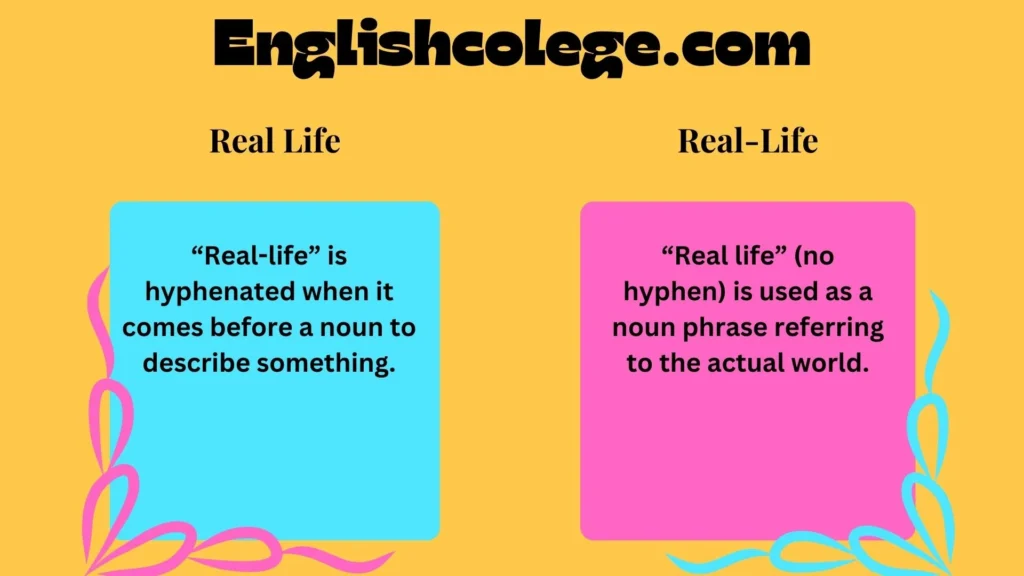
“Real-life” is hyphenated when it comes before a noun to describe something.
“Real life” (no hyphen) is used as a noun phrase referring to the actual world.
Let’s break that down.
Understanding the Basics: When Words Work as Nouns or Adjectives
The key to knowing whether to hyphenate lies in grammar function—is the phrase acting as a noun or an adjective?
- As a noun: “Real life” stands alone and names something—the reality outside imagination.
- ✅ I prefer real life over online games.
- As an adjective: “Real-life” describes or modifies another noun.
- ✅ She’s a real-life superhero.
Here’s a simple table that clears it up:
| Usage | Function | Example | Correct Form |
|---|---|---|---|
| Noun phrase | Refers to reality itself | In real life, things aren’t perfect. | Real life |
| Adjective (compound modifier) | Describes a noun | That’s a real-life mystery. | Real-life |
✅ Quick Tip:
If “real” and “life” come before a noun, use the hyphen. If they stand alone after a verb, don’t.
Think: “A real-life hero” ✅ but “He’s a hero in real life” ✅ (no hyphen).
Hyphenation Rules in American English
To master “real life” and “real-life,” it helps to understand the general rules of hyphenation in English.
Rule 1: Hyphenate Compound Modifiers Before Nouns
When two or more words join together to describe a noun, hyphenate them for clarity.
Examples:
- A full-time job
- A well-known author
- A real-life event
Rule 2: Don’t Hyphenate After the Noun
If the phrase comes after the noun, leave it open.
Examples:
- Her job is full time.
- That author is well known.
- This story happened in real life.
Rule 3: Prioritize Clarity Over Habit
Use a hyphen only when it prevents confusion. The goal is to make the sentence instantly clear to the reader.
“Real Life” vs. “Real-Life” in Grammar and Style Guides
Professional editors follow strict style manuals to stay consistent. Here’s what the top three say about this phrase.
| Style Guide | Rule on Hyphens | Example Usage |
|---|---|---|
| AP Stylebook | Hyphenate compound modifiers before nouns | A real-life event. |
| Chicago Manual of Style | Use hyphens for clarity before nouns | A real-life situation. |
| Merriam-Webster | Lists “real-life” as a compound adjective | Real-life examples make writing relatable. |
So, if you’re writing journalism, academic papers, or formal content, the hyphenated form (“real-life”) is your go-to when it modifies another noun.
Capitalization in Titles: “Real-Life” or “Real-life”?
Capitalization rules depend on which style you follow—Title Case or Sentence Case.
| Style | Correct Example | Notes |
|---|---|---|
| Title Case | Real-Life Stories That Inspire You | Capitalize both parts of the hyphenated word. |
| Sentence Case | The movie is based on a real-life story. | Only the first word and proper nouns are capitalized. |
💡 Pro Tip: When using a headline or blog title, capitalize both “Real” and “Life” if you’re using title case formatting.
Examples of “Real Life” and “Real-Life” in Sentences
Seeing the phrase in context makes it stick faster.
“Real Life” (Noun)
- In real life, people rarely act like movie characters.
- She’s better at puzzles in real life than online.
- Real life doesn’t come with a script.
“Real-Life” (Adjective)
- He told a real-life ghost story.
- That book is based on a real-life adventure.
- They created a game inspired by real-life experiences.
Mixed Usage Example
In real life, superheroes don’t exist, but she’s a real-life example of courage.
That sentence shows both uses perfectly—one as a noun, one as an adjective.
Common Mistakes and How to Avoid Them
Even good writers mix them up. Here’s how to avoid the pitfalls.
| Mistake | Why It’s Wrong | Correct Form |
|---|---|---|
| A real life event | Missing hyphen when modifying a noun | A real-life event |
| He acts real-life | Wrong usage; “real-life” describes nouns only | He acts in real life |
| In real-life, people differ | Wrong placement of hyphen | In real life, people differ |
⚠️ Common Error:
Adding a hyphen where it doesn’t belong. Remember: no hyphen if it’s after a verb or preposition.
Alternatives and Synonyms for “Real Life”
Sometimes, repeating real life or real-life makes writing sound dull. Here are natural substitutes you can use depending on tone and context.
| Alternative | When to Use It | Example |
|---|---|---|
| Reality | Academic, formal, or technical writing | Virtual reality versus reality. |
| Actual life | When contrasting fiction vs. truth | The book mirrors actual life. |
| Everyday life | Describing normal routines | He captures the beauty of everyday life. |
| Tangible world | When emphasizing physical experience | Digital art meets the tangible world. |
| The real world | Informal or conversational | Welcome to the real world! |
Quick Grammar Recap: When to Hyphenate
Here’s a cheat sheet you can pin to your desk or notebook:
- ✅ Use real-life when it’s before a noun:
A real-life example, a real-life situation. - ❌ Don’t use a hyphen when it’s a noun phrase:
In real life, things are messy. - ⚖️ Follow AP or Chicago style for consistency.
- 💬 When unsure, read it aloud. If it sounds natural, it probably is.
Case Study: How Hyphens Change Meaning
Consider this pair of sentences:
- She shared a real-life story.
- She shared a real life story.
The first means she shared a story from reality. The second, without the hyphen, looks awkward and could mislead readers—it sounds like she shared a story that was real life itself.
That one little dash avoids confusion.
“Hyphens act like glue—they hold ideas together so meaning doesn’t fall apart.”
— Grammarist Insight, 2024 Edition
How “Real Life” Appears in Popular Culture
You’ve likely seen both forms in headlines, book titles, and social media.
| Medium | Example Usage | Why It Matters |
|---|---|---|
| Movies | Based on a Real-Life Story | Describes the film’s basis. |
| Blogs | In Real Life: What Working Freelancers Face Daily | Used as a noun phrase. |
| News | The Real-Life Heroes Behind the Mission | Adds drama and clarity. |
Even professional editors prefer real-life for headlines because it’s compact, descriptive, and visually clear.
Common Confusions with Similar Phrases
Writers often mix up phrases that look similar but follow different logic. Let’s compare a few:
| Phrase | Hyphen Rule | Example |
|---|---|---|
| Real-life | Hyphenate before a noun | A real-life event. |
| Full-time | Hyphenate before a noun | A full-time teacher. |
| High school | No hyphen | He’s in high school. |
| Long-term | Hyphenate before a noun | Long-term goals matter. |
Seeing these side-by-side shows the pattern: when two words modify a single noun idea, hyphenate them.
Why the Hyphen Still Matters in Digital Writing
In the fast-paced world of blogs and SEO writing, punctuation directly affects readability. Hyphens improve:
- Scanning ability: Readers instantly grasp “real-life example” as one idea.
- Keyword clarity: Search engines read “real-life” differently than “real life,” affecting ranking and intent.
- Professional tone: Consistent hyphenation signals grammatical care.
💡 SEO Insight:
Using both “real-life” and “real life” naturally within an article helps capture more search intent—because readers may type either form.
FAQs: Real Life or Real-Life?
Is “real-life” hyphenated in AP Style?
Yes. AP Style uses a hyphen when the phrase modifies a noun (e.g., a real-life hero). Without the hyphen, it becomes a noun phrase (in real life).
Do I hyphenate “real life” in British English?
Yes, British English follows the same rule. Real-life modifies nouns, while real life stands alone.
Which is more common: “real life” or “real-life”?
“Real life” appears more often overall because it’s used broadly as a noun. However, “real-life” is frequent in journalism, fiction, and marketing.
Should I capitalize both words in a title?
If using title case (as in blog posts or book titles), capitalize both: Real-Life Lessons Learned the Hard Way.
Can I use “real-life” in formal writing?
Absolutely. Just ensure it functions as a compound modifier. Grammar guides accept it as standard English.
Conclusion
When in doubt, ask yourself what role the phrase plays.
- If it’s describing something → hyphenate (“real-life”).
- If it’s the thing itself → no hyphen (“real life”).
That’s it.
Consistency is what makes your writing trustworthy. Hyphens aren’t decoration—they’re precision tools. Whether you’re editing blog posts, crafting fiction, or writing for the web, using “real-life” correctly shows your mastery of detail.
“Good writing isn’t about rules; it’s about making your reader’s journey effortless.”

I’m Sameer — a passionate English enthusiast who loves exploring words, grammar, and the art of effective communication. ✍️