
English can be tricky. Some words sound the same but carry completely different meanings.
These are called homophones, and they can make both speaking and writing a challenge.
Two words that often confuse people are quaff and coif. On the surface, they may sound alike, but they live in entirely different worlds:
one’s about drinking, the other about styling hair.
In this article, we’ll explore Quaff vs Coif Homophones, understand their origins, usage, and how to never mix them up again.
Along the way, we’ll also cover other common homophone confusions to sharpen your English skills.
Understanding Homophones
What Are Homophones?
Homophones are words that sound identical or nearly identical but differ in meaning and/or spelling. English is full of them, which can make communication tricky, especially for learners.
For example:
| Homophones | Meaning 1 | Meaning 2 |
|---|---|---|
| Pair vs Pear | Two of something | The fruit |
| There vs Their vs They’re | Location | Possession |
“English is a funny language; you can’t just spell by sound!” – Anonymous
Homophones can appear in writing, speech, and even historical texts, which is why knowing them improves clarity.
Why Homophones Confuse People
People often confuse homophones because:
- Pronunciation is identical, but spelling is different.
- Context is missing in fast communication.
- Some words are archaic or rarely used, like “quaff” and “coif.”
Being aware of homophones helps you avoid embarrassing mistakes in emails, essays, or even casual conversation.
Exploring ‘Quaff’
Meaning of Quaff
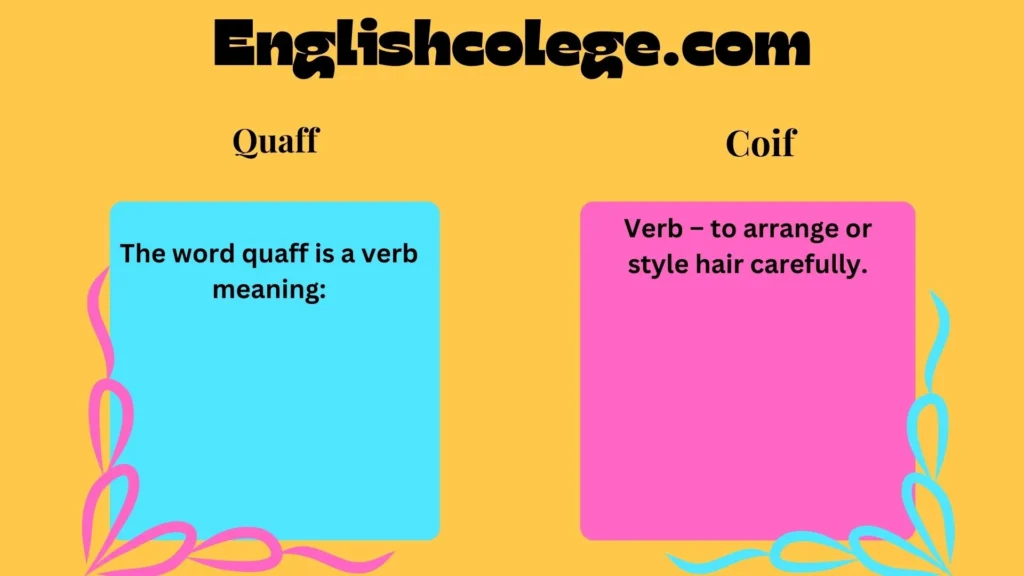
The word quaff is a verb meaning:
“To drink heartily or with enthusiasm.”
It’s often used in literature or historical texts to describe someone enjoying a drink fully and energetically.
Examples of Quaff in sentences:
- “At the medieval feast, the guests quaffed wine from golden goblets.”
- “After the marathon, she quaffed a bottle of water in seconds.”
Quaff as a Noun
While rare, “quaff” can also be used as a noun to describe a drink taken eagerly.
- Example: “He raised his quaff to the victory toast.”
Origin of Quaff
Etymology:
- Old English: cwafian, meaning “to gulp or swallow.”
- Related to Middle High German: quaffen, meaning “to drink in large draughts.”
Quaff has been used in English literature for centuries, particularly in medieval texts and poetry.
Exploring ‘Coif’
Meaning of Coif
Coif has two main uses:
- Noun – a type of hairstyle or hair covering.
- Verb – to arrange or style hair carefully.
Examples:
- Noun: “The princess wore a delicate coif woven with ribbons.”
- Verb: “The stylist coifed her hair before the ceremony.”
Historical Context
The word “coif” is tied to medieval Europe.
- Coif as headgear: Often a close-fitting cap worn under helmets or for modesty.
- Coif as hairstyle: Popular among nobles and clerics in the Middle Ages.
Fun Fact: Medieval coifs were worn by both men and women to signify status and propriety.
Coif in Modern English
Today, “coif” appears mostly in literature, fashion magazines, or historical contexts. In daily conversation, “style” or “hairdo” is more common.
Quaff vs Coif: Direct Comparison
| Feature | Quaff | Coif |
|---|---|---|
| Part of Speech | Verb / Noun | Noun / Verb |
| Meaning | Drink heartily | Hair style or cover / to arrange hair |
| Historical Use | Medieval feasts, literature | Medieval headgear, noble hairstyles |
| Modern Use | Rare, literary | Fashion, stylistic writing |
| Example Sentence | “He quaffed the ale without hesitation.” | “She coifed her hair for the ball.” |
Key takeaway: Quaff = drink enthusiastically. Coif = hair or head covering. One belongs to gastronomy, the other to hairstyling.
Common Mistakes
People sometimes confuse these words because of their similar pronunciation, but they are never interchangeable.
Memory tips:
- Think Q = Quaff = Quick gulp of a drink.
- Think C = Coif = Comb your hair.

Example Sentences in Depth
Quaff in Everyday Use
- “After scoring the winning goal, he quaffed a soda with a big smile.”
- “At Oktoberfest, tourists quaffed beer from enormous steins.”
Quaff in Historical Texts
- “The knight quaffed deeply from his goblet, celebrating the king’s victory.”
- Used in Shakespearean literature for dramatic effect.
Coif in Modern Language
- “The hairdresser coifed her client’s curls into an elegant updo.”
- Fashion blogs often mention coif when describing hairstyles for events.
Coif in Historical Context
- “The squire adjusted his chainmail under his coif before the battle.”
- Indicates social rank or protection, not just fashion.
Additional Homophones and Common Confusions
Even after mastering Quaff vs Coif, English has many other tricky pairs:
Elicit vs Illicit
- Elicit: To draw out or provoke a reaction.
- Illicit: Illegal or forbidden.
- Example: “The teacher’s question elicited laughter.” / “The gang was involved in illicit activities.”
Indexes vs Indices
- Indexes: Typically for books or lists.
- Indices: Used in mathematics or statistics.
- Table:
| Word | Use Case | Example |
|---|---|---|
| Indexes | Book/table of contents | “Check the index for references.” |
| Indices | Math/statistics | “Stock market indices rose today.” |
Alone vs Lonely
- Alone: Solitary, without company.
- Lonely: Feeling sad due to being alone.
- Example: “I enjoy being alone in the library.” / “He felt lonely after moving to a new city.”
Hive Mind
- Collective intelligence of a group.
- Often used in tech, social behavior, and gaming communities.
Suffice It to Say vs Suffice to Say
- Correct form: Suffice it to say.
- Means: “It is enough to state that…”
- Example: “Suffice it to say, the project was a success.”
Retcon
- Stands for retroactive continuity.
- Often used in storytelling, comics, or TV shows to revise earlier plot details.
- Example: “The show retconned the character’s origin to fit a new storyline.”
Practical Tips for Mastering Homophones
- Read in context – Words make sense in a sentence.
- Use mnemonics – Like Q = Quaff = Quick drink.
- Write and practice – The more you use words, the easier to remember.
- Refer to dictionaries – Trust sources like Merriam-Webster or Oxford English Dictionary.
- Listen actively – Podcasts, audiobooks, or lectures improve recognition.
FAQs
What does ‘quaff’ mean in simple terms?
It means to drink something quickly or enthusiastically.
Can ‘coif’ be used as a verb?
Yes, it means to style or arrange hair carefully.
Are ‘quaff’ and ‘coif’ interchangeable?
No, they have completely different meanings. Quaff = drink, Coif = hair.
Is ‘coif’ still used today?
Yes, mostly in literature, fashion, or historical references.
How can I remember the difference between homophones?
Use mnemonics, context clues, and practice writing them in sentences.
Conclusion
English homophones like quaff and coif can be tricky, but knowing their meanings and usage makes writing and speaking much more precise.
Quaff brings images of hearty drinking, while coif takes us back to medieval hairstyles and head coverings.
By practicing these words and understanding other homophones, you can speak and write with confidence, clarity, and flair.

I’m Sameer — a passionate English enthusiast who loves exploring words, grammar, and the art of effective communication. ✍️