
Language is full of subtle nuances that can completely change meaning. One of the most common examples learners struggle with is the difference between “proud for you” and “proud of you.”
At first glance, both may seem correct—but in standard English, they aren’t interchangeable. In this guide, you’ll learn exactly which phrase is correct, why it’s correct, and how to use it naturally in real conversation or writing.
You’ll also discover the emotional and grammatical reasons behind each, how to avoid common mistakes, and what to say instead when “proud for you” does fit.
Understanding the Core Meaning of “Proud”
The word “proud” is an adjective that expresses admiration, satisfaction, or joy about someone’s achievement or quality. It comes from the Old French prud, meaning valiant or brave. Over time, it evolved to describe a positive feeling of accomplishment—either about yourself or someone else.
In modern English, the preposition following “proud” defines the relationship between the speaker and the subject.
Let’s break it down:
| Preposition | Example | Implied Meaning |
|---|---|---|
| of | “I’m proud of you.” | I feel pride because of your action or quality. |
| for | “I’m proud for you.” | I feel happy on your behalf. |
Notice the difference? “Of” connects pride directly to its source, while “for” shifts it slightly outward—it’s pride mixed with empathy or happiness for someone else’s success.
The Grammar Behind “Proud of You”
Let’s start with the phrase that’s universally accepted: “proud of you.”
Grammatically, this structure follows a simple and logical pattern:
Subject → Linking Verb → Adjective + Preposition + Object
Example:
- I’m proud of you.
- She’s proud of her son.
- We’re proud of our team’s success.
In each case, the preposition “of” links the feeling of pride to the cause or object of that emotion. It shows direct ownership of the feeling—you feel pride because of someone’s actions.
✅ When to Use “Proud of You”
Use “proud of you” when:
- You’re personally connected to the achievement.
- You want to show direct admiration or emotional investment.
- You’re acknowledging effort, growth, or success.
Examples:
- “I’m proud of you for finishing that marathon.”
- “Your parents are proud of you for graduating.”
- “He’s proud of himself for overcoming his fears.”
In each case, the emotion reflects ownership of pride, not just happiness.
Grammar Tip: “Of” often connects emotions directly to their source:
afraid of, ashamed of, fond of, tired of—and, of course, proud of.
Why “Proud for You” Sounds Awkward
Now let’s tackle the less common phrase—“proud for you.”
Grammatically, it’s not wrong, but it’s rarely used and often sounds awkward to native speakers. Why? Because the preposition “for” changes the meaning of the emotion.
“For” generally indicates purpose, benefit, or reason, not ownership. When you say, “I baked a cake for you,” it means you’re the beneficiary—not that you own the cake.
So, when someone says, “I’m proud for you,” the phrase suggests you’re feeling proud on their behalf, almost like saying, “I’m happy for your success.”
That’s not incorrect—it’s just not the same.
⚠️ When “Proud for You” Can Work
It can occasionally sound natural in emotional or poetic contexts, especially when expressing shared happiness rather than personal pride.
Examples:
- “I’m proud for you that you finally reached your goal.”
- “We’re proud for you and your family—what an incredible moment.”
Here, “proud for you” doesn’t mean I feel pride because of you. It means I’m happy and proud that something good happened to you.
Comparison Table
| Phrase | Meaning | Emotion Type | Example | Correctness |
|---|---|---|---|---|
| Proud of you | Feeling pride in someone’s actions or qualities | Direct pride | “I’m proud of you for your hard work.” | ✅ Standard English |
| Proud for you | Feeling joy or happiness on someone’s behalf | Indirect happiness | “I’m proud for you that you won.” | ⚠️ Limited use |
In short:
- “Proud of you” = personal pride and admiration.
- “Proud for you” = shared happiness for another’s success.
Common Mistakes and How to Fix Them
Many English learners—and even native speakers—confuse “of” and “for.” Here’s why and how to fix it.
❌ Mistake #1: Mixing “of” and “for” Interchangeably
Some believe they can swap prepositions freely. They can’t. Each preposition carries a different emotional connection.
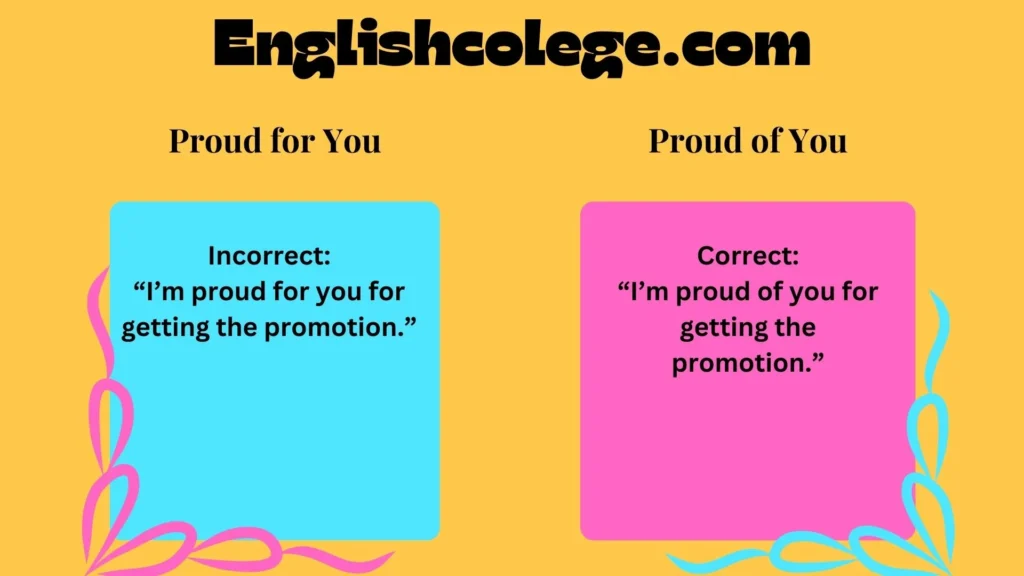
Incorrect:
“I’m proud for you for getting the promotion.”
Correct:
“I’m proud of you for getting the promotion.”
❌ Mistake #2: Using “Proud for You” as a Direct Compliment
People often say “proud for you” thinking it sounds kind, but it feels slightly off in English speech patterns. Instead, use “happy for you” when sharing joy.
Better Alternative:
“I’m happy for you—that’s amazing!”
✅ Simple Trick to Remember
If the pride belongs to you → use “of.”
If you’re sharing happiness → use “for.”
Historical and Linguistic Background
The expression “proud of” dates back to Middle English, roughly the 13th century, where proud of meant “elated about one’s own or another’s achievement.”
Over centuries, “proud of” became the standard construction, especially in emotional and familial contexts:
“The king was proud of his son’s valor.”
Meanwhile, “proud for” occasionally appeared in older poetry and letters, where the emotion leaned more toward empathy or moral support.
However, in modern English—especially since the 19th century—“proud for you” has become rare and situational, mostly reserved for sentimental writing or southern American dialects.
You can even verify this through Google Ngram Viewer, which tracks word frequency over time. The data shows “proud of” is used exponentially more than “proud for.”
Emotional and Social Impact of Saying “Proud of You”
Language isn’t just grammar—it’s emotion. Saying “I’m proud of you” carries deep emotional weight. It validates effort, recognizes growth, and builds connection.
Psychologists note that expressions of pride and acknowledgment play a key role in strengthening bonds—especially in parent-child, teacher-student, or mentor-mentee relationships.
💬 Real-Life Example
A father tells his daughter after graduation:
“I’m proud of you. You worked so hard for this moment.”
This phrase doesn’t just celebrate her achievement. It conveys love, support, and recognition.
By contrast:
“I’m proud for you.”
—sounds detached, as if the pride isn’t personal but sympathetic.
🧠 Fact:
A 2021 linguistic study in The Journal of Positive Psychology found that direct acknowledgments like “I’m proud of you” increase emotional connection and motivation by over 30% compared to indirect expressions such as “I’m happy for you.”
Alternative Ways to Express Pride
There are many ways to express pride naturally, depending on tone and formality. Here’s a quick reference guide:
| Tone | Alternative Phrase | Example Use |
|---|---|---|
| Formal | “You’ve done an exceptional job.” | “You’ve done an exceptional job on that project.” |
| Casual | “I’m so happy for you!” | “I’m so happy for you—you totally earned it!” |
| Supportive | “You should be proud of yourself.” | “You should be proud of yourself for sticking with it.” |
| Emotional | “That took real courage.” | “That took real courage—I admire you.” |
| Encouraging | “Keep doing what you’re doing.” | “Keep doing what you’re doing—you’re growing every day.” |
🎯 Quick Tip:
Use “I’m happy for you” when you celebrate someone’s success without claiming ownership of the pride.
Use “I’m proud of you” when you’ve been emotionally invested in their effort.
Quick Recap: The Rule in a Nutshell
| Use | Correct Phrase | Purpose |
|---|---|---|
| To express personal admiration | Proud of you | Direct connection to the person’s success |
| To express shared happiness | Proud for you | Emotional sympathy, not ownership |
| To celebrate without pride | Happy for you | Congratulatory, neutral tone |
Mnemonic:
You’re of my pride, not for my pride.
Case Study: “Proud of You” in Real Life
Let’s take a real-world example to see how this phrase shapes communication.
Scenario:
Emma, a first-generation college student, graduates at the top of her class. Her mentor, Dr. Lee, says:
“Emma, I’m proud of you. You’ve pushed through so many challenges.”
The emotion here is personal and genuine. Dr. Lee’s pride reflects his role and emotional investment in Emma’s journey.
Now imagine if he said:
“Emma, I’m proud for you.”
It’s still kind—but it distances the emotion. It suggests happiness about her success, not pride in her achievement.
This subtle shift shows how prepositions can affect emotional connection.
Final Thoughts on Using “Pride” Expressions
To sound fluent, confident, and emotionally authentic in English, always use “proud of you” when expressing personal pride or admiration.
Reserve “proud for you” for those rare occasions when you mean you’re happy on someone’s behalf.
Mastering such nuances doesn’t just polish your grammar—it makes your English sound more human, warm, and emotionally intelligent.
FAQs About “Proud of You” vs “Proud for You”
What does “proud of you” really mean?
It means you feel genuine admiration or satisfaction because of someone’s actions or character. It’s an emotional acknowledgment of effort and achievement.
Can I ever use “proud for you”?
Yes, but sparingly. It fits when expressing happiness for someone’s success rather than personal pride—like “I’m proud for you that your book got published.”
Why do people say “proud of you” instead of “happy for you”?
Because “proud of you” shows deeper involvement. “Happy for you” simply congratulates someone; “proud of you” connects your emotions to their growth or success.
Is “proud of” always followed by a person?
Usually, yes. But it can also refer to objects or events linked to human effort: “We’re proud of our city,” “I’m proud of my work.”
How can I teach this difference to ESL students?
Use visual or emotional cues. Draw a link: “Pride belongs of someone, joy belongs for someone.” Practice with comparison sentences and role-play examples.

I’m Sameer — a passionate English enthusiast who loves exploring words, grammar, and the art of effective communication. ✍️