
We’ve all seen it — someone confidently types “It’s my perogative!” in a heated online debate or a cheeky Instagram caption. It looks fine at first glance, right? The problem is that “perogative” isn’t actually a word.
The correct spelling is “prerogative.”
It’s one of those words that sound straightforward when spoken but trip up even skilled writers when written.
Let’s dive deep into why that happens, what “prerogative” really means, where it comes from, and how you can remember it for good.
Perogative or Prerogative Synonym
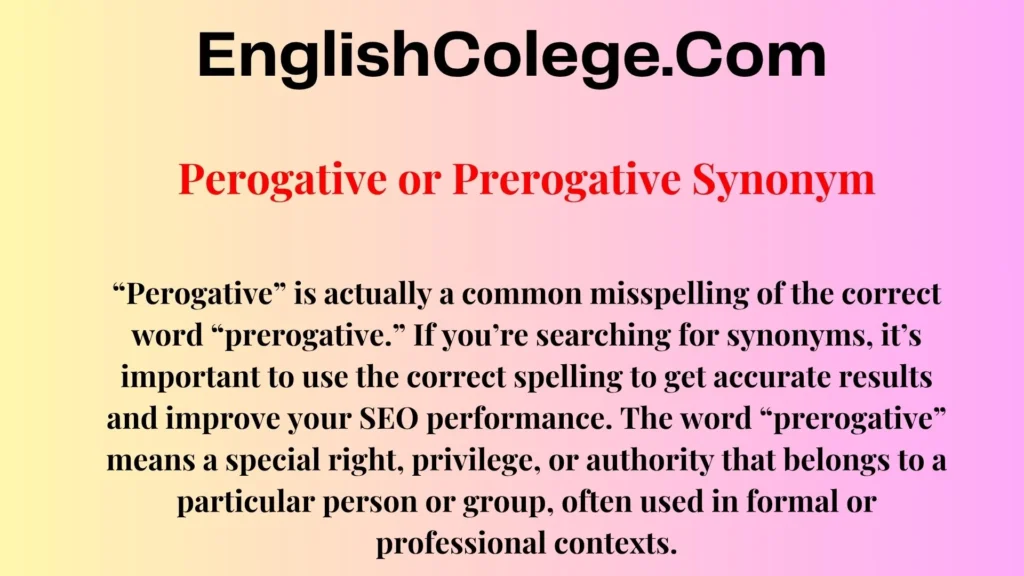
“Perogative” is actually a common misspelling of the correct word “prerogative.” If you’re searching for synonyms, it’s important to use the correct spelling to get accurate results and improve your SEO performance. The word “prerogative” means a special right, privilege, or authority that belongs to a particular person or group, often used in formal or professional contexts.
Some strong synonyms for “prerogative” include privilege, right, entitlement, authority, liberty, and discretion. For example, you might say, “It’s your prerogative to make that decision,” which can also be written as, “It’s your right or authority to decide.” Using these alternatives naturally in your content can improve readability and keyword variation. For SEO, mixing primary keywords like “prerogative synonym” with related terms helps search engines better understand your content.
Why This Spelling Mix-Up Matters
At first, spelling might seem like a small thing — but language shapes how people perceive you. Using “perogative” instead of “prerogative” in a job email or essay can subtly undermine your credibility.
When you understand the origin, usage, and meaning behind the word, you not only spell it right — you use it with confidence.
Here’s why this confusion is so common:
- Pronunciation trickery: The middle “r” in prerogative often goes soft when spoken, sounding like “perogative.”
- Phonetic illusion: Our ears simplify sounds — what we hear isn’t always what’s written.
- Frequency bias: Online typos and social media captions reinforce the wrong version.
Even major artists and celebrities have made the mistake publicly. Remember Britney Spears’ hit “My Prerogative”? Many people still sing it as “My Perogative.” That’s how powerful phonetics can be.
Understanding the Confusion: Why ‘Perogative’ Looks Right but Isn’t
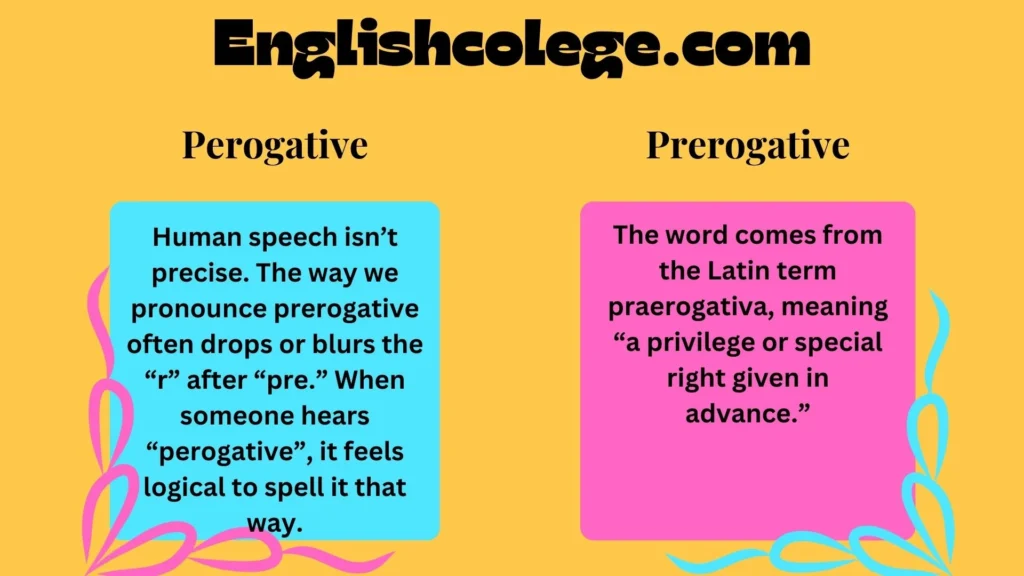
Human speech isn’t precise. The way we pronounce prerogative often drops or blurs the “r” after “pre.” When someone hears “perogative”, it feels logical to spell it that way.
This phenomenon is called phonological simplification, where sounds merge or vanish to make speech smoother. English is full of these examples:
| Misheard Word | Correct Form | Why It Happens |
|---|---|---|
| Sherbert | Sherbet | Extra “r” sound added |
| Expresso | Espresso | “X” sound feels natural |
| For all intensive purposes | For all intents and purposes | Misheard idiom |
| Perogative | Prerogative | “R” dropped after “pre” |
When writing, our brains often rely on how a word sounds rather than how it’s structured. That’s why “perogative” seems acceptable — but dictionaries disagree.
The True Origin of ‘Prerogative’
Let’s travel back in time for a moment. Words carry stories, and prerogative has a fascinating one.
- The word comes from the Latin term praerogativa, meaning “a privilege or special right given in advance.”
- It later appeared in Old French as prérogative, before entering Middle English around the 15th century.
The Latin root reveals its true meaning:
- “Prae-” means before.
- “Rogare” means to ask or propose.
So the original sense was “the right to ask first” — a privilege granted ahead of others.
Here’s a quick evolution timeline:
| Era | Language | Word Form | Meaning |
|---|---|---|---|
| Ancient Rome | Latin | Praerogativa | A privilege granted before others |
| Old French | Prérogative | Privilege or special right | |
| Middle English | Prerogatif / Prerogative | Right or authority | |
| Modern English | Prerogative | Exclusive right, privilege, or power |
Understanding this lineage helps you remember the prefix “pre” — it’s not optional. It’s part of the DNA of the word.
‘Perogative’: A Modern Misspelling with No Official Standing
You might find “perogative” in blog comments, social posts, or even printed text. But make no mistake — it’s not recognized by any reputable dictionary.
According to language databases and search statistics:
- “Prerogative” appears over 500 times more often in published English than “perogative.”
- Merriam-Webster, Oxford, and Cambridge list only “prerogative.”
- “Perogative” is classified as a common misspelling.
Let’s see it in action:
| Sentence | Correct or Incorrect? |
|---|---|
| It’s my perogative to decide. | ❌ Incorrect |
| It’s my prerogative to decide. | ✅ Correct |
The incorrect form spreads because of phonetic spelling — writing based on sound, not structure. You’ll see this a lot in informal online English, especially where grammar checkers aren’t active.
What ‘Prerogative’ Actually Means
Now that we’ve nailed the spelling, what does prerogative actually mean?
At its core, “prerogative” refers to a right or privilege that belongs exclusively to a particular person or group.
Here’s a breakdown by context:
| Context | Meaning | Example |
|---|---|---|
| Legal | A right or power held by the crown or state | The royal prerogative allows the monarch to grant pardons. |
| Political | Executive or governmental authority | Presidents exercise certain prerogatives during emergencies. |
| Workplace | Authority or discretion of leadership | It’s the manager’s prerogative to make staffing changes. |
| Everyday Speech | Personal right or choice | It’s your prerogative to say no. |
In short: prerogative = privilege + authority + right.
‘Prerogative’ in Pop Culture and Media
This word shows up everywhere — songs, interviews, movies, and political debates.
Pop Culture Spotlight
- Britney Spears – “My Prerogative” (2004): A hit single that revived the word’s popularity for a new generation.
- Bobby Brown – “My Prerogative” (1988): The original anthem of independence — emphasizing the right to live life your own way.
Both artists used the word correctly, though many fans misheard it as “perogative.”
In News and Politics
You’ll often hear “prerogative” in legal and political contexts:
- “The royal prerogative allows the King to appoint ministers.”
- “It’s the governor’s prerogative to call a special session.”
In these cases, the term signals authority derived from position or law.
Cultural Quote
“It’s every human being’s prerogative to stand up for what they believe in.”
— Anonymous
The Correct Pronunciation
Even pronunciation plays a huge role in the confusion. Here’s how to get it right.
- IPA: /prɪˈrɒɡətɪv/
- Syllables: pre·rog·a·tive (four syllables)
- Stress: Second syllable (ROG)
Common mispronunciations:
- ❌ “per-OG-a-tive”
- ✅ “pri-ROG-a-tive”
Pronunciation tip:
Think “PRE-view your ROGue choices.”
That little reminder keeps the “pre” and “rog” clear in your mind.
How to Remember the Correct Spelling
Want a quick fix to lock it in forever? Try these techniques:
1. Mnemonic Trick
“Pre + rogare = prerogative.”
You must ask before you act — and those who ask first have the prerogative.
2. Visual Memory
Write the word in segments: PRE + ROG + ATIVE.
Repeat it a few times — your brain remembers the rhythm.
3. Association
Link it to “privilege” or “priority.” They all share the “pre” prefix, meaning “before.”
4. Flash Practice
Create quick contrast flashcards:
| Incorrect | Correct |
|---|---|
| Perogative | Prerogative |
| Expresso | Espresso |
| Sherbert | Sherbet |
5. Real-Life Context
Use the word naturally in sentences. The more you see it, the stronger your recall becomes:
- It’s your prerogative to choose your friends wisely.
- Company leaders often exercise their prerogative in promotions.
Related Word Pairs That Confuse Writers
English loves to test your patience with lookalike or soundalike words. Here are a few common pairs that trip people up — and how to remember them.
| Word Pair | Correct Usage | Quick Tip |
|---|---|---|
| Coliseum / Colosseum | Colosseum refers to the Roman amphitheater; coliseum is a general term. | The Roman one has two “s.” |
| Normalcy / Normality | Both correct, but normalcy is more common in US English. | Use “normalcy” in American contexts. |
| Casted / Cast | The correct past tense is cast. | He cast his vote, not casted. |
| Naive / Nieve | Only naive is correct. | Think of naïve with the two dots. |
| Throne / Thrown | Throne is a seat of royalty; thrown is past tense of throw. | Royalty sits on a throne. |
Getting these right builds linguistic precision — and makes your writing shine.
Case Study: Real-World Impact of a Spelling Mistake
Imagine a company CEO sending a press release that reads:
“It’s our perogative to make bold decisions.”
It looks minor, but journalists and investors notice. A single spelling error can make the statement appear unprofessional.
Now compare:
“It’s our prerogative to make bold decisions.”
This version communicates authority, polish, and care. Spelling influences perception more than most people realize.
In fact, studies show:
- 59% of readers are less likely to trust content with spelling mistakes.
- Professional recruiters flag poor spelling as a top 3 red flag in applications.
Language accuracy = credibility.
Quick Recap Table
| Word | Correct? | Meaning | Example |
|---|---|---|---|
| Perogative | ❌ No | Nonexistent word | – |
| Prerogative | ✅ Yes | Exclusive right or privilege | It’s your prerogative to decide. |
FAQs
What does “prerogative” mean in simple terms?
It means a special right or privilege that someone has — often because of their position or authority. Example: It’s your prerogative to choose your path.
Is “perogative” ever acceptable?
No. It’s not listed in any major dictionary. It’s an informal misspelling caused by how people pronounce the word.
Why do people say “perogative” instead of “prerogative”?
Because the middle “r” is often softened or dropped in speech, leading people to spell it how it sounds — “perogative.”
How can I remember the spelling of “prerogative”?
Use the mnemonic: “You must ask before you act — pre + rogare.” Remember that the “pre” means “before.”
What are synonyms for “prerogative”?
- Privilege
- Right
- Authority
- Liberty
- Entitlement
Conclusion
In the end, there’s no debate — “prerogative” is the only correct spelling.
It carries centuries of linguistic history and still holds powerful meaning today — representing authority, choice, and personal freedom. Whether you’re quoting Bobby Brown, writing an essay, or crafting an email, choosing the right spelling isn’t just grammar; it’s professionalism.
So next time you hear someone say “perogative,” you’ll know better — and you’ll have the prerogative to set the record straight.

I’m Sameer — a passionate English enthusiast who loves exploring words, grammar, and the art of effective communication. ✍️