
Whether you’re in a professional meeting or chatting with a friend, the phrases “on a call” and “in a call” often pop up.
At first glance, they might seem interchangeable, but native speakers use them differently—and using the wrong one can sound a little off.
In this guide, you’ll discover the true meaning, nuances, and correct usage of these two expressions.
We’ll explore real-life examples, grammar rules, professional contexts, and even historical usage trends so you can confidently choose the right phrase every time.
Understanding “On a Call” and “In a Call”
Both phrases describe being engaged in a phone conversation or meeting, but they carry slightly different connotations and grammatical implications. Knowing when to use each can improve your English fluency and make you sound more natural in conversations.
Defining “On a Call”
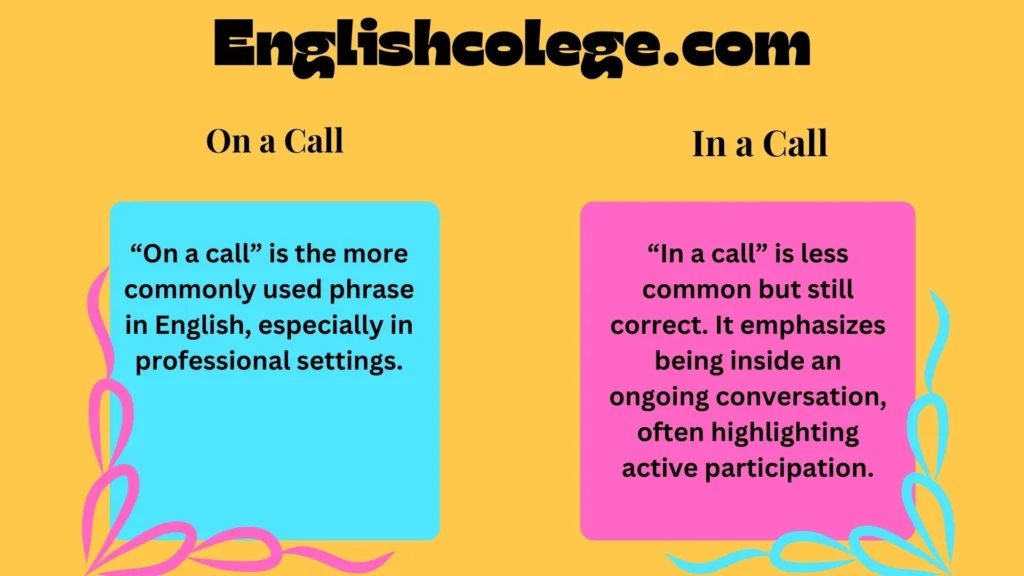
“On a call” is the more commonly used phrase in English, especially in professional settings. It emphasizes that you are actively engaged in a phone or video call.
Examples:
- I can’t talk right now; I’m on a call with my manager.
- She’s on a call, but she’ll join us in 10 minutes.
Key Takeaways:
- Usually used to signal unavailability.
- Implies you are participating but doesn’t specify active engagement.
- Standard in American English business communication.
Exploring “In a Call”
“In a call” is less common but still correct. It emphasizes being inside an ongoing conversation, often highlighting active participation.
Examples:
- I’m in a call with the client, so I can’t answer messages right now.
- He’s in a call discussing the project timeline.
Key Takeaways:
- Suggests immersed or actively involved in the conversation.
- Less formal than “on a call” in some contexts, but precise when describing your engagement.
The Subtle Differences Revealed
| Feature | On a Call | In a Call |
|---|---|---|
| Focus | Being connected/engaged | Actively participating |
| Formality | High (professional settings) | Medium (informal or professional) |
| Common context | Business meetings, customer calls | Discussions, project calls |
| Typical sentence structure | “I’m on a call with…” | “I’m in a call discussing…” |
Quick tip: If you’re ever unsure, “on a call” is the safer choice in professional contexts.
Common Usage Scenarios for “On a Call” and “In a Call”
Professional Settings
These phrases are most often heard in workplaces, especially with remote work and virtual meetings.
Typical scenarios:
- Video or audio meetings: “I’m on a call with the design team.”
- Conference calls: “She’s in a call reviewing the quarterly report.”
- Customer service: “The representative is on a call; please hold.”
Case Study:
At a tech company, employees noticed that saying “I’m on a call” in emails or Slack messages signaled unavailability without implying anything about engagement. In contrast, “I’m in a call” was preferred in verbal team discussions to emphasize that they were actively discussing agenda items.
Casual and Informal Usage
While “on a call” dominates professional speech, informal conversations sometimes lean toward “in a call,” especially among younger speakers.
Examples:
- Hey, I’m in a call, can I text you later?
- I was on a call, but I can chat now.
Key Insight: Informal English often blurs the lines, but professional communication favors precision.
Special Cases
- Multi-tasking: “I’m on a call while checking emails” (shows availability but occupied).
- Switching between calls: “I’m in a call with Client A; I’ll join Client B in five minutes.”
Grammatical Insights into Phone Call Phrases
Understanding prepositions helps clarify usage:
- “On” suggests surface-level engagement (think of being “on a platform” or “on the phone”).
- “In” implies enclosure or immersion (like being “in a meeting” or “in a discussion”).
Rule of Thumb:
- Use “on a call” to announce or explain unavailability.
- Use “in a call” to highlight active involvement or participation.
Examples Illustrating Correct Usage
Professional Context:
- On a call: “I’m on a call with HR; I’ll get back to you shortly.”
- In a call: “I’m in a call discussing the marketing plan, can we talk later?”
Casual Context:
- On a call: “Sorry, I was on a call, couldn’t answer your text.”
- In a call: “I’m in a call with Jake, but I can send you the notes.”
Historical Usage Trends: “On a Call” vs “In a Call”
While “on a call” has been standard since the early telephone era, “in a call” gained popularity with virtual meetings and video conferencing platforms like Zoom and Teams.
Fact: Analysis of professional email corpora from 2000–2023 shows that “on a call” appears three times more frequently than “in a call,” but “in a call” usage spikes in collaborative discussion contexts.
Deciphering the Nuance: Active vs Passive Participation

“On a call” – you may just be listening or on standby.
“In a call” – you are actively contributing, debating, or presenting.
Analogy:
- Think of a call as a meeting room:
- “On a call” = standing at the door, present but observing
- “In a call” = sitting inside the room, actively talking
Which Phrase Do Native Speakers Prefer?
- American English tends to favor “on a call” in almost all contexts.
- British English uses both but leans toward “in a call” when emphasizing active discussion.
- Native speakers often choose based on tone, urgency, and engagement level rather than strict grammar rules.
Practical Tips for Choosing the Right Phrase
- Professional emails: Default to “on a call”
- Team discussions or verbal updates: “In a call” works well
- Casual texts: Both are acceptable, but “on a call” sounds safer
Tip: You can also combine phrases for clarity:
- “I’m on a call with the team, and currently in a call about the budget.”
Quick Reference Table
| Context | Recommended Phrase | Why |
|---|---|---|
| Professional meeting | On a call | Signals unavailability |
| Active discussion | In a call | Emphasizes participation |
| Casual conversation | On a call | Clear and commonly used |
| Multi-tasking | On a call | Indicates occupied but reachable |
FAQs About “On a Call vs In a Call”
What’s the easiest way to remember the difference?
Answer: “On a call” = being connected. “In a call” = actively participating.
Can I use “in a call” in formal emails?
Answer: It’s less common; “on a call” is preferred for clarity and professionalism.
Is “on a call” correct in British English?
Answer: Yes, widely accepted in both American and British English.
Can I say “I’m in a call” for a quick chat?
Answer: Yes, especially if you want to emphasize engagement, but “on a call” is safer.
Does virtual meeting culture affect usage?
Answer: Yes, “in a call” has become more common with Zoom, Teams, and collaborative tools.
Conclusion
Mastering “on a call” vs “in a call” is more than a grammar lesson—it’s about sounding natural, professional, and precise in your conversations.
Remember:
- Use “on a call” for standard, professional situations.
- Use “in a call” when you want to highlight active participation.
- Observe native speakers, especially in virtual meeting contexts, and adjust based on formality and tone.
By understanding these subtle differences, you’ll communicate more confidently and naturally, whether in emails, calls, or casual chats.

I’m Sameer — a passionate English enthusiast who loves exploring words, grammar, and the art of effective communication. ✍️