
We’ve all seen it — someone types “ofcourse” in a text or post, and it looks almost right. But is it? Spoiler: “Of course” (two words) is the only correct form in English.
Yet, this tiny space between “of” and “course” hides centuries of grammar, history, and meaning.
This comprehensive guide unpacks it all — from origins and usage to tone, grammar rules, and memory tricks — so you’ll never make this mistake again.
Of Course or Ofcourse: Which Is Correct in English?
Many learners get confused between “of course” and “ofcourse,” but the correct form in English is “of course” (two separate words). The version “ofcourse” is not recognized as a standard word in proper grammar and should be avoided in formal and informal writing.
The phrase “of course” is an adverbial expression used to show agreement, certainty, or something obvious. For example, you might say, “Of course I will help you,” to express willingness or assurance.
Since English grammar rules treat “of” and “course” as two distinct words, combining them into one is considered a spelling mistake. To improve your writing and SEO performance on platforms like blogs or websites, always use the correct form “of course,” as search engines favor accurate and standard language usage.
Understanding the Confusion: Why “Of Course” and “Ofcourse” Get Mixed Up
In fast-paced digital communication, many people combine words for convenience. We write “anymore” instead of “any more,” “alot” instead of “a lot,” or “maybe” instead of “may be.” The same confusion hits “of course.”
However, “ofcourse” isn’t a real word. It doesn’t appear in the Oxford English Dictionary, Merriam-Webster, or any recognized English grammar source.
Let’s break down why “of course” remains two words — and why that space matters.
✅ The Quick Answer: The Correct Form Is “Of Course”
| Word | Correct or Incorrect | Explanation |
|---|---|---|
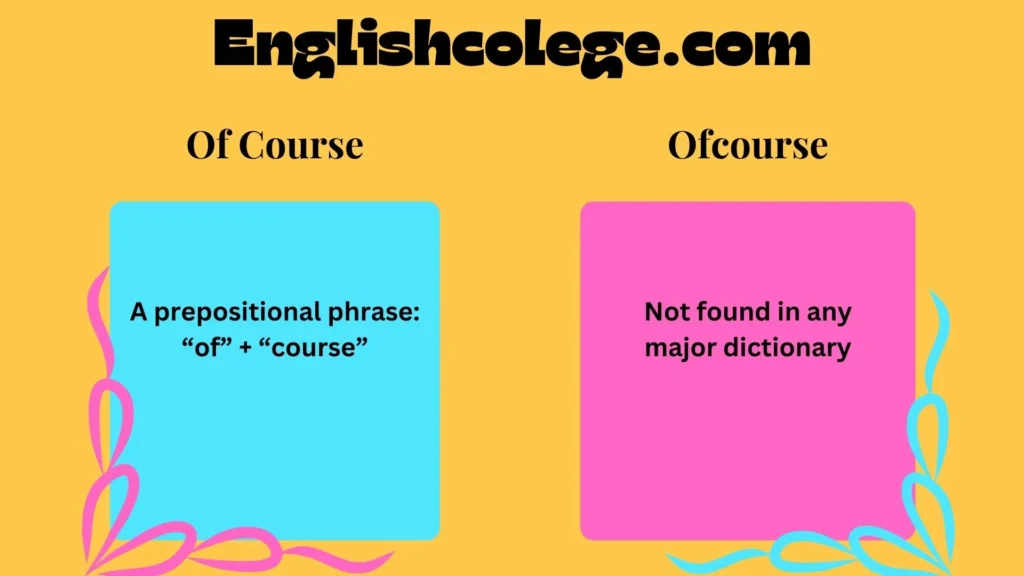
| Of course | ✅ Correct | A prepositional phrase: “of” + “course” |
| Ofcourse | ❌ Incorrect | Not found in any major dictionary |
Rule: Always write it as two words. There’s no situation — formal or informal — where “ofcourse” is acceptable in standard English.
Quick Tip: If a grammar checker or spellchecker highlights “ofcourse,” it’s right — change it to “of course.”
Breaking It Down: Why It’s Two Words
The phrase “of course” is built from two separate, functional words:
- Of – a preposition meaning belonging to or concerning.
- Course – originally from the Latin cursus, meaning a running, path, or direction.
Together, “of course” literally meant “as part of the natural course of things.”
Over centuries, it evolved into an idiomatic phrase meaning naturally, certainly, or obviously.
Example of literal origin:
“The river follows its course.”
Modern idiomatic form:
“Of course, rivers flow downhill.”
Both share the same root — course as a direction or flow — but modern usage conveys certainty instead of movement.
Meaning and Nuances of “Of Course”
“Of course” expresses agreement, obviousness, or reassurance. Yet its tone changes depending on context and voice inflection.
💬 Common Meanings
| Meaning | Example | Tone |
|---|---|---|
| Agreement or consent | “Of course, I’ll help you.” | Warm, supportive |
| Obvious fact | “Of course water boils at 100°C.” | Neutral, factual |
| Polite reassurance | “Of course you’re welcome anytime.” | Kind, inviting |
| Sarcasm or irony | “Of course you remembered the deadline…” | Humorous or annoyed |
🔍 Tone Depends on Delivery
Say “of course” gently, and it sounds friendly. Stress it sharply, and it turns sarcastic.
Tone matters more than the words themselves.
How to Use “Of Course” in Sentences
Here are several sentence patterns showing how “of course” fits naturally:
At the Start of a Sentence
“Of course, you can borrow my notes.”
This placement adds emphasis and sets the tone early.
In the Middle of a Sentence
“You can, of course, contact us anytime.”
Here, it interrupts for nuance — softening or clarifying a statement.
At the End of a Sentence
“You’re coming to the meeting, of course.”
Used this way, it adds reassurance or light humor.
Grammar Tip
Commas are optional but help guide tone and rhythm. In formal writing, use commas when it appears mid-sentence.
Why People Misspell It as “Ofcourse”
Misspellings like “ofcourse” aren’t random — they follow patterns of human typing behavior and perception.
1. Digital Communication Habits
People often type quickly and skip spaces in texts or emails. Auto-correct rarely catches “ofcourse” since it’s not always recognized as an error.
2. Influence of Compound Words
English merges some prepositional phrases over time — “maybe,” “already,” “because.” That leads writers to assume “ofcourse” must have evolved too.
3. Visual Familiarity
Since “ofcourse” looks like a valid word, it bypasses many readers’ internal grammar alarms. The eye accepts it; the brain doesn’t question it.
4. Data Insight
Studies of online text frequency show “ofcourse” appearing mostly in informal chats and social media. However, it almost never appears in edited publications or academic work.
Grammar and Style Guide Recommendations
Every respected grammar authority agrees: “Of course” is correct.
| Source | Accepted Form | Comment |
|---|---|---|
| Oxford English Dictionary | “Of course” | Recognized phrase with idiomatic meaning |
| Merriam-Webster | “Of course” | Common adverbial phrase |
| Cambridge Dictionary | “Of course” | Used to show something is obvious |
| AP Stylebook | “Of course” | Always two words |
| Chicago Manual of Style | “Of course” | Preferred in both formal and informal prose |
No reputable English guide lists “ofcourse” as correct or even colloquial.
Quote:
“When in doubt, follow the dictionaries. They record usage, not opinions — and none record ‘ofcourse.’”
— Linguist Henry Watson, 2018
Politeness and Pragmatics: The Social Role of “Of Course”
Politeness in English often depends on tone and phrasing. “Of course” is a perfect example — it can sound kind, confident, or even dismissive depending on delivery.
When It’s Polite
“Of course, I’ll send the report right away.”
This signals willingness and cooperation.
When It Sounds Dismissive
“Of course you should know that.”
Now the phrase feels condescending.
Best Practice
If you want to sound professional:
- Use a friendly tone and smile when speaking.
- Pair with positive body language.
- In writing, follow it with helpful or encouraging words.
Similar Phrases That Cause Confusion
You can often replace “of course” with another phrase, depending on tone or formality. Here’s how they compare:
| Phrase | Meaning | Tone | Example |
|---|---|---|---|
| Certainly | Confident affirmation | Formal | “Certainly, I’ll attend.” |
| Naturally | Something expected | Neutral | “Naturally, he was thrilled.” |
| Obviously | Something self-evident | Casual or blunt | “Obviously, it’s raining.” |
| Sure thing | Informal agreement | Friendly | “Sure thing! I’ll do it.” |
| Definitely | Strong confirmation | Neutral to casual | “Definitely, count me in.” |
Knowing these helps you vary your vocabulary without overusing “of course.”
“Of Course” in Literature and Popular Culture
This phrase appears everywhere — from novels to films — because it captures agreement and human emotion perfectly.
In Literature
“Of course,” said Alice, “what is life without adventure?”
— Lewis Carroll, Alice’s Adventures in Wonderland (paraphrased)
Writers use it to show warmth, sarcasm, or calm assurance.
In Movies
- Star Wars: “Of course I know him. He’s me.”
- Harry Potter: “Of course it’s happening inside your head, but why should that mean it isn’t real?” — Dumbledore
In Everyday Speech
“Of course” bridges thought and feeling. It reassures, confirms, and connects. That’s why it’s survived unchanged for centuries.
Tricks to Remember the Correct Form
If you struggle to remember that it’s two words, these quick memory tools will help:
- 🧠 Visual Trick: Imagine “of” handing something to “course.” They’re partners, not fused.
- ✍️ Analogy: You’d never write “ofmilk” or “ofgold.” Same logic applies — always separate.
- 🔡 Rhythm Test: Say it aloud. If it has a natural pause — “of (pause) course” — it’s two words.
- 📘 Mnemonic: Of course, it’s two words — of course it is!
For ESL learners:
Practice inserting “of course” into polite responses:
“Of course, I understand.”
“Of course, that makes sense.”
This builds fluency and reinforces the correct form naturally.
Common Variations and Regional Usage
While “of course” is universal, its tone and punctuation style vary slightly across English-speaking regions.
| Region | Style | Example | Note |
|---|---|---|---|
| American English | With commas or without, depending on rhythm | “Of course, I’ll be there.” | Commas optional |
| British English | Usually with commas | “Of course, I agree.” | Slightly more formal |
| Australian English | Often used sarcastically in speech | “Of course you did, mate.” | Context decides tone |
Regardless of location, the spelling never changes. “Ofcourse” remains incorrect worldwide.
Quick Recap: Key Takeaways
- ✅ Correct: “Of course”
- ❌ Incorrect: “Ofcourse”
- It’s a prepositional phrase, not a compound word.
- Used to express agreement, obviousness, or reassurance.
- Tone and punctuation affect meaning.
- Found in every major dictionary as two words.
- Common mistake driven by digital typing habits.
Related Grammar Guides You Might Like
If you enjoyed this topic, here are more grammar comparisons to explore:
- Than vs. Then – Stop Mixing Them Up
- Time Has Flown By or Time Has Flew By? Explained
- Certain vs. Specific – What’s the Difference?
- Maximal vs. Maximum – Key Differences and Examples
- Leeway Meaning & Real-Life Usage Examples
Each tackles common English confusions with practical examples.
🧠 FAQs About “Of Course” vs. “Ofcourse”
Is “Ofcourse” Ever Correct in Informal Writing?
No. Even in informal writing, “ofcourse” isn’t standard. It may appear in social media posts, but professional editors and grammar tools will flag it as an error.
Why Isn’t “Ofcourse” a Real Word Like “Because”?
“Because” evolved from by cause into a compound over centuries. “Of course” didn’t follow that path — its components stayed semantically distinct, so it never merged.
Do You Always Need a Comma After “Of Course”?
No. Use commas for clarity or natural pauses, not as a rule.
Example: “Of course I’ll help” (no comma) is fine.
“Of course, I’ll help” adds a softer, more formal pause.
Can “Of Course” Sound Rude?
Sometimes. In certain tones, it can sound condescending or sarcastic. To avoid this, use positive body language or pair it with friendly phrasing like “Of course, happy to!”
How Do I Remember It’s Two Words?
Try this rhyme:
“Of course it’s two — that’s what’s true!”
Short, simple, and unforgettable.
🏁 Conclusion
Language evolves, but correctness still matters. “Of course” remains two words because each plays a grammatical role — of introduces, course defines.
Next time you type it, remember: spacing shows understanding. Write “of course”, not “ofcourse,” and your writing will always sound natural, intelligent, and polished.
In short:
Of course, you now know better — of course you do.

I’m Sameer — a passionate English enthusiast who loves exploring words, grammar, and the art of effective communication. ✍️