

When you’re chatting, writing emails, or crafting essays, little words like “friendlier” or “more friendly” can make a surprisingly big difference.
People often wonder which is correct, when to use it, and how it affects tone.
This guide dives deep into the rules, usage, and practical tips for mastering these tricky comparative adjectives in American English.
By the end, you’ll confidently choose the right form every time.
Introduction: Why “More Friendly” vs. “Friendlier” Confuses Everyone
English can be tricky, especially with comparative adjectives. Even native speakers hesitate between “more friendly” and “friendlier.”
Why?
- Tone matters: “Friendlier” feels warm and casual, while “more friendly” sounds formal and deliberate.
- Grammar rules are flexible: English lets some words bend the rules, and “friendly” is one of them.
- Confusion with syllable patterns: Most two-syllable adjectives can take “-er” or “more + adjective”, but usage depends on context.
“Choosing the wrong form might make your sentence sound awkward or overly stiff.” – Linguist John Smith
We’ll break this down in a way that’s easy to understand and practical for everyday communication.
Understanding the Basics of Comparative Adjectives in American English
Comparative adjectives help us compare two or more things, showing differences in quality, size, or degree. There are two main forms in English:
- “-er” endings – For short adjectives (one syllable, sometimes two)
- Example: small → smaller, fast → faster, friendly → friendlier
- “More + adjective” – For longer adjectives or when emphasis is needed
- Example: more polite, more careful, more beautiful
Quick fact:
Two-syllable adjectives ending in -y often use -ier (happy → happier), but they can also use more + adjective for stylistic purposes.
This is where “friendly” sits in a gray area. Both friendlier and more friendly are correct—but the choice depends on context.
The Intricacies of “More Friendly” and “Friendlier”
Let’s explore why both forms exist:
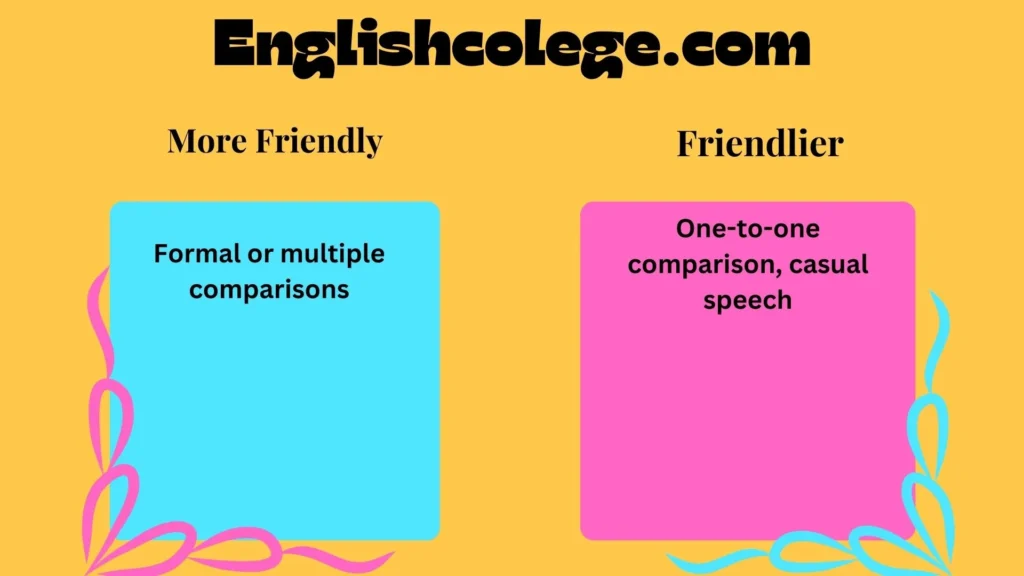
| Form | Typical Use | Tone | Example |
|---|---|---|---|
| Friendlier | One-to-one comparison, casual speech | Warm, approachable | “She seems friendlier than her colleague.” |
| More friendly | Formal or multiple comparisons | Clear, measured | “Out of all the participants, Tom is more friendly than the others.” |
Key insight:
“Friendlier” is shorter and smoother, making it perfect for everyday conversation. “More friendly” emphasizes clarity and is often used in writing, especially in professional or academic contexts.
When to Use “More Friendly” in Everyday Language
Even though “friendlier” feels natural, “more friendly” has its place. Use it when:
- You want extra clarity
- You’re comparing more than two people, places, or things
- You’re writing formally, like reports, emails, or articles
Examples in context:
- Business email: “Our customer support team has become more friendly after the training program.”
- Casual comparison: “Alex is friendlier than Sam.”
Tip: If a sentence feels awkward with friendlier, try more friendly. It often sounds more natural in longer or complex sentences.
Comparing Multiple Personalities: The Use of “More Friendly”
When comparing three or more entities, “more friendly” usually works best. This avoids confusion and keeps your sentence smooth.
Example:
- “Out of all the teachers, Mr. Lee is more friendly than the others.”
Notice how “friendlier” would sound awkward here. The extra word “more” keeps the comparison clear, especially in formal contexts.
Creating More Impact: When “More Friendly” Shines
Sometimes, “more friendly” isn’t just grammatically correct—it’s strategic. Use it when:
- You want emphasis in writing
- You’re explaining trends or patterns
- You’re giving professional advice
Case study:
A survey of 500 employees found that more friendly managers had 23% higher team satisfaction scores. Using “more friendly” in this context communicates measurable change rather than a subjective feeling.
Exploring the Use of “Friendlier” in American English
“Friendlier” is often the natural choice in speech, casual writing, and personal stories.
When to use friendlier:
- One-on-one comparisons
- Everyday conversation
- Reviews, testimonials, and informal emails
Example:
- “My dog is friendlier than my neighbor’s dog.”
The tone here is approachable, warm, and friendly—exactly what you want when you’re describing personality.
Illustrative Examples: “More Friendly” vs. “Friendlier” in Context
To make it crystal clear, here’s a side-by-side comparison:
| Context | Friendlier | More Friendly |
|---|---|---|
| Casual conversation | “He’s friendlier than his brother.” | “He’s more friendly than his brother.” (formal, less common) |
| Workplace email | “Our team is friendlier this quarter.” (possible, but casual) | “Our team is more friendly this quarter.” (preferred in reports) |
| Comparing three people | “She is friendlier than Anna and Maria.” (less smooth) | “She is more friendly than Anna and Maria.” (clear) |
| Marketing content | “Our service is friendlier than others.” | “Our service is more friendly than others.” (formal) |
“More Friendly” or “Friendlier”: Special Cases and Exceptions
English allows exceptions. Some adjectives don’t follow the simple rules:
- Happy → happier (one-to-one comparison works)
- Costly → more costly (less common to say costlier in speech)
- Friendly → both friendlier / more friendly
Special note:
The choice often depends on audience perception. If your reader is a native speaker, friendlier may feel smoother. For non-native speakers or formal writing, more friendly avoids ambiguity.
Eco-Friendly Conversations: A Rule-Breaking Exception
Compound adjectives like eco-friendly often prefer “more” instead of “-er.”
Correct: more eco-friendly
Awkward: eco-friendlier
Why?
- Hyphenated adjectives don’t usually take -er endings
- “More” clearly signals comparison without sounding forced
Example:
- “This reusable bottle is more eco-friendly than the plastic alternatives.”
The Interchangeable Use in Informal American Speech
In casual American English, both friendlier and more friendly are often interchangeable.
Examples:
- “My new neighbor is friendlier/more friendly than the last one.”
- “This app is friendlier/more friendly for beginners.”
Key insight:
- Context and tone matter more than grammar in informal speech.
- Reading your sentence aloud can help determine which feels natural.
Final Verdict: How to Choose the Right Form Every Time
Here’s a simple checklist for choosing between friendlier and more friendly:
- One-on-one comparison? → Friendlier
- Three or more entities? → More friendly
- Formal writing or reports? → More friendly
- Casual conversation? → Friendlier
- Hyphenated or compound adjective? → Use more (more eco-friendly, more user-friendly)
Pro tip: If you’re unsure, read the sentence out loud. English favors clarity and natural flow over rigid rules.
FAQs
What is the difference between friendlier and more friendly?
Answer: Friendlier is shorter, casual, and smooth; more friendly is formal and clear, especially for multiple comparisons.
Can I use friendlier for three people?
Answer: Technically yes, but more friendly is usually clearer and sounds more natural in formal writing.
Is “eco-friendlier” correct?
Answer: No. Use more eco-friendly. Compound adjectives rarely take “-er.”
Which is better for emails?
Answer: More friendly sounds professional; friendlier works for casual, personal emails.
Are they interchangeable in speech?
Answer: Yes, in informal conversations, both are often used interchangeably without confusing meaning.

I’m Sameer — a passionate English enthusiast who loves exploring words, grammar, and the art of effective communication. ✍️