
English has a lot of small phrases that can confuse even native speakers. Among them, “Me Too,” “Me as Well,” and “I as Well” often trip up learners and sometimes even casual speakers.
They might seem similar, but using them correctly can make your speech sound natural and polished.
In this post, we’ll break down each phrase, explore their correct usage, highlight common mistakes, and show practical examples to help you sound confident and fluent in English.
Imagine your friend says: “I love chocolate.” If you also love chocolate, what do you say? Most people respond with “Me Too,” but you might also hear “Me as Well” or mistakenly, “I as Well.”
These small phrases are more than just filler words—they show agreement, connection, and shared experience. Using the wrong phrase can make you sound awkward or grammatically incorrect.
By learning the difference between “Me Too,” “Me as Well,” and “I as Well,” you’ll improve your conversation skills, writing, and overall confidence in English.
Understanding “Me Too”
Definition and Standalone Nature
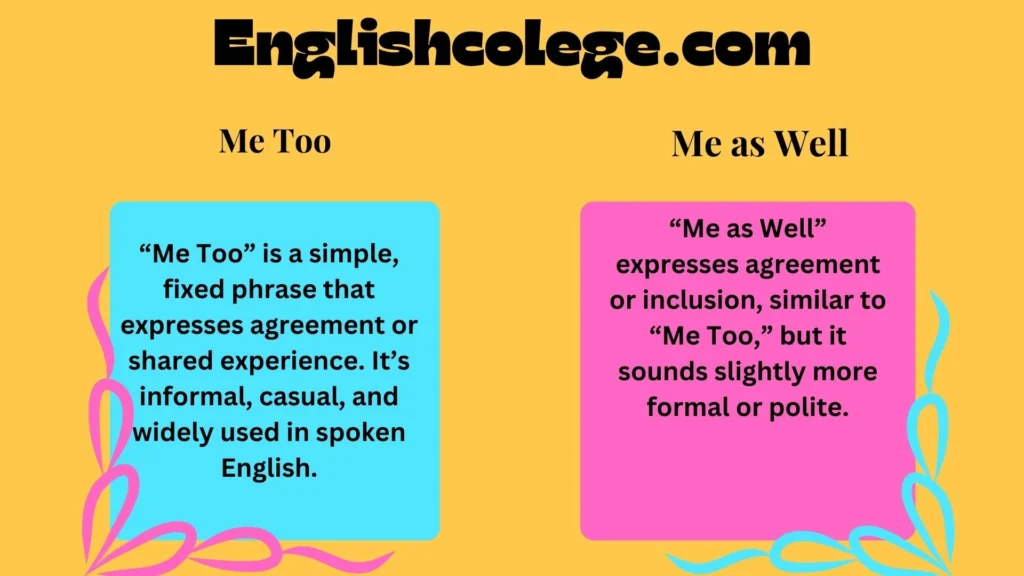
“Me Too” is a simple, fixed phrase that expresses agreement or shared experience. It’s informal, casual, and widely used in spoken English.
- It is standalone, meaning you can say it alone without repeating the original sentence.
- It uses the object pronoun “me” rather than “I,” which is why “I too” is less common in everyday speech.
Key point: “Me Too” is always correct in casual conversations and rarely sounds wrong.
Examples in Everyday Conversation
Here are some examples to see it in action:
- Friend: “I love pizza.”
You: “Me too!” - Colleague: “I can’t wait for the weekend.”
You: “Me too.” - Social media post: “I finally finished my project.”
Comment: “Me too! That took forever.”
Notice how “Me Too” is flexible—it can be used in speech, text messages, or even informal emails.
Context and Appropriateness
- Informal situations: Perfect with friends, classmates, or social media.
- Professional settings: Less common; “I also” or “I do too” are more formal alternatives.
- Quick tip: If the sentence stands alone, “Me Too” is your best choice.
When to Use “Me as Well”
Definition and Usage
“Me as Well” expresses agreement or inclusion, similar to “Me Too,” but it sounds slightly more formal or polite.
- Often used in polite conversation or writing.
- Works in both spoken and written English.
Example:
- “I’ll attend the meeting tomorrow.” → “Me as well.”
- “She enjoys classical music.” → “Me as well.”
Notes on Style and Tone
- Slightly more professional than “Me Too.”
- Can be used in emails, polite conversations, or presentations.
- Does not feel out of place in neutral or semi-formal contexts.
Quick tip: If you want to sound professional but friendly, “Me as Well” is the safe choice.
Avoiding “I as Well”
Why It’s Grammatically Incorrect
Many English learners make the mistake of saying “I as Well”.
- The phrase is incorrect because “I” is a subject pronoun, but this expression requires an object pronoun (“me”).
- “I as Well” mixes grammatical roles and sounds unnatural.
Think of it this way:
| Pronoun Type | Correct Phrase | Incorrect Phrase |
|---|---|---|
| Subject | I also love pizza | I as well love pizza ❌ |
| Object | Me too / Me as well | I as well ❌ |
Correct Alternatives
- Me too → for casual, standalone agreements.
- I also / I as well → for formal or complete sentences.
Examples:
- ❌ Incorrect: “I as well love pizza.”
- ✅ Correct (informal): “Me too!”
- ✅ Correct (formal): “I love pizza as well.”
- ✅ Correct (formal): “I also love pizza.”
Common Mistakes and Why They Happen
- Learners overgeneralize “I” because they think all statements need a subject pronoun.
- Quick trick: If it stands alone, always use “Me Too” or “Me as Well.”
- If it’s part of a full sentence with a verb, “I also” or “I as well” works.
Comparing “Me Too” vs. “Me as Well” vs. “I as Well”
Usage Chart
| Expression | Pronoun | Formality | Correct Example | Notes |
|---|---|---|---|---|
| Me Too | Object | Informal | “I love coffee.” → “Me too.” | Casual, friendly speech |
| Me as Well | Object | Neutral | “I’ll attend the event.” → “Me as well.” | Polite conversation or writing |
| I as Well | Subject | Incorrect | ❌ | Don’t use alone; grammatically wrong |
Popularity and Trends
- “Me Too” dominates casual conversations and social media.
- “Me as Well” is less common but safe for polite conversation or semi-formal writing.
- “I as Well” is a frequent ESL mistake. Avoid using it standalone.
Practical Tips for Choosing the Right Expression
- Ask yourself: Is this casual, friendly, or formal?
- Casual → “Me Too”
- Neutral / polite → “Me as Well”
- Formal writing with a complete sentence → “I also” or “I as well” after the verb
Memory trick:
- If it stands alone → use “Me”
- If it comes after a verb → use “I”
Example scenarios:
- Text message:
Friend: “I just bought a new phone.”
You: “Me too!” ✅ - Email / Letter:
“I will submit my report tomorrow.”
“I will submit mine as well.” ✅ - Casual conversation with strangers:
“I enjoy hiking.”
“Me as well.” ✅ (polite and safe)
Related English Confusions (Quick Reference)
Sometimes, learners confuse other small words too. Here’s a quick cheat sheet:
| Confused Pairs | Difference |
|---|---|
| Negligence vs. Neglect | Negligence = failure to act; Neglect = ignoring something |
| Wright vs. Write | Wright = surname; Write = verb |
| Organisation vs. Organization | UK vs US spelling |
| At vs. In | Prepositions of location/time |
| Ibid vs. Idem | Academic citations |
| Calendar vs. Colander | Homophones / pronunciation confusion |
These small differences are easy to fix once you recognize patterns and practice consistently.
FAQs
What’s the difference between “Me Too” and “Me as Well”?
Answer: “Me Too” is informal and casual; “Me as Well” is slightly more formal and polite but both show agreement.
Can I use “I as Well” in conversation?
Answer: No, it’s grammatically incorrect alone. Use “Me too” or “Me as Well” instead.
When should I use “I also”?
Answer: Use “I also” in full sentences or formal writing after the subject and before the verb.
Is “Me as Well” acceptable in writing?
Answer: Yes, it’s polite and neutral, suitable for emails or professional communication.
Why do learners say “I as Well”?
Answer: They confuse subject and object pronouns. Remember, standalone expressions need object pronouns (Me).
Conclusion
Mastering “Me Too,” “Me as Well,” and “I as Well” may seem small, but it makes a big difference in English fluency.
- Me Too → casual, friendly, social media.
- Me as Well → polite, semi-formal, professional contexts.
- I as Well → incorrect if used alone; restructure as “I also” or place “as well” after the verb.
Start practicing these phrases in your daily conversations. Soon, using the correct one will feel natural, and your English will sound polished, confident, and professional.

I’m Sameer — a passionate English enthusiast who loves exploring words, grammar, and the art of effective communication. ✍️