
Choosing between “Me and My Family” and “My Family and I” seems simple—until you actually have to say it out loud.
Suddenly, you hesitate. Which one’s right? Which one sounds more polite? And why do people get it wrong so often?
In this article, you’ll learn exactly when to use “My Family and I” and when to use “My Family and Me.”
We’ll explore grammar rules, practical examples, and subtle differences in tone and context. By the end, you’ll have crystal-clear confidence using both forms naturally and correctly.
Understanding the Grammar Behind It: Subject vs. Object Pronouns
At the heart of this confusion lies a simple rule of grammar—the difference between subject and object pronouns.
| Type | Function | Examples |
|---|---|---|
| Subject Pronouns | Perform the action in a sentence | I, he, she, we, they |
| Object Pronouns | Receive the action in a sentence | me, him, her, us, them |
So, “I” is a subject pronoun—it does something.
“Me” is an object pronoun—it receives something.
Let’s look at this rule in action:
- ✅ I went to the park. (I = subject)
- ✅ The teacher called me. (me = object)
Now, add “my family” to both examples:
- ✅ My family and I went to the park.
- ✅ The teacher called my family and me.
See the pattern? The rule doesn’t change, even when you add “my family.”
Grammar Tip: If you’re unsure, remove “my family.” Whatever pronoun still sounds correct—that’s the one you should use.
Why “My Family and I” Feels Polite (and Often Sounds Correct)
English has a long tradition of self-referential politeness—placing others before yourself. That’s why “my family and I” feels more proper.
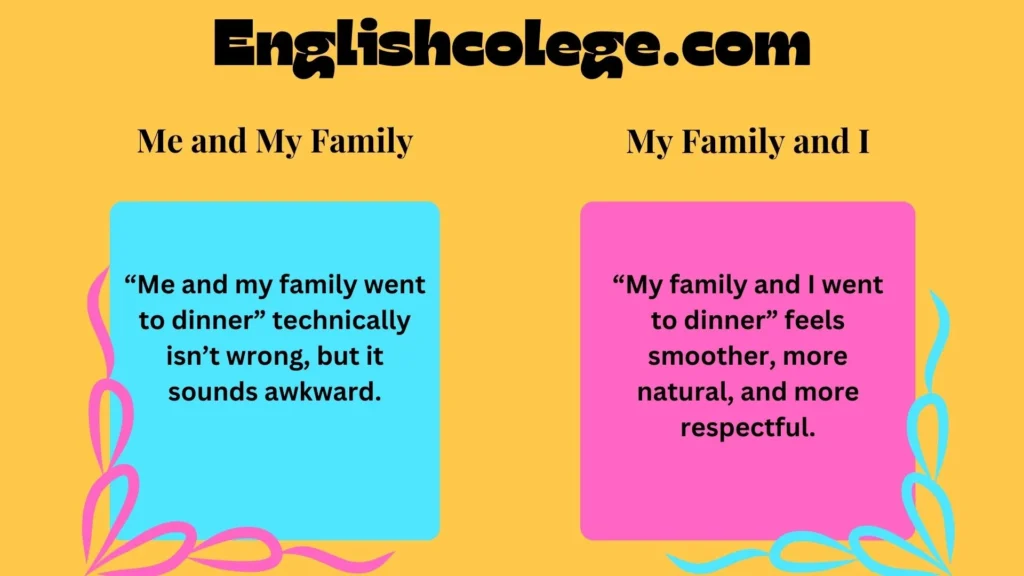
- “I and my family went to dinner” technically isn’t wrong, but it sounds awkward.
- “My family and I went to dinner” feels smoother, more natural, and more respectful.
This convention developed from social etiquette rather than grammar. It’s considered polite because it reflects modesty—putting others before you in speech, just like in behavior.
But here’s the key: order doesn’t affect grammatical correctness.
The real rule comes down to whether the pronoun is the subject or the object.
When “My Family and I” Is Correct
Use “My Family and I” when the phrase is the subject—the one performing the action.
Examples:
- ✅ My family and I are planning a vacation.
- ✅ My family and I love cooking together on weekends.
- ✅ My family and I moved to a new city last year.
In each example, “my family and I” are doing something. They’re the doers—the subject of the sentence.
Quick Grammar Formula:
Subject = “My Family and I”
Verb = What you’re doing
Object = What the action affects
Here’s a visual breakdown:
| Sentence Part | Example | Function |
|---|---|---|
| Subject | My family and I | Doer |
| Verb | went | Action |
| Object | to the park | Receiver |
When “My Family and Me” Is Correct
Use “My Family and Me” when the phrase is the object—the one receiving the action.
Examples:
- ✅ The teacher praised my family and me for our project.
- ✅ The gift was sent to my family and me.
- ✅ He took a photo of my family and me.
Here, “my family and me” aren’t doing anything—they’re receiving the action.
Simple Test: Remove “my family.”
If “me” fits, you’ve got it right.
✅ “The teacher praised me.”
❌ “The teacher praised I.”
Quick Grammar Hacks You’ll Actually Remember
Here are a few grammar hacks that make choosing easy every time:
- Drop Test:
Remove “my family.” Say the sentence with only “I” or “me.”- “She called ___.” (me)
- “___ called her.” (I)
- Role Rule:
- Doing the action → “My family and I.”
- Receiving the action → “My family and me.”
- Politeness Order:
Always put yourself last:- “My friends and I,” not “I and my friends.”
- “The teacher spoke to my friends and me,” not “me and my friends.”
Common Mistakes and Misconceptions
Even native speakers mix these up, often out of habit or overcorrection.
Overcorrection: The “Fancy” Mistake
Some people think “I” sounds more proper, so they use it everywhere:
- ❌ “He gave the tickets to my family and I.”
(Wrong! “I” is the subject form.) - ✅ “He gave the tickets to my family and me.”
The “Between You and I” Trap
This one’s so common that even presidents and celebrities say it:
- ❌ “Between you and I”
- ✅ “Between you and me” (because “me” follows a preposition)
Regional and Informal Speech
In casual conversation, people often bend rules.
You might hear:
“Me and my family went out for dinner.”
It’s grammatically incorrect, but very common in speech. While fine among friends, avoid it in formal writing or professional settings.
Context Matters: Spoken vs. Written English
Grammar rules don’t always reflect how people speak.
- In spoken English, rhythm and habit sometimes override rules.
- “Me and my family went shopping” rolls off the tongue easily.
- In written English, grammar precision matters more.
- “My family and I went shopping” looks polished and correct.
So, context dictates your choice. You might relax the rule when talking casually but stick to proper form when writing essays, emails, or professional content.
Think of it like dress code:
Speech = casual wear
Writing = formal outfit
How Grammar Education Shapes Perception
Many people were taught in school that “I” is more polite, which made “me” seem wrong.
But that’s only half the story.
Grammatical education often focuses on appearances over rules.
Teachers emphasize “Say ‘John and I’” because students tend to say “Me and John.”
Over time, people began applying “I” everywhere—even when it’s wrong.
Quote to Remember:
“Grammar is not about sounding fancy; it’s about sounding right.”
Understanding why something works helps you speak and write naturally—without second-guessing.
Practice Section: Test Yourself
Try these sentences. Fill in the blanks with “My Family and I” or “My Family and Me.”
| Sentence | Your Choice |
|---|---|
| _______ are going to the zoo this weekend. | ✅ My family and I |
| The invitation was sent to _______. | ✅ My family and me |
| _______ love spending time together on holidays. | ✅ My family and I |
| The neighbors invited _______ to their party. | ✅ My family and me |
| _______ have been planning this trip for months. | ✅ My family and I |
The more you practice, the easier it gets.
Case Study: Real-Life Usage
Let’s look at two real scenarios that illustrate how people naturally use these phrases.
Case 1: Formal Email
“My family and I appreciate your kind invitation.”
→ Correct because the family is performing the action of appreciation.
Case 2: Social Media Caption
“The photographer captured my family and me beautifully.”
→ Correct because they are receiving the action (being captured).
The difference is subtle but powerful. One letter—“I” vs. “me”—completely changes grammatical accuracy.
Cultural and Linguistic Notes
Different cultures and languages handle pronoun order differently.
For example:
- In Spanish or French, pronoun order may not follow the same politeness rule.
- English emphasizes humility and balance—hence “My family and I.”
Understanding this nuance helps non-native speakers see English not just as rules, but as a reflection of culture and values.
Quick Reference Table
| Function | Correct Form | Example | Common Mistake |
|---|---|---|---|
| Subject | My family and I | My family and I went to church. | Me and my family went to church. |
| Object | My family and me | The teacher praised my family and me. | The teacher praised my family and I. |
| After Prepositions | My family and me | It’s between my family and me. | Between my family and I. |
Common Myths Debunked
Myth 1: “I” always sounds more formal, so it must always be right.
→ ❌ Wrong. Grammar depends on function, not formality.
Myth 2: “Me” sounds uneducated.
→ ❌ Also wrong. It’s 100% correct when used as an object.
Myth 3: Grammar rules are outdated.
→ ❌ Incorrect. Rules evolve, but clarity and structure remain essential.
FAQs
Is “Me and My Family” ever correct?
Grammatically, no—not in formal writing. However, it’s common in casual speech. The correct form depends on whether you’re the subject or object.
Can I start a sentence with “Me and My Family”?
It’s not grammatically correct in standard English. Use “My family and I” instead.
Why does “My Family and I” sound more polite?
Because English speakers often put others first as a sign of courtesy, even though it doesn’t change the grammar.
How do I check if I’ve used it right?
Drop “my family.” If “I” fits, use “My family and I.” If “me” fits, use “My family and me.”
Do native speakers break this rule?
Yes, frequently in informal speech. But in writing or formal situations, stick to the correct grammatical form.
Conclusion
You’ll never hesitate again once you understand this rule:
Use “My family and I” when you’re doing something.
Use “My family and me” when something is done to you.
Politeness, context, and habit can blur the lines, but grammar brings clarity. Whether you’re writing a professional email or chatting casually, knowing why a phrase is right gives you confidence—and that’s the hallmark of good communication.

I’m Sameer — a passionate English enthusiast who loves exploring words, grammar, and the art of effective communication. ✍️