

When you write your academic bio, résumé, or LinkedIn headline, a small apostrophe can change everything.
Many people write “Masters student” instead of “Master’s student” — and while it looks harmless, it’s actually grammatically incorrect.
This guide breaks down the correct form, explains why the apostrophe matters, and shows how to use each term properly in academic and professional contexts.
Why This Grammar Question Matters
Language defines professionalism. In academia, even small grammar details reflect credibility. A misplaced apostrophe in “Master’s” can make a résumé look careless or unpolished.
You’ve probably seen all three versions online:
- “Masters Student”
- “Master’s Student”
- “MS Student”
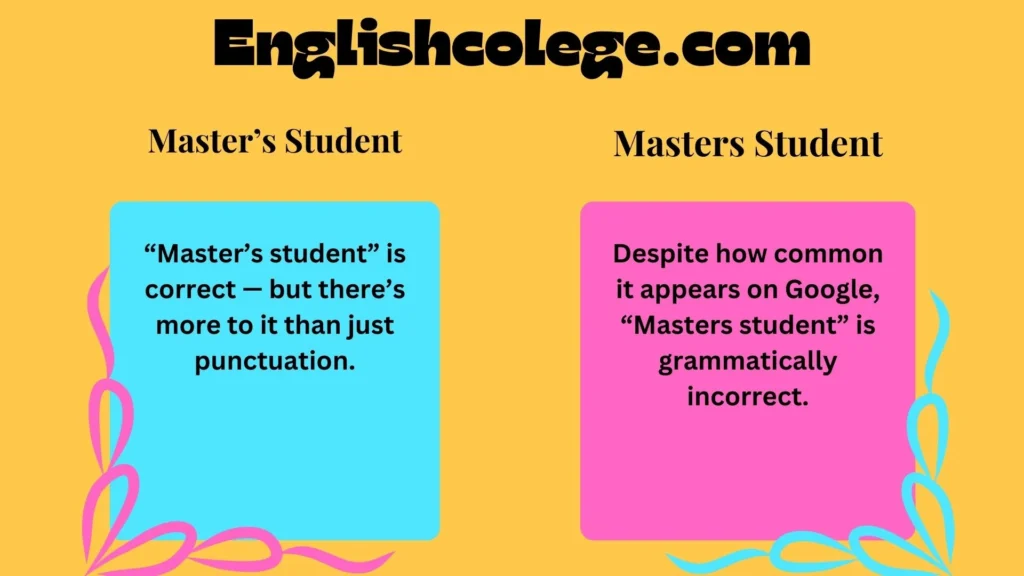
So, which one is right? The short answer: “Master’s student” is correct — but there’s more to it than just punctuation.
The Grammar Behind “Master’s Degree”: Understanding the Apostrophe
Let’s start with the foundation — the apostrophe in “Master’s.”
What the Apostrophe Means
The apostrophe shows possession, not plurality.
When you say “Master’s degree”, you’re literally saying “degree of a master.”
- ✅ Correct: Master’s degree → the degree of a master.
- ❌ Incorrect: Masters degree → means multiple masters own the degree.
That’s why style guides and universities insist on the possessive form.
The Linguistic Logic
Historically, “Master’s” came from Latin magister, meaning teacher or learned person. English adopted the possessive form to indicate ownership — a degree belonging to a master.
Think of it like these parallels:
| Degree Type | Correct Form | Reason |
|---|---|---|
| Master’s degree | ✅ | Possessive of “master” |
| Bachelor’s degree | ✅ | Possessive of “bachelor” |
| Doctorate | ✅ | Noun, not possessive |
| Masters degree | ❌ | Missing possessive apostrophe |
So, “Master’s” always needs the apostrophe.
What Does “Master’s Student” Mean?
A Master’s student is someone currently enrolled in a Master’s degree program.
Examples:
- “I’m a Master’s student at Columbia University studying Environmental Policy.”
- “She’s a Master’s student researching data privacy in AI systems.”
The phrase can be used in both formal and informal settings. It’s clear, professional, and widely accepted in American English.
When to Use “Master’s Student”
Use “Master’s student” when:
- Describing your academic level in bios, introductions, or LinkedIn profiles.
- Referring to current enrollment rather than completion.
- Writing in a professional or academic tone.
Example:
“As a Master’s student in Public Health, I focus on community wellness and epidemiology.”
“MS Student” Explained: Meaning, Context, and Usage
Now, what about “MS student”?
MS stands for Master of Science, one specific type of Master’s degree.
When to Use “MS Student”
Use “MS student” when you need clarity about the program type, especially in science, technology, or engineering fields.
- ✅ “I’m an MS student in Computer Science.”
- ✅ “She’s an MS student at Stanford working on a robotics project.”
Comparison Table
| Term | Meaning | Context | Formality |
|---|---|---|---|
| Master’s student | Any student pursuing a Master’s degree | General | Medium to High |
| MS student | Student pursuing a Master of Science | STEM-specific | Medium |
| Masters student | Incorrect form | — | — |
In Formal Writing
Avoid abbreviations like “MS” unless you’ve already defined them earlier in the text. Write out the full term once:
“I am pursuing a Master of Science (MS) in Physics.”
Then, you can safely use “MS student” later in your writing.
“Masters Student” Without the Apostrophe: Why It’s Wrong
Despite how common it appears on Google, “Masters student” is grammatically incorrect.
Why It’s Wrong
“Masters” is plural, not possessive. It suggests multiple masters, not ownership. The degree belongs to one master, not several.
Incorrect:
“He’s a masters student at MIT.”
Correct:
“He’s a master’s student at MIT.”
Why It’s Common
- Many people forget the possessive rule.
- Search engines and informal posts repeat the mistake.
- Some UK sources drop the apostrophe (rarely, and inconsistently).
But in American English, “Master’s student” remains the standard across all major style guides.
Possessive Consistency: “Master’s Degree,” “Bachelor’s Degree,” and Beyond
Possessive consistency matters. The same rule applies to all degree titles.
| Degree | Correct Form | Incorrect Form | Notes |
|---|---|---|---|
| Master’s degree | ✅ | Masters degree | Always possessive |
| Bachelor’s degree | ✅ | Bachelors degree | Same rule |
| Doctoral degree | ✅ | Doctor’s degree | Not possessive; use “doctoral” |
| Associate degree | ✅ | Associate’s degree | No possessive |
Quick Grammar Tip:
Only “Master’s” and “Bachelor’s” take the apostrophe. “Doctoral” and “Associate” do not.
Capitalization and Formality: “Master of Science” vs “Master’s”
When should you capitalize it?
Rules to Remember:
- Capitalize formal titles:
- “She earned a Master of Science in Biology.”
- “He’s completing a Master of Arts in History.”
- Lowercase general references:
- “She’s pursuing a master’s degree.”
- “He’s a master’s student in linguistics.”
APA, MLA, and Chicago Guidelines
All three agree:
- Capitalize the specific degree title.
- Lowercase when referring to it generically.
Style Guide Authority: What Experts Say
Here’s what major academic style guides recommend:
| Style Guide | Preferred Form | Notes |
|---|---|---|
| APA (7th ed.) | Master’s degree | Possessive; lowercase unless formal name |
| MLA (9th ed.) | Master’s degree | Same rule applies |
| Chicago Manual of Style | Master’s degree | Always possessive |
| Oxford University Press | Master’s degree | Consistent with US usage |
Quote (APA 7th Edition):
“Use the possessive form when referring to degrees, e.g., master’s degree, bachelor’s degree.”
These authorities confirm it — “Master’s” wins every time.
“Master’s Student” vs “Master’s Candidate”
The terms “Master’s student” and “Master’s candidate” sound similar but mean slightly different things.
Difference Explained
- Master’s student: Anyone enrolled in a Master’s program.
- Master’s candidate: A student who has completed all coursework and is awaiting final approval or thesis defense.
Example:
“After passing my comprehensive exams, I became a Master’s candidate in Psychology.”
In simple terms:
- If you’re still taking classes → Master’s student.
- If you’re finishing your thesis → Master’s candidate.
Correct Abbreviations for Common Master’s Degrees
Master’s degrees come in many forms. Here are the standard abbreviations recognized in the US:
| Full Degree Title | Abbreviation | Field |
|---|---|---|
| Master of Arts | M.A. | Humanities |
| Master of Science | M.S. | STEM |
| Master of Education | M.Ed. | Education |
| Master of Fine Arts | M.F.A. | Arts |
| Master of Business Administration | M.B.A. | Business |
| Master of Engineering | M.Eng. | Engineering |
| Master of Public Health | M.P.H. | Health Sciences |
| Master of Laws | LL.M. | Law |
Formatting Tip:
Use periods (M.S., M.A.) in US English. British English often omits them (MS, MA).
Applying It All: Examples of Correct Usage
Let’s see how all these rules apply in real writing.
Formal Examples
- “I’m pursuing a Master of Science in Civil Engineering.”
- “He’s a Master’s student at UCLA working on renewable energy systems.”
- “She earned her Master’s degree in Sociology in 2024.”
Conversational Examples
- “I’m doing my master’s in design.”
- “He’s an MS student researching nanotech.”
In Academic Contexts
- “The university offers scholarships for Master’s students in Computer Science.”
- “All MS students must complete a capstone project.”
Common Grammar Mistakes and How to Avoid Them
Even advanced writers mix these up. Here’s what to watch for:
| Mistake | Why It’s Wrong | Correct Form |
|---|---|---|
| Masters student | Missing apostrophe | Master’s student |
| Master degree | Not possessive | Master’s degree |
| MSs student | Redundant plural | MS student |
| Master Degree Program | Inconsistent capitalization | Master’s Degree Program (formal title only) |
Quick Proofreading Checklist
✅ Apostrophe in “Master’s”
✅ Capitalize full degree names only
✅ Use consistent abbreviations
✅ Define “MS” or “MA” once before using
Summary Table: The Correct Forms at a Glance
| Phrase | Correct? | Explanation |
|---|---|---|
| Master’s degree | ✅ | Correct possessive form |
| Masters degree | ❌ | Missing apostrophe |
| Master’s student | ✅ | Correct and formal |
| Masters student | ❌ | Incorrect grammar |
| MS student | ✅ | Acceptable abbreviation |
| Master’s candidate | ✅ | Student nearing completion |
Final Takeaway
Using the correct term — “Master’s student” — isn’t just about grammar. It’s about showing precision and respect for language. In academic and professional writing, small errors can alter how others perceive your expertise.
Remember:
- Use Master’s student for correctness.
- Use MS student only for clarity in specific contexts.
- Never drop the apostrophe in Master’s.
As the saying goes:
“Good writing is clear thinking made visible.”
Even an apostrophe can speak volumes.
Frequently Asked Questions (FAQs)
What’s the correct spelling — Master’s student or Masters student?
The correct spelling is Master’s student. The apostrophe shows possession, meaning the degree belongs to a master.
Is “MS student” the same as “Master’s student”?
Not exactly. “MS student” refers specifically to a Master of Science student, while “Master’s student” is more general.
Do I capitalize “Master’s degree”?
Only when using the full degree title, like “Master of Arts.” Otherwise, keep it lowercase: “She earned her master’s degree.”
Is it okay to say “Master candidate”?
The correct term is “Master’s candidate” — it refers to someone who has completed coursework and is finishing their thesis or final project.
Why do people write “Masters student” without an apostrophe?
It’s a common error caused by habit or regional differences. But in American English, the possessive form “Master’s student” is always correct.

I’m Sameer — a passionate English enthusiast who loves exploring words, grammar, and the art of effective communication. ✍️