

English can be tricky. Sometimes, even seasoned writers stumble over phrases like “due to” and “do to”.
One small misstep can make your writing look sloppy, confuse readers, and reduce your credibility.
In this guide, we’ll break down everything you need to know about Due To vs Do To, their origins, correct usage, common mistakes, and tips to write with confidence.
By the end, you’ll never second-guess these phrases again.
Understanding the Common Mix-Up: Why “Due To” vs. “Do To” Confuses Writers
The confusion between “due to” and “do to” happens more often than you might think. Both sound similar, but their meanings and uses are different. Misusing them can make even professional writing seem careless.
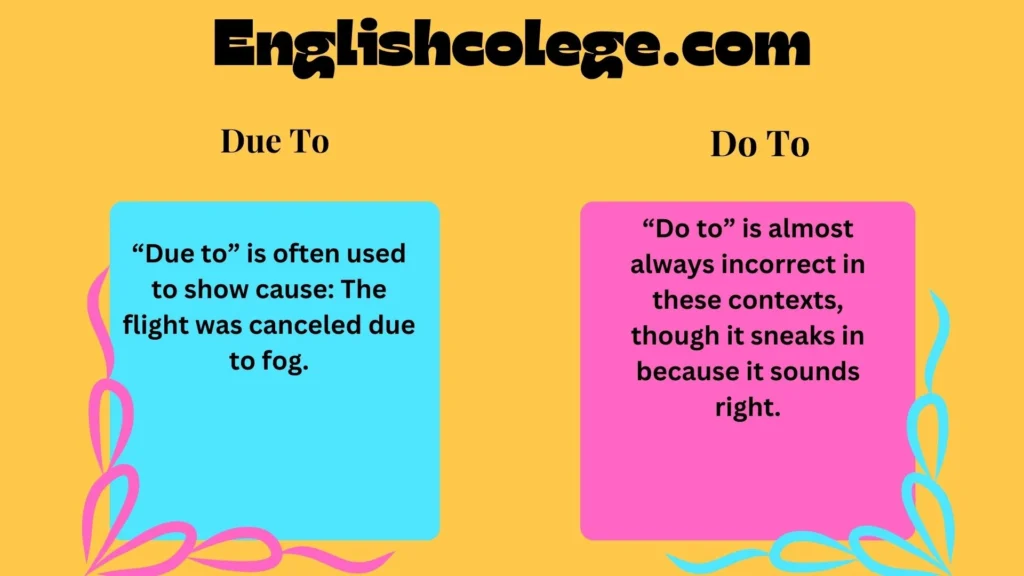
- “Due to” is often used to show cause: The flight was canceled due to fog.
- “Do to” is almost always incorrect in these contexts, though it sneaks in because it sounds right.
Fact: Even newspapers and online articles occasionally misuse “due to”, showing that grammar confusion isn’t limited to beginners.
Tip: Listening carefully and practicing examples can train your brain to spot the correct usage.
Origins and Meanings: Tracing “Due To” and “Do To”
Due To
- Derived from the older phrase “owing to”, meaning “caused by”.
- Traditional grammar rules require it to follow a linking verb like is, was, were:
- Correct: The delay was due to heavy traffic.
- Wrong: Heavy traffic caused the delay do to rain.
Do To
- Essentially a misheard or mistyped version.
- “Do to” only makes sense when “do” is a verb and “to” is part of a prepositional phrase:
- Example: What did you do to fix the problem?
- Outside this context, it’s usually incorrect.
Fun Fact: This confusion is a classic example of a homophone trap, where words sound alike but have different meanings.
Correct Usage of “Due To” in English Grammar
The simplest rule to remember:
Use “due to” when it describes the cause of a noun, not an action.
Examples of Correct Usage:
| Correct Use | Explanation |
|---|---|
| The cancellation was due to rain. | “Due to rain” modifies “cancellation” (a noun). |
| His absence was due to illness. | “Due to illness” explains the reason for the absence. |
| The score was low due to lack of preparation. | Clear cause-effect relationship. |
Incorrect Examples to Avoid:
- The game was canceled do to rain. ❌
- She missed the meeting do to traffic. ❌
Quick Rule of Thumb: If you can replace it with “caused by”, it’s correct.
Misconceptions and Mistakes: Why People Say “Do To”
Many writers use “do to” by mistake because of:
- Auditory confusion: “due to” and “do to” sound almost identical in speech.
- Autocorrect and spellcheck errors: Some programs don’t flag this mistake.
- Influence from casual writing: Social media and texting often normalize errors.
Case Study: A popular online news outlet published 12 articles in one month where “do to” was mistakenly used instead of “due to.” Readers pointed it out, showing even professionals struggle.
Tip: Proofreading aloud can help catch errors your eyes might skip.

Homonyms and Grammar Confusion
English is full of homonyms and homophones, words that sound alike but have different meanings. They contribute to mistakes like “do to” vs “due to”.
Common Examples:
| Confusing Pair | Correct Usage | Example |
|---|---|---|
| Seam / Seem | Seam: stitch line / Seem: appear | The seam ripped. / It seems obvious. |
| Wart / Wort | Wart: skin growth / Wort: herb | The doctor removed the wart. / Add the wort to the brew. |
| Sceptic / Skeptic | Both mean doubter | The sceptic questioned the theory. |
| Evidence / Evince | Evidence: proof / Evince: show clearly | The evidence was strong. / He evinced great skill. |
Understanding homophones helps reduce confusion with phrases like “due to” vs “do to.”
Alternatives to “Due to the Fact That”
“Due to the fact that” is wordy. Here are simpler, stronger alternatives:
- Because → The match was canceled because of rain.
- Since → Since it rained, the game was postponed.
- Owing to → Owing to heavy traffic, she was late.
Tip: Shorter is almost always better. Concise sentences improve readability and impact.
Simplifying Writing for Clarity
Confusion arises when writers overcomplicate phrases. Here’s how to keep your writing crisp and correct:
- Replace long phrases with clear alternatives.
- Read sentences aloud to check flow.
- Verify if “due to” is actually modifying a noun.
- Use tables or lists for complex explanations.
Example:
- Wordy: The project was delayed due to the fact that the team lacked resources.
- Clear: The project was delayed because the team lacked resources.
Tools to Assist Grammar Precision
Even skilled writers benefit from tools. Some popular grammar helpers include:
- Grammarly: Flags incorrect “do to” usage instantly.
- Hemingway App: Highlights wordy sentences and readability issues.
- Microsoft Editor: Offers suggestions for concise phrasing.
Pro Tip: Tools are great, but human proofreading ensures nuance and context are correct.
Memory Tricks & Practical Tips
To master Due To vs Do To, try these:
- Mnemonic: If you can replace it with “caused by,” use due to.
- Practice daily: Spot “do to” errors in news articles or social posts.
- Write examples: Make 5-10 sentences using due to correctly each day.
Quick Mental Check:
- Does it explain a noun? ✅ → Use due to
- Is it part of an action question? ✅ → Use do to
Bonus Section: Other Commonly Confused Words
Here’s a table of commonly confused words, similar to “due to” vs “do to”:
| Confused Pair | Correct Usage | Example |
|---|---|---|
| Seam / Seem | Seam: stitch / Seem: appear | The seam tore. / It seems fine. |
| I’m Good / I’m Well / I’m Fine | Good: ability or moral / Well: health / Fine: okay | I’m good at chess. / I’m well, thanks! / I’m fine today. |
| Sceptic / Skeptic | Both: doubter | The sceptic doubted the claim. |
| Wart / Wort | Wart: skin / Wort: herb | The wart was removed. / Add the wort to the potion. |
| Evidence / Evince | Evidence: proof / Evince: show clearly | Evidence was conclusive. / He evinced courage. |
| Much / Many | Much: uncountable / Many: countable | Much water is needed. / Many people attended. |
Note: Recognizing patterns in confusing words strengthens your grammar overall.
FAQs About “Due To vs Do To”
What is the difference between due to and do to?
Answer: Due to shows cause; do to is usually incorrect unless “do” is a verb in a sentence.
Can I use “do to” in formal writing?
Answer: Only if “do” is an action verb. Otherwise, it’s incorrect and unprofessional.
Is “due to the fact that” correct?
Answer: Grammatically yes, but it’s wordy. Prefer “because” or “since.”
How can I remember the difference?
Answer: Replace with “caused by.” If it fits, use due to.
Why do so many people confuse these phrases?
Answer: They sound alike, and homophones in English make mistakes easy to make.
Conclusion
Mastering Due To vs Do To may seem small, but it improves clarity, professionalism, and readability in your writing. Remember:
- Due to → shows cause, follows nouns
- Do to → rarely correct, only valid with an action verb
By practicing examples, using memory tricks, and leveraging tools, you’ll never confuse these again. Writing becomes smoother, simpler, and more polished.
Tip: Keep a reference table for commonly confused words—it’s a small effort for long-term improvement.

I’m Sameer — a passionate English enthusiast who loves exploring words, grammar, and the art of effective communication. ✍️