
Ever noticed how “listen to music” and “listen to the music” sound almost identical but don’t mean quite the same thing? English learners often mix them up because the difference is subtle yet important.
That tiny word “the” changes how specific your meaning is.
This guide dives deep into the grammar, context, and meaning behind both expressions.
You’ll also get practical examples, quick tips, and even a short quiz to help you master this common confusion for good.
Understanding the Basics: “Music” as an Uncountable Noun
Let’s start simple. The word “music” in English is an uncountable noun. That means you can’t count it using numbers like you can with “songs” or “albums.”
| Countable | Uncountable |
|---|---|
| a song, two songs | music |
| a musician, many musicians | sound, water, information |
Uncountable nouns represent things seen as wholes or mass concepts—you can’t split them naturally into separate, countable units.
Why This Matters
Because music is uncountable, we don’t say:
- ❌ a music
- ❌ many musics
Instead, we use:
- ✅ some music
- ✅ a piece of music
- ✅ two pieces of music
So, before we even talk about “listen to” phrases, it’s key to understand that music behaves grammatically like water or air.
Quote: “You can’t count music, but you can count moments it makes you feel alive.”
Exploring General Usage: When to Use “Listen to Music”
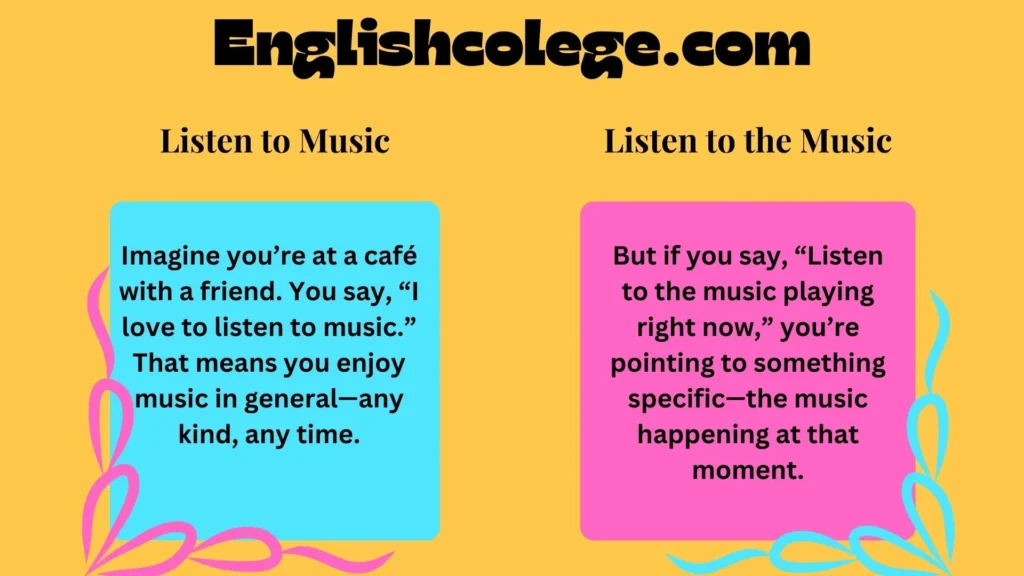
When you say “listen to music,” you’re talking about music in general, not one specific piece or performance. It refers to the habit, activity, or concept of enjoying music.
Examples:
- “I love to listen to music before bed.”
- “She listens to music while jogging.”
- “Most people listen to music on their phones these days.”
This version focuses on what you do, not which music you’re listening to.
In Context
Imagine you’re chatting with a friend:
You: “What do you like to do for fun?”
Friend: “I listen to music.”
The response doesn’t specify what kind of music—it’s a general activity.
Pro tip: Use listen to music when talking about:
- Preferences and hobbies
- General statements or routines
- When the kind or source of music isn’t specified
The Specifics: Using “Listen to the Music”
Now, let’s add “the.”
When you say “listen to the music,” you’re referring to a particular piece or set of music—something identifiable by you and your listener.
Examples:
- “Listen to the music playing in the background—it’s beautiful.”
- “Can you listen to the music he composed?”
- “Listen to the music of the ocean waves in that song.”
Here, “the” points to something specific and known in the situation.
| Phrase | Meaning | Example |
|---|---|---|
| listen to music | general activity | “I listen to music every night.” |
| listen to the music | specific music | “Listen to the music coming from next door.” |
Real-Life Example
Imagine you’re at a live concert. The band just started playing a new song. Your friend says:
“Hey, listen to the music, not just the lyrics.”
They’re asking you to focus on that specific music—not music in general.
Grammatical Guidelines: The Role of Articles in English
Articles (a, an, the) help specify whether we’re talking about something general or specific.
| Article | Type | Example | Meaning |
|---|---|---|---|
| a/an | Indefinite | “a song” | any song, not specified |
| the | Definite | “the song” | a specific, known song |
| Ø (no article) | General | “music” | the concept of music in general |
Rule of Thumb
- Use no article when speaking generally about uncountable nouns.
- Use “the” when referring to something already known or specific in context.
So, “listen to music” = general, “listen to the music” = specific.
The Definite Article “The” in Action
Let’s see how “the” changes meaning in common examples:
| Without “the” | With “the” |
|---|---|
| “I listen to music.” → Any music. | “I listen to the music.” → Particular music. |
| “He studies history.” → The subject in general. | “He studies the history of Japan.” → Specific period or region. |
Remember: The transforms a general concept into a specific instance.
Case Study: Context Change with “The”
- “Listen to music at home.” → General habit.
- “Listen to the music we recorded.” → That exact recording.
This shift in article use changes the scope of meaning, not the activity itself.
Why “A Music” Doesn’t Work: Countability Rules
It’s a classic grammar trap. You might hear phrases like “a music that moves me,” but grammatically, that’s incorrect.
The Rule
Since music is uncountable, you can’t use the article “a” directly before it.
✅ Correct Alternatives:
- “A piece of music”
- “A kind of music”
- “A type of music”
| Incorrect | Correct |
|---|---|
| a music | a piece of music |
| two musics | two kinds of music |
| many musics | many styles of music |
Why It Matters
Native speakers understand the difference subconsciously, but using “a music” can instantly sound unnatural. Instead, rephrase to count what’s measurable—pieces, songs, types, or genres.
Common Confusions: “Listening to Music” vs. “Listening to the Radio”
Here’s another subtle but essential comparison.
The Radio Takes “The”
We say “listen to the radio” because radio refers to a specific medium or device—not the concept of sound.
Examples:
- “I listen to the radio on my drive to work.”
- “She listens to the radio for news updates.”
Meanwhile, cis a general concept, not a device or medium.
| Phrase | Focus | Correct Form |
|---|---|---|
| listen to music | activity or art form | ✅ |
| listen to the radio | specific medium | ✅ |
So, radio behaves like television in “watch the TV,” while music behaves like art in “enjoy art.”
Contextual Clues: Deciding Which Phrase to Use
When unsure whether to say music or the music, look at the context.
Ask Yourself:
- Am I talking about music in general?
→ Use listen to music - Am I referring to specific, known music?
→ Use listen to the music
Quick Guide
| Situation | Correct Phrase | Example |
|---|---|---|
| Talking about habits | listen to music | “He listens to music while cooking.” |
| Talking about specific sounds | listen to the music | “Listen to the music in this scene—it’s haunting.” |
| Discussing genres or styles | listen to music | “I love to listen to music from the 80s.” |
| Referring to a concert or song | listen to the music | “Listen to the music they played at the wedding.” |
Figuring Out the Context in Conversations
Context shapes meaning in real dialogue. Here’s how it plays out.
Scenario 1:
“Do you like listening to music?”
→ General interest or hobby.
Scenario 2:
“Listen to the music—it’s our wedding song!”
→ Refers to a specific moment and sound.
Tip for Learners
Think about whether both people in the conversation know what music you’re talking about.
If yes → use “the music.”
If not → use “music.”
Tips to Remember: “Listen to Music” or “Listen to the Music”
Here’s a simple cheat sheet to keep it straight:
| Usage | When to Use | Example |
|---|---|---|
| listen to music | Talking generally or about habits | “I listen to music every day.” |
| listen to the music | Talking about specific, identifiable music | “Listen to the music playing outside.” |
| Never use ‘a music’ | Because ‘music’ is uncountable | “A piece of music” is correct. |
| ‘The’ shows specificity | When both speaker and listener know what’s being discussed | “The music from that movie was emotional.” |
Mnemonic Device
General = no “the” → listen to music
Specific = use “the” → listen to the music
Pro Tip: When in doubt, drop “the.” It’s better to sound slightly broad than grammatically wrong.
FAQs about “Listen to Music” vs. “Listen to the Music”
1. Is “listen to music” always correct?
Yes, it’s always correct when speaking generally about the activity or habit of enjoying music.
2. Can I say “listen music” without “to”?
No, the verb listen always requires to when followed by a noun: “listen to music,” “listen to the radio,” “listen to your teacher.”
3. What about “listening music” vs. “listening to music”?
“Listening music” is incorrect. Always say “listening to music.”
4. Can I ever use “a music”?
Not alone. You can say “a piece of music” or “a type of music.”
5. Why do some songs use “listen to the music” in lyrics?
Songwriters often mean a specific sound or feeling, so “the music” fits perfectly for that purpose.
Conclusion
The difference between “listen to music” and “listen to the music” may seem small, but it changes meaning in powerful ways.
- “Listen to music” = general habit or activity.
- “Listen to the music” = specific sound or known music.
- Never use “a music.”
Mastering article use helps your English sound smoother and more natural. Next time you hear your favorite song, pause and notice: are you appreciating music in general, or the music of that special moment?

I’m Sameer — a passionate English enthusiast who loves exploring words, grammar, and the art of effective communication. ✍️