
Have you ever stumbled while typing and wondered, “Is it sustain or substain?” You’re not alone.
Many English learners and even native speakers mix them up because they sound similar and look like they could both be real words.
But here’s the truth:
👉 “Sustain” is the correct word. “Substain” doesn’t exist in standard English.
In this detailed guide, you’ll learn why this confusion happens, how to use “sustain” correctly, and how to avoid spelling mistakes that can make your writing look less professional. Let’s dive in.
Understanding the Confusion Between “Sustain” and “Substain”
Mistakes like substain happen more often than you think. It looks legitimate because English has plenty of words starting with sub- like submarine, substantial, and substitute. Naturally, your brain tries to connect substain with the same pattern.
However, there’s no such verb as “substain.” Type it into any reputable dictionary — Merriam-Webster, Oxford, or Cambridge — and you’ll find nothing. The correct term is “sustain.”
Why does this matter? Because in professional, academic, and everyday writing, even small spelling errors can make a big difference in how others perceive your credibility and command of English.
The Definition and Origin of “Sustain”
The word “sustain” traces back to the Latin word sustinēre, which means to hold up, support, or endure. It entered English through Old French (soustenir) and has been in use since the 14th century.
At its core, to sustain means to keep something going over time.
It conveys the idea of strength, endurance, and continuation — whether it’s sustaining energy, a business, or even life itself.
Let’s break it down further.
Core Meanings of “Sustain”
| Usage | Meaning | Example |
|---|---|---|
| Support / Maintain | To keep something functioning or continuing | “The bridge can sustain heavy loads.” |
| Endure / Withstand | To bear or experience something unpleasant | “She sustained injuries in the fall.” |
| Prolong / Continue | To keep something alive, ongoing, or active | “They sustained their friendship through the years.” |
| Legal (Uphold) | To confirm or approve a statement, objection, or decision | “The judge sustained the objection.” |
Key takeaway: Every use of sustain connects back to the idea of holding up or keeping steady over time.
The Role of “Sustain” as a Verb
As a verb, “sustain” is remarkably flexible. It fits perfectly in contexts that involve endurance, support, and continuity.
1. To Support or Maintain
Used when something provides strength, resources, or assistance.
“The economy was sustained by foreign investments.”
2. To Endure or Withstand
Describes how something or someone bears pressure, damage, or hardship.
“The structure sustained minor damage during the storm.”
3. To Prolong or Continue
Shows ongoing effort, consistency, or energy.
“You need proper nutrition to sustain high energy levels.”
4. In Legal Language
A judge “sustains” an objection when they agree with it.
“Objection sustained,” the judge declared firmly.
Fun fact: This is one of the few words that travels easily between technical, formal, and everyday contexts — from law to music to environmental discussions.
“Sustain” as a Noun in Music 🎵
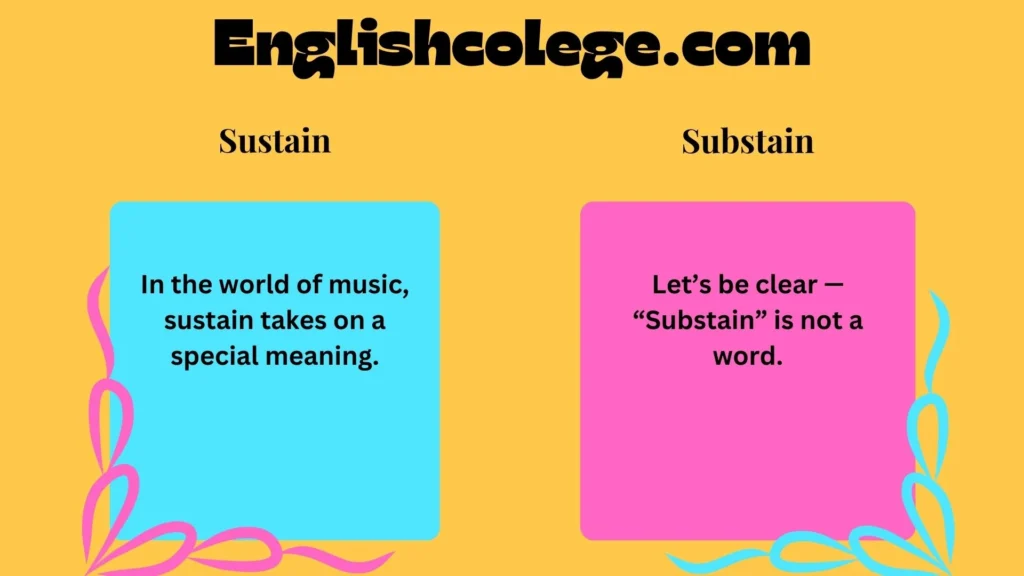
In the world of music, sustain takes on a special meaning. It’s used as a noun to describe how long a sound lasts after being produced.
For example:
“The sustain on that guitar note was incredible.”
Musicians use this term when talking about the duration of a note’s vibration before it fades away. In digital sound editing, it’s often part of the ADSR envelope, which stands for:
- Attack – How quickly the sound starts
- Decay – How fast it drops from peak
- Sustain – How long it holds
- Release – How it fades out
Here’s a simple visual representation:
| Attack | Decay | Sustain | Release |
|   /|     |       ___      |     \   |
|  / |_____|      |   |     |______\  |
In musical terms, a longer sustain means a richer, fuller sound.
The Nonexistence of “Substain” in the English Language
Let’s be clear — “Substain” is not a word. It doesn’t appear in:
- Merriam-Webster Dictionary
- Oxford English Dictionary
- Cambridge Dictionary
- Collins Dictionary
So where does substain come from? Here are a few likely reasons.
Why People Write “Substain” by Mistake
- Phonetic Confusion: The prefix sub- appears so often in English that your brain might automatically assume substain fits the pattern.
- Auto-correct Errors: Many writing tools might not flag substain if they’re using outdated or unverified dictionaries.
- Word Association: Words like substantial, abstain, and maintain can make “substain” feel plausible.
- Accent and Pronunciation: Regional accents might blur “sustain” and “substain,” especially when spoken quickly.
To verify if a word exists, use trusted sources like Merriam-Webster or Cambridge Dictionary.
Remember: Just because a word “sounds” right doesn’t mean it’s real.

Common Confusions: “Sustain” vs. Similar Words
English is full of look-alike and sound-alike words. Here are a few that often trip people up when learning “sustain.”
| Word | Part of Speech | Meaning | Example |
|---|---|---|---|
| Sustain | Verb | To support, maintain, or endure | “He sustained heavy losses in business.” |
| Abstain | Verb | To choose not to do something | “She abstained from eating sweets.” |
| Maintain | Verb | To keep in good condition | “They maintain their garden beautifully.” |
| Substantial | Adjective | Large, important, or significant | “They received a substantial donation.” |
| Substain | ❌ — | Not a word | — |
Tip: If you can’t find a word in a reputable dictionary, it’s safe to assume it’s incorrect or outdated.
Real-World Examples of “Sustain” in Sentences
To understand “sustain,” let’s explore how it appears in varied real-world contexts.
Environmental Example 🌍
“Solar power helps sustain life on Earth by reducing carbon emissions.”
Business Example 💼
“The company’s innovation sustained its growth through economic downturns.”
Personal Example ❤️
“Her optimism sustained her through the hardest days.”
Legal Example ⚖️
“The court sustained the lawyer’s objection due to lack of evidence.”
Musical Example 🎸
“The sustain of the violin added warmth to the melody.”
Notice something? Each usage still reflects the root meaning — to keep something going or supported.
Memory Tricks to Remember the Right Word
If you’ve ever typed “substain” by accident, these simple memory aids can help:
- Think “Support = Sustain.”
Both start with “S,” and sustain literally means to support or uphold. - Visual Trick:
The prefix sub- means “under.” So imagine “substain” sinking under — wrong and unsupported! - Word Association:
Connect “sustain” with “sustainability,” a word you see everywhere in today’s environmental discussions. - Pronunciation Clue:
Say it aloud: suh-stayn. There’s no extra “b” sound. - Check Before You Click Send:
Use built-in spell checkers or apps like Grammarly to flag rare typos.
Common Misspellings Related to “Sustain”
Even advanced writers occasionally trip on similar-looking words. Here’s a quick reference chart:
| Incorrect | Correct | Why It’s Wrong |
|---|---|---|
| Substain | Sustain | “Substain” doesn’t exist |
| Sustane | Sustain | Wrong vowel ending |
| Sustainn | Sustain | Double “n” doesn’t belong |
| Sustayn | Sustain | Phonetic but incorrect spelling |
Pro Tip: Whenever in doubt, look for examples of usage from trusted publications like The New York Times or The Guardian. You’ll never find “substain” there.
Expert Insight: Why “Sustain” Matters in Modern English
“Language is sustained through usage, not invention. The moment a word stops being used correctly, it begins to lose meaning.”
— Dr. Eleanor Price, Linguistics Professor, University of Chicago
“Sustain” carries powerful connotations today. It’s not just about endurance; it’s about long-term balance and preservation.
Here’s how different industries use it:
- Environmental Science: Sustainable development and resource conservation.
- Business: Sustaining profits, customer loyalty, and innovation.
- Engineering: Sustaining structures against pressure or weight.
- Music: Describing how long a sound continues after being produced.
Each field relies on sustain to describe strength over time.
Quick Recap Table
| Concept | “Sustain” | “Substain” |
|---|---|---|
| Exists in English? | ✅ Yes | ❌ No |
| Definition | To support, maintain, or keep going | — |
| Common Usage | Daily speech, business, law, environment, music | — |
| Example Sentence | “They sustained their efforts despite setbacks.” | — |
| Root Origin | Latin sustinēre | — |
Related Vocabulary Guides to Improve Your English
If you’re curious about similar word confusions, these guides will help you sharpen your language skills:
- Abetter vs. Abettor – Legal terms explained clearly.
- Correlate to or With? – Preposition usage demystified.
- Criticize vs. Criticise – Understanding British vs. American spelling.
- Unsecure vs. Insecure – Subtle meaning differences.
- Toad vs. Towed – Homophones that trick even pros.
- Ginormous Meaning and Usage – From slang to dictionary-approved word.
Each of these explores real examples and proper usage, just like this one.
FAQs About “Sustain” and “Substain”
What does “sustain” actually mean?
Sustain means to support, maintain, or keep something going. It can also mean to endure hardship or uphold a statement or judgment.
Is “substain” ever correct?
No. “Substain” is not a valid English word. It’s a common misspelling of “sustain.”
Can “sustain” be used as a noun?
Yes, but mainly in music. It refers to how long a sound or note lasts before fading.
How can I remember the correct spelling?
Remember: Support starts with S — so does Sustain. “Substain” should be subtracted from your vocabulary.
What are some synonyms for “sustain”?
Depending on context: maintain, uphold, endure, continue, preserve, support, nourish.
Conclusion
Let’s wrap this up simply:
“Sustain” is the correct, widely accepted English word meaning to maintain, support, or keep something going.
“Substain” doesn’t exist — not in any dictionary, academic reference, or real-world usage.
By learning the right word and understanding its roots, you not only improve your writing but also build credibility and fluency.
So next time you’re tempted to type “substain,” stop, smile, and remember —
You can sustain success, but you can’t substain it.

I’m Sameer — a passionate English enthusiast who loves exploring words, grammar, and the art of effective communication. ✍️