
Ever wondered if the phrase is “Knick of time” or “Nick of time”? You’re not alone.
This tiny difference in spelling has puzzled English learners and native speakers alike. The phrase pops up in movies, books, and everyday speech—but which one is right?
Let’s dive deep into this idiom’s origin, meaning, and correct spelling. Along the way, we’ll explore its history, similar expressions, and how to use it naturally in writing and conversation.
Is It “Knick of Time” or “Nick of Time” Meaning?
Aksar log confuse ho jate hain ke correct phrase “knick of time” hai ya “nick of time.” Sahi aur standard English expression “nick of time” hai, jabke “knick of time” ghalat spelling hai aur grammar ke hisaab se accept nahi ki jati. “Nick of time” ka matlab hota hai bilkul theek waqt par, yani kisi kaam ka last moment par complete ho jana ya kisi mushkil se bas waqt par bach jana.
Example ke taur par: “He reached the station in the nick of time.” Iska matlab hai ke wo train miss hone se just pehle pohanch gaya. Yeh phrase daily English conversations, exams, aur writing mein kaafi use hota hai. SEO ke liye bhi zaroori hai ke aap correct form “nick of time meaning” use karein, taake aapki content ranking better ho aur readers ko accurate information mile.
Why This Tiny Spelling Difference Confuses So Many People
A small slip of the pen can turn a familiar phrase into nonsense. Many people write “knick of time” because it sounds almost identical to “nick of time.” This confusion happens with other words too—think “Don vs. Dawn” or “Compliment vs. Complement.”
The reason? English pronunciation often hides the spelling clues. When you hear “nick of time,” you don’t notice that there’s no silent “k.” So, “knick” slips in unnoticed.
Here’s a quick example:
“She finished the report in the knick of time.” ❌
“She finished the report in the nick of time.” ✅
The second one is correct—and once you understand why, you’ll never mix them up again.
The Correct Phrase: “Nick of Time” ✅
Let’s be clear: “Nick of time” is the correct phrase.
It means just in time or at the last possible moment before something happens.
Quick Examples
- “The firefighters arrived in the nick of time.”
- “He hit the brakes in the nick of time.”
- “The team scored in the nick of time to win the game.”
The phrase emphasizes urgency and relief—the feeling of narrowly avoiding disaster.
Word Breakdown
| Word | Meaning | Origin |
|---|---|---|
| Nick | A small cut, notch, or precise moment | Old English / Middle English |
| Time | A moment or point in duration | Old English (tīma) |
Together, they form a vivid image—catching something right at the exact notch or point in time.
Meaning of “Nick of Time”
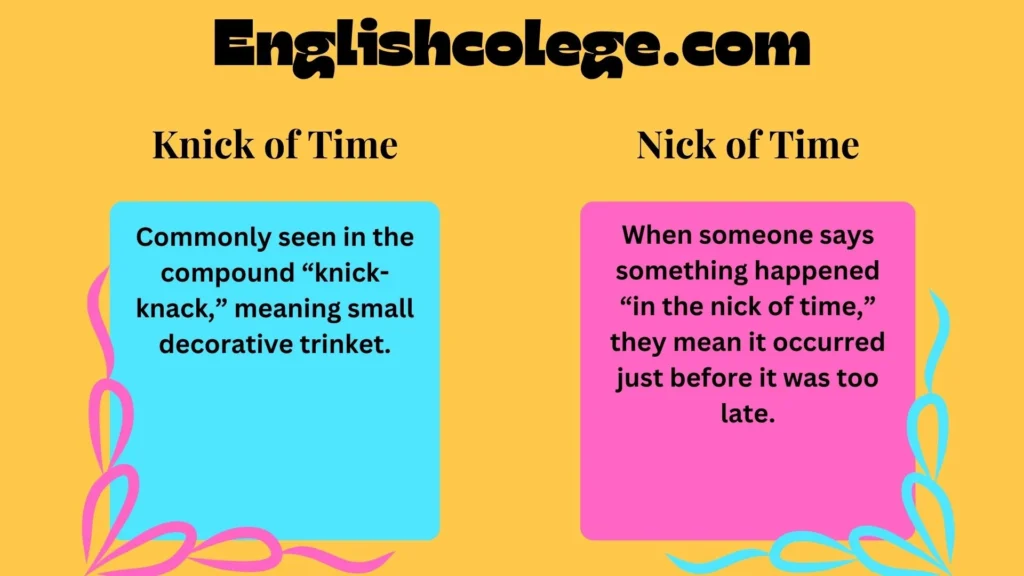
When someone says something happened “in the nick of time,” they mean it occurred just before it was too late. The phrase describes precision, urgency, and sometimes luck.
Emotional Tone
- Relief: “We reached the airport in the nick of time.”
- Surprise: “He found the missing document in the nick of time.”
- Excitement: “The hero appeared in the nick of time to save the day!”
This idiom captures moments where timing is everything.
The Origin of “Nick of Time”
The idiom dates back to the 16th or 17th century in England. Back then, “nick” referred to a precise or critical point—like the notch marks carved on wood or sticks to measure time or events.
Historical Usage
In the 1500s, “nick” meant “a critical moment.”
Writers used it to describe the exact instant something occurred.
For example:
“Even in the very nick of time, the messenger arrived.”
— Recorded in English literature, 1580s
These notches, or nicks, symbolized exactness. So, “nick of time” literally meant the exact instant when something must happen.
Why “Knick” Is Incorrect ❌
The word “knick” does exist—but it doesn’t belong here.
Definition of “Knick”
- A small chip, crack, or cut in a surface (like a scratch).
- Commonly seen in the compound “knick-knack,” meaning small decorative trinket.
Example:
- “There’s a small knick on the wooden table.”
See the difference? “Knick” has nothing to do with time. The confusion arises because of:
- Phonetic similarity: “Nick” and “knick” sound identical.
- Spelling habits: Words like “knock,” “know,” and “knee” start with a silent “k.”
- Auto-correct errors or speech-to-text misunderstandings.
So, while “knick” is a real word, it doesn’t fit in this idiom. Using “knick of time” is grammatically and semantically wrong.
The Linguistic Logic Behind “Nick”
Why does “nick” make sense? Because nick often refers to something precise or narrowly achieved.
Examples of “Nick” in Other Phrases
| Phrase | Meaning |
|---|---|
| Nick a goal | Score just barely or luckily |
| Nick something | Steal or grab quickly |
| Nick of time | Arrive or act at the last possible moment |
The pattern is clear: “Nick” conveys precision, narrowness, or an exact point of action.
Analogy
Think of “nick” as a knife’s cut—sharp and exact. When something happens “in the nick of time,” it’s like slicing into the perfect moment before it’s too late.
Synonyms and Similar Phrases
There are plenty of ways to express the same sense of urgency or timing. Here are some that carry the same meaning:
| Synonym | Meaning | Example |
|---|---|---|
| Just in time | Happening right before the deadline | “She caught the bus just in time.” |
| At the last minute | Near the final opportunity | “He submitted the form at the last minute.” |
| By the skin of one’s teeth | Barely escaping failure | “They avoided the crash by the skin of their teeth.” |
| Under the wire | Completing something before the deadline | “The project was finished under the wire.” |
| Before the buzzer | Just before time runs out | “He scored before the buzzer.” |
Each carries a slightly different emotional tone—from casual to dramatic—but all point to timing perfection.
“Nick of Time” in Modern Usage
Even today, the idiom remains common in both speech and writing. It’s widely used in:
- News headlines: “Rescuers arrive in the nick of time.”
- Movies and TV shows: Action heroes often save the day “in the nick of time.”
- Everyday conversation: “You made it to the meeting in the nick of time!”
Case Study: Pop Culture Example
In the 1995 thriller Nick of Time starring Johnny Depp, the title perfectly captures the story’s tension—a man has only minutes to act before tragedy strikes. The film’s name emphasizes the idiom’s meaning: time running out, decisions made at the last possible second.
Similar Spelling Mix-Ups in English
English is full of pairs that sound similar but differ in meaning. These confusions often happen for the same reason as “nick vs. knick.”
| Word Pair | Correct Usage | Example |
|---|---|---|
| Don vs. Dawn | Don = put on; Dawn = sunrise | “He’ll don his jacket at dawn.” |
| Compliment vs. Complement | Compliment = praise; Complement = completes | “Her shoes complement her dress.” |
| Cacti vs. Cactuses | Both correct; Cacti is more formal | “There are many cacti in the desert.” |
| Monies vs. Moneys | Both correct; used in financial contexts | “Public monies were allocated to schools.” |
| Joint vs. Join | Joint = shared or connected; Join = act of linking | “We decided to join forces at the joint event.” |
Understanding these subtle differences strengthens your writing and ensures clarity.
Practical Tips to Avoid Idiom Spelling Mistakes
You can easily prevent errors like “knick of time” with these habits:
1. Check Reputable Dictionaries
Use reliable sources like:
These confirm that “nick of time” is the correct version.
2. Read Idioms in Context
When you learn a phrase, look for it in example sentences. Context helps lock the correct spelling in your memory.
3. Use Mnemonics
Try this:
“Nick cuts it close in time.”
That image reminds you that nick involves something sharp, exact, or narrowly achieved.
4. Listen to Audio Pronunciations
Hearing native speakers can help reinforce proper pronunciation—and spelling recognition.
5. Be Skeptical of Auto-Correct
Spell-check tools sometimes replace “nick” with “knick.” Always double-check before posting or submitting formal writing.
Summary: Lock It In Your Memory
To recap:
- ✅ Correct phrase: “Nick of time.”
- ❌ Incorrect phrase: “Knick of time.”
- Meaning: Something happens just before it’s too late.
- Origin: 16th-century English—“nick” meaning exact point.
- Synonyms: “Just in time,” “At the last minute,” “By the skin of one’s teeth.”
Mnemonic Reminder:
“A nick is sharp, precise, and right on time.”
Use it confidently—because now you know exactly what it means and where it came from.
Frequently Asked Questions
Is it “Nick of time” or “Knick of time”?
It’s “Nick of time.” “Knick” is incorrect in this context, even though it’s a real word.
What does “Nick of time” mean?
It means something happens just in time—at the last possible moment before it’s too late.
Where did “Nick of time” come from?
It originated in 16th-century England, where “nick” meant a precise or critical moment.
Can I say “Knick of time”?
No. While it sounds similar, “knick” means a small cut or chip, not a precise moment in time.
What are other ways to say “Nick of time”?
You can say “just in time,” “at the last minute,” or “by the skin of your teeth.”

I’m Sameer — a passionate English enthusiast who loves exploring words, grammar, and the art of effective communication. ✍️