

Ever caught yourself wondering whether you should say “in the street” or “on the street”? You’re not alone.
These tiny prepositions — in, on, and at — can twist English learners into knots. Yet, mastering them makes your English sound natural and confident.
This guide breaks down the difference between “in the street” and “on the street”, explains grammar rules, explores regional variations between American and British English, and shows you how to use them like a native speaker.
The Role of Prepositions in English
Prepositions are small but mighty. They connect nouns, pronouns, or phrases to other words in a sentence — showing location, time, or direction.
Think of them as bridges that link ideas together.
Here are a few examples:
| Preposition | Function | Example |
|---|---|---|
| In | Inside or within boundaries | In the room, in the city, in the car |
| On | On top of or attached to a surface | On the table, on the wall, on the bus |
| At | Specific point or position | At the door, at the station, at the corner |
Each one carries a subtle visual cue. “In” suggests being surrounded, “on” implies contact or surface, and “at” points to a specific spot.
That difference is key to understanding phrases like “in the street” and “on the street.”
Understanding “In the Street”
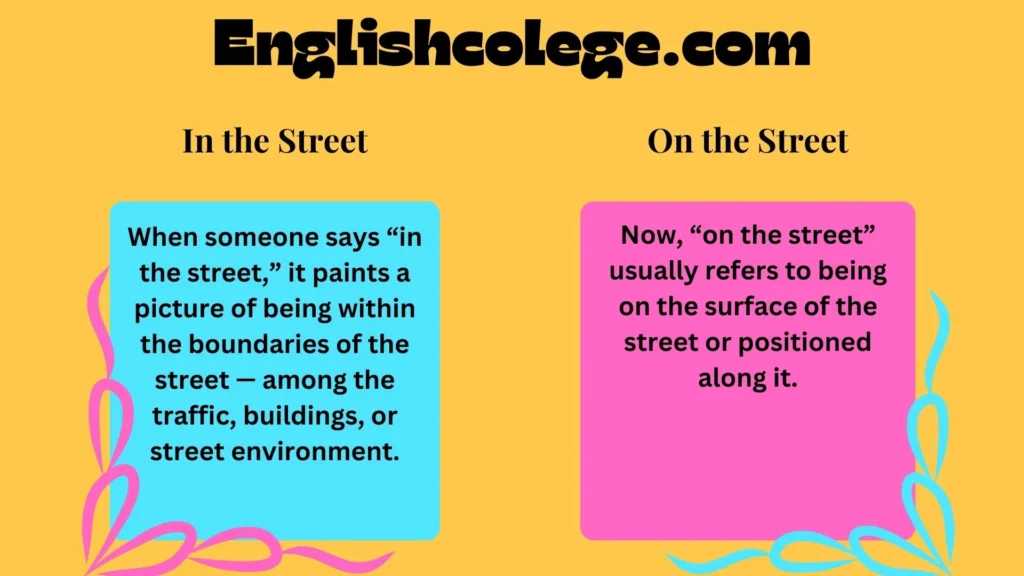
When someone says “in the street,” it paints a picture of being within the boundaries of the street — among the traffic, buildings, or street environment.
Meaning: Being physically inside the space that the street occupies.
It’s often used to describe actions happening in that space rather than beside it.
Examples:
- Children were playing in the street after school.
- The car stopped suddenly in the street.
- A parade marched in the street downtown.
Notice how “in the street” focuses on activity happening within the street area. It gives a sense of immersion — like being part of the street’s movement, sounds, and life.
When to Use “In the Street”
Use it when you mean:
- Someone or something occupies or moves within the street.
- You’re describing action, not position.
- The situation is British English (it’s more common there).
Visualize It
Imagine drawing the outline of a street. If something is in the street, it’s inside that outline — not standing on the sidewalk or in a shop nearby.
Understanding “On the Street”
Now, “on the street” usually refers to being on the surface of the street or positioned along it.
It’s more common in American English, and it’s the preferred form when talking about location, position, or general reference.
Meaning:
Something is either touching the surface of the street or located along it.
Examples:
- There’s a coffee shop on the street corner.
- They were walking on the street when it started to rain.
- He lives on the same street as me.
Here, “on” emphasizes location and visibility rather than being inside or surrounded by the street environment.
In idiomatic usage, “on the street” can also mean homeless or publicly known.
Idiomatic Uses:
- He’s been living on the street for years. → (homeless)
- Word on the street is that the company’s expanding. → (common rumor)
Fun Fact: English speakers often use “on” when they imagine contact with a surface — think on the road, on the highway, on the map.
Grammatical Rules: When to Use “In” vs. “On”
Let’s put the two side by side for clarity:
| Context | Use In the Street | Use On the Street |
|---|---|---|
| Literal presence | ✅ The kids are playing in the street. | ✅ The shop is on the street corner. |
| Movement or action | ✅ Cars are racing in the street. | 🚫 Incorrect — location, not action. |
| Position or location | 🚫 | ✅ He lives on the street near the park. |
| Figurative meaning | 🚫 | ✅ She ended up on the street after losing her job. |
| British English | Common | Also used, but with nuance |
| American English | Rare | Most preferred |
Grammar Tip:
- Use “in” when something is within or among the street.
- Use “on” when referring to location, contact, or visibility.
Contextual Nuance: Emphasis and Imagery
The choice between “in” and “on” isn’t just grammar — it’s imagery.
It changes what the listener sees in their mind.
“In the Street” → Immersion & Action
It places you inside the scene, surrounded by motion or sound.
“Children were running in the street.”
You picture them darting around cars, laughing, maybe chasing a ball.
“On the Street” → Location & Visibility
It positions you on the surface, emphasizing where something or someone is.
“A new café opened on the street.”
You imagine it facing the street, not inside it.
Think of “in” as immersive and “on” as observational.
Regional Differences: American vs. British English
The biggest divide comes from regional usage.
| Region | Common Expression | Example |
|---|---|---|
| British English (BE) | In the street | Our house is in the next street. |
| American English (AE) | On the street | Our house is on the next street. |
Why the Difference?
British English traditionally uses “in the street” to describe physical presence or activity inside a street area.
American English favors “on the street”, viewing the street as a surface rather than a contained space.
Example Comparison:
- British: Children play in the street during festivals.
- American: Children play on the street during block parties.
Both are correct — they just reflect different mental images and linguistic traditions.
The Rare “At the Street” Expression
You might sometimes hear “at the street”, though it’s less common.
It’s used when referring to a specific point or location — not the street in general.
Examples:
- Let’s meet at the street corner.
- The bus stopped at the streetlight.
- Turn left at the street with the bakery.
Why It Works:
“At” points to a specific, fixed spot. You’re not describing being within or on a street — just a place where something happens or begins.
“At” = precise
“On” = surface
“In” = space
A quick mnemonic:
👉 At = Point | On = Surface | In = Space
Are “In the Street” and “On the Street” Ever Interchangeable?
Sometimes, yes — but meaning shifts slightly depending on what you emphasize.
| Sentence | Meaning | Preferred Usage |
|---|---|---|
| People are protesting in the street. | They’re standing or moving within the street. | ✅ “In the street” |
| People are protesting on the street. | Similar, but focuses more on location. | ✅ “On the street” (AE) |
| Shops line up on the street. | Position along the street. | ✅ “On the street” |
| Cars parked in the street. | Within the street space. | ✅ “In the street” |
Quick Test:
Ask yourself —
“Am I describing action inside the street or position along it?”
If it’s action, use in. If it’s position, use on.
Everyday English: Real-world Examples
Let’s see how native speakers actually use both forms.
| Sentence | Context | Preposition |
|---|---|---|
| We met in the street after work. | Within the street space | In |
| There’s a bakery on the street next to mine. | Positional | On |
| Don’t park in the street; it’s a tow zone. | Movement / space | In |
| He’s been living on the street since last year. | Figurative (homelessness) | On |
| They danced in the street during the festival. | Immersive action | In |
Observation:
American media, songs, and movies almost always use “on the street.”
Examples:
- Bruce Springsteen – “Down on the Street”
- “Sesame Street” (not “in the street”)
British newspapers or novels may use “in the street.”
“The crowd gathered in the street to celebrate.”
Quick Reference Summary
Here’s a short cheat sheet to remember it all:
| Function | Correct Preposition | Example |
|---|---|---|
| Inside or among | In the street | Kids playing in the street |
| On the surface or facing | On the street | Shops on the street |
| Specific location or point | At the street | Meet at the street corner |
Key takeaway:
Use “in” for presence, “on” for position, and “at” for precision.
Related Language Guides
If you enjoyed this, you’ll love these similar topics that help sharpen your English understanding:
- Dietitian vs. Dietician – Which Spelling Is Correct?
- Anesthesia vs. Anaesthesia – American vs. British Spelling
- Pour, Pore, or Poor – Understanding Homophones
- Dammit or Damnit – The Right Way to Spell It
- Chary vs. Cherry – Spelling & Meaning Explained
FAQs: Common Questions About “In the Street” vs. “On the Street”
What’s the main difference between “in the street” and “on the street”?
“In the street” means within or among the street space, while “on the street” means on or along the street surface. “In” focuses on action or immersion; “on” emphasizes location or visibility.
Is “in the street” British English and “on the street” American English?
Mostly yes. British English uses “in the street” more frequently, while American English prefers “on the street.” Both are grammatically correct but regionally flavored.
Can I use “at the street”?
Yes, but only for specific points or intersections, like “Meet me at the street corner.” It’s not used for general activity or location.
Is “on the street” ever used figuratively?
Absolutely. It can mean homeless (“He lives on the street”) or public rumor (“Word on the street is…”). These idiomatic uses are common in American English.
How can I remember the difference easily?
Use this quick rule:
- In = Inside or among
- On = Surface or along
- At = Specific point
A good image: You stand on the street, play in the street, and meet at the corner.
Conclusion
Prepositions may seem tiny, but they shape your message more than you think. Understanding when to use “in the street” or “on the street” helps your English sound clear, precise, and natural.
So next time you describe a scene, remember:
- Use “in” when describing activity inside a street.
- Use “on” when describing position or presence along it.
- Use “at” for specific meeting points.
Mastering these nuances doesn’t just make you sound fluent — it helps you think in English.
“Precision in small words makes the big difference in communication.”

I’m Sameer — a passionate English enthusiast who loves exploring words, grammar, and the art of effective communication. ✍️