
Mistaking “impatient” for “inpatient” is more common than you think.
They look nearly identical—just one letter apart—but their meanings couldn’t be more different. One describes an emotion, while the other refers to medical care.
Understanding the difference isn’t just about spelling; it’s about context, tone, and clarity.
Let’s dive deep into what separates these two easily confused words so you can use each one confidently and correctly.
Impatient vs Inpatient Reddit
On platforms like Reddit, users often discuss the confusion between “impatient” and “inpatient,” especially in writing and casual conversations. “Impatient” describes a person who feels restless or annoyed when something takes too long. For example, someone waiting for exam results might feel impatient. In contrast, “inpatient” refers to a person admitted to a hospital for treatment and staying overnight or longer.
Reddit threads frequently highlight how a simple spelling difference can completely change the meaning of a sentence. Many users share funny mistakes, like writing “I’m an inpatient for my delivery” instead of “impatient,” which creates confusion. Understanding the context is key to using these words correctly. If you’re talking about emotions, use “impatient.” If it’s about medical care, “inpatient” is the correct choice.
Why “Impatient” and “Inpatient” Confuse So Many People
It’s easy to see why people mix them up. Both words sound similar when spoken quickly, both begin with “im-” or “in-,” and both often appear in serious conversations. But here’s the key:
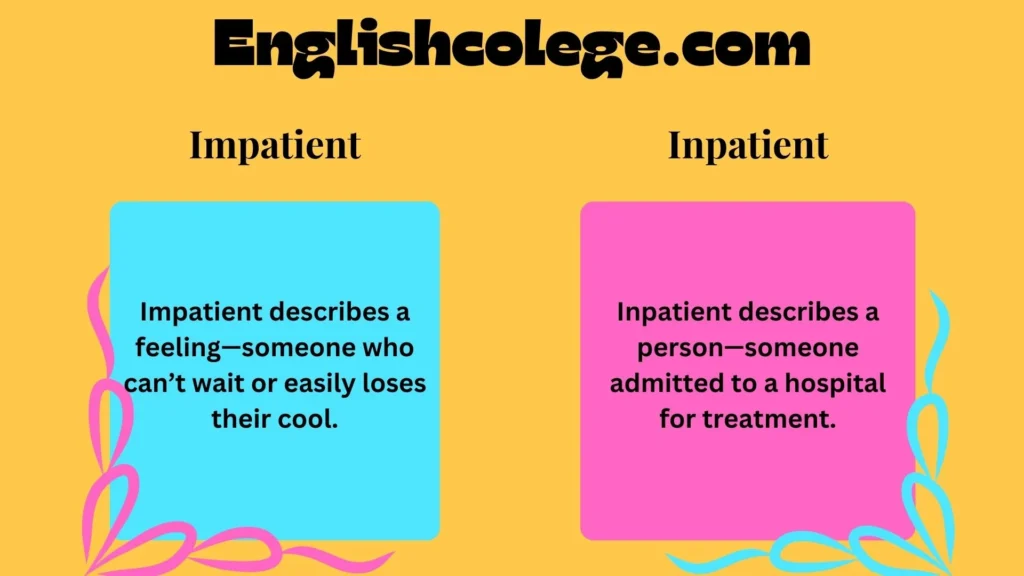
- Impatient describes a feeling—someone who can’t wait or easily loses their cool.
- Inpatient describes a person—someone admitted to a hospital for treatment.
Here’s a quick example to show the difference:
“I’m getting impatient waiting for my doctor.”
“The doctor is busy treating an inpatient in the next room.”
In the first sentence, impatient shows emotion. In the second, inpatient identifies a hospital patient.
Definition and Core Meaning of “Impatient”
The word “impatient” is an adjective. It describes someone who is restless, eager, or unable to wait calmly.
Dictionary Definition (Simplified):
Impatient (adjective) – showing irritation or eagerness because of delay, opposition, or anything that slows progress.
Pronunciation: /ɪmˈpeɪʃənt/
Examples in Sentences
- She was impatient for the meeting to begin.
- Don’t be impatient with children—they learn at their own pace.
- He tapped his foot, clearly impatient about the delay.
Emotional and Behavioral Nuances of “Impatient”
Impatience isn’t always negative—it depends on the context.
Negative connotation:
- Being short-tempered or easily annoyed.
- Example: “His impatient tone made everyone uncomfortable.”
Neutral or positive connotation:
- Being eager or enthusiastic to move forward.
- Example: “She was impatient to start her new job.”
Everyday triggers for impatience include:
- Long waiting times (in traffic, lines, or meetings)
- Slow responses (texts, emails, or feedback)
- Unmet expectations or delays in progress
Psychologists often link impatience to a desire for control or instant gratification—traits common in fast-paced environments.
Common Phrases and Idioms with “Impatient”
“Impatient” frequently appears in phrases and idioms. Here are a few common ones:
| Expression | Meaning | Example |
|---|---|---|
| Impatient for | Eagerly waiting for something | “I’m impatient for the results.” |
| Impatient with | Annoyed by someone | “She gets impatient with slow learners.” |
| Grow impatient | Lose patience gradually | “He grew impatient after waiting an hour.” |
Pro Tip:
The preposition for often shows eagerness, while with shows irritation.
Linguistic Roots and Etymology of “Impatient”
“Impatient” originates from Latin:
- im- meaning “not,”
- patientem meaning “bearing” or “enduring.”
So, “impatient” literally means “not enduring” or “unable to wait.”
It entered Middle English in the 14th century and has remained largely unchanged. The connection to patience makes it easy to remember: If patience means calm endurance, impatience means the lack of it.
Definition and Core Meaning of “Inpatient”
Now let’s look at “inpatient.”
Inpatient is both a noun and an adjective.
- As a noun: It refers to a person who stays in a hospital overnight or longer.
- As an adjective: It describes care or treatment provided to such a person.
Dictionary Definition (Simplified):
Inpatient (noun/adjective) – a patient admitted to a hospital for at least one night for medical care or observation.
Pronunciation: /ˈɪnˌpeɪʃənt/
Real-World Usage of “Inpatient”
In the medical world, “inpatient” distinguishes between types of care.
| Term | Definition | Example |
|---|---|---|
| Inpatient | Patient admitted overnight or longer | “He’s recovering as an inpatient after surgery.” |
| Outpatient | Patient treated without overnight stay | “She’s attending outpatient therapy sessions.” |
Examples in Context
- The hospital opened a new inpatient ward for mental health.
- Inpatient treatment usually involves 24-hour supervision.
- The average inpatient stay in U.S. hospitals is around 4.6 days (according to CDC data).
Healthcare providers use the term to classify billing, insurance, and treatment types.
“Impatient” vs. “Inpatient” in Context
Here’s a clear side-by-side comparison:
| Word | Part of Speech | Meaning | Example Sentence | Context |
|---|---|---|---|---|
| Impatient | Adjective | Restless, eager, easily annoyed | “She was impatient for the concert to begin.” | Emotion/Behavior |
| Inpatient | Noun/Adjective | Hospitalized person or treatment | “The doctor visited the inpatient ward.” | Healthcare/Medical |
Pronunciation Guide
- Impatient: /ɪmˈpeɪʃənt/ (starts with im)
- Inpatient: /ˈɪnˌpeɪʃənt/ (starts with in)
A simple trick: You’re “in” the hospital as an inpatient.
Tips to Remember the Difference
1. Mnemonics
- Inpatient → Think “IN” the hospital.
- Impatient → Think “I’M not patient.”
2. Visualization Trick
Imagine two scenarios side by side:
- Someone tapping their foot at a bus stop → Impatient
- Someone lying in a hospital bed → Inpatient
3. Quick Test Sentences
Try filling in the blanks:
- He was _______ waiting for his results.
(Answer: impatient) - The doctor is visiting an _______ in the ICU.
(Answer: inpatient)
These small exercises help reinforce the difference naturally.
Common Misconceptions and Mistakes
Even advanced English speakers make mistakes with these two.
Frequent Errors:
- Typing inpatient when you mean impatient in casual writing.
- Over-relying on spell-check or autocorrect, which may not catch the context.
- Mispronouncing inpatient as impatient when speaking quickly.
Why It Happens:
The prefix im- and in- both mean “not” in Latin, which adds to the confusion. However, inpatient doesn’t mean “not patient”—it refers to hospital care.
How to Avoid It:
- Always check the sentence context. If it’s emotional, it’s impatient. If it’s medical, it’s inpatient.
- Read your text aloud—your ear often catches what your eyes miss.
Related English Word Confusions
Here are a few other pairs that trip people up just as much:
| Confused Pair | Correct Usage Example |
|---|---|
| Affect vs. Effect | “The weather will affect our plans.” / “The effect was surprising.” |
| Compliment vs. Complement | “He paid her a nice compliment.” / “That color complements your eyes.” |
| Stationary vs. Stationery | “The bike was stationary.” / “I bought new stationery for school.” |
| Then vs. Than | “Finish your work, then go out.” / “He’s taller than me.” |
| Advice vs. Advise | “She gave good advice.” / “I advise you to wait.” |
Learning to recognize patterns between these pairs strengthens your overall English accuracy.
Quick Recap: The Fast Memory Table
| Term | Meaning | Type | Example |
|---|---|---|---|
| Impatient | Restless, eager, unable to wait | Adjective | “She was impatient to start.” |
| Inpatient | Hospitalized person or care | Noun/Adjective | “He’s recovering as an inpatient.” |
Summary Rule:
If it’s about feelings, it’s impatient.
If it’s about hospitals, it’s inpatient.
FAQs
What does “impatient” really mean?
It means being unable to wait calmly—feeling restless, eager, or easily annoyed by delays.
Is “inpatient” a noun or an adjective?
Both. As a noun, it refers to a hospitalized person. As an adjective, it describes the type of care provided.
Can “impatient” ever be positive?
Yes. When it shows eagerness or excitement rather than frustration—like being impatient to learn something new.
What’s the opposite of “impatient”?
The opposite is patient, meaning calm and tolerant during delays or difficulties.
How can I remember “inpatient” easily?
Think of the prefix “in” as “inside the hospital.” If the person stays overnight, they’re an inpatient.
Conclusion
The difference between “impatient” and “inpatient” may seem minor, but it changes meaning completely.
- Impatient expresses emotion—restlessness, eagerness, or frustration.
- Inpatient describes a medical status—someone admitted to receive care.
Remember: You can be impatient while waiting to see an inpatient!
The best way to master these distinctions is through context and repetition. Read examples, practice short sentences, and use memory tricks. Once you internalize the difference, you’ll never second-guess it again.

I’m Sameer — a passionate English enthusiast who loves exploring words, grammar, and the art of effective communication. ✍️