
Ever paused mid-sentence wondering, “Should I say if he was or if he were?” You’re not alone.
Even seasoned writers and fluent English speakers get tripped up by this subtle rule.
The confusion stems from one key thing — English mood — specifically, the subjunctive mood, which we use to talk about hypothetical or imaginary situations.
This guide breaks down everything you need to know, step by step, with examples, explanations, and quick tips so you’ll never second-guess this grammar choice again.
Understanding Mood in English Grammar
In English, verbs don’t just show time (past, present, future). They also show mood — the speaker’s attitude toward what’s being said.
The two moods that matter most for this topic are:
| Mood | Purpose | Example | Meaning |
|---|---|---|---|
| Indicative | Describes facts or real situations | If he was late, he missed the bus. | A real or possible situation |
| Subjunctive | Describes unreal, hypothetical, or wished-for situations | If he were late, I’d be surprised. | An imagined or unreal situation |
So, “was” belongs to the indicative mood, while “were” belongs to the subjunctive mood.
That one difference changes everything about meaning.
Conditional Sentences: The Grammar Framework
Before diving into when to use was or were, it helps to understand conditional sentences — sentences that describe what happens under certain conditions.
There are two main types relevant here:
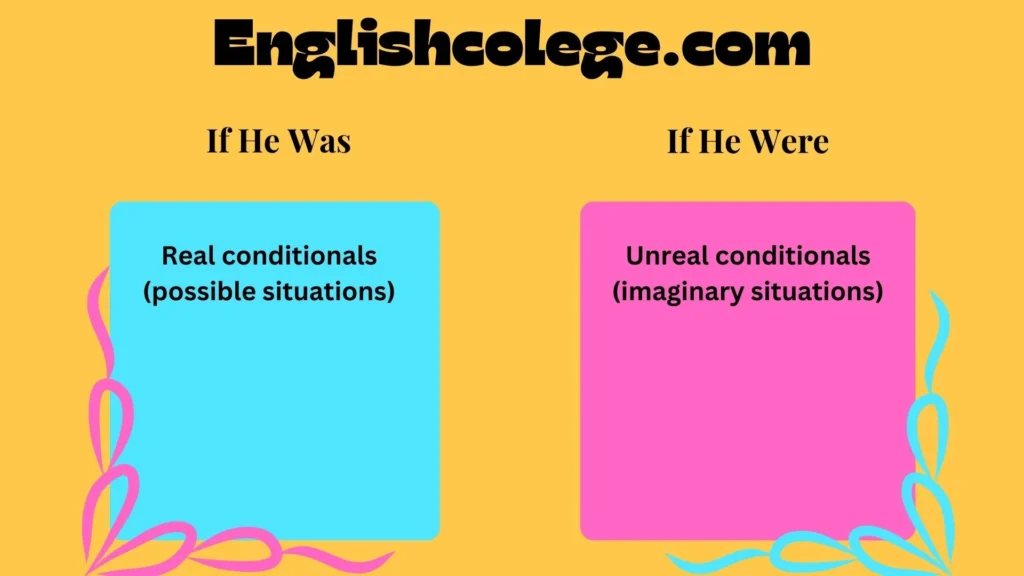
- Real conditionals (possible situations)
These refer to events that can actually happen.
👉 If he was tired, he probably went to bed. - Unreal conditionals (imaginary situations)
These describe things that aren’t true or are purely hypothetical.
👉 If he were tired, he’d rest.
Here’s a quick comparison:
| Type | Condition Type | Example | Mood |
|---|---|---|---|
| Real | Possible or factual | If he was home, he saw it happen. | Indicative |
| Unreal | Hypothetical or contrary to fact | If he were home, he would’ve seen it. | Subjunctive |
Rule of thumb:
Ask yourself — Is this situation real or imagined?
- If real → use was
- If imagined → use were
When to Use “Was”
“Was” is used for situations that are real, possible, or based in fact. It follows the standard rules of past tense.
✅ Use “was” when:
- You’re describing something that actually happened. If he was late, the teacher probably noticed.
- You’re unsure but think it could be true. If she was angry, I understand why.
- You’re referring to a real event in the past. If it was raining, we stayed inside.
💡 Tip:
Think of was as your “reality” verb.
If there’s even a chance the situation happened or could happen, was is your best choice.
When to Use “Were”
“Were” comes into play when talking about imaginary, impossible, or unreal scenarios.
This is where the subjunctive mood shines.
✅ Use “were” when:
- You’re imagining or wishing for something different. If I were taller, I’d play basketball.
- You’re talking about something contrary to fact. If he were here, he’d help us.
- You’re being polite or formal in hypotheticals. If I were you, I’d double-check that email.
📘 Grammar Note:
Even though “were” sounds plural, in the subjunctive mood it applies to all subjects — I, he, she, it, we, they.
So yes, it’s correct to say:
If I were you
If he were younger
If it were possible
That’s why we say “If I were rich” — not “If I was rich.”
Shortcut Memory Guide: Was vs Were
Here’s a simple way to remember:
| Question | Answer | Use |
|---|---|---|
| Is it real or possible? | Yes | Use was |
| Is it imagined or impossible? | Yes | Use were |
Or try this trick:
Was = Reality
Were = Imagination
Common Mistakes to Avoid
Even experienced writers slip up when using was and were. Here’s what to watch for.
❌ Mixing moods in one sentence
Wrong: If he were there yesterday, he saw it.
✅ Right: If he was there yesterday, he saw it.
❌ Using “were” everywhere (overcorrection)
Some people use “were” because it sounds more formal.
Wrong: If she were here earlier, we’d have met her. (Real situation)
✅ Right: If she was here earlier, we’d have met her.
❌ Ignoring formality and tone
In casual speech, was often replaces were even for hypotheticals.
That’s fine in conversation but not ideal in academic or professional writing.
Context and Tone: When Flexibility Matters
In everyday speech, you’ll often hear people say:
“If I was you, I’d take the job.”
Technically, it’s subjunctive, so “If I were you” is correct.
But in modern usage, many native speakers blur the line — and that’s okay in informal settings.
However:
- In formal writing, “If I were you” is preferred.
- In casual conversation, “If I was you” sounds more natural.
So the right choice depends on:
- Audience (teacher vs friend)
- Tone (formal vs conversational)
- Purpose (essay vs chat)
Grammar evolves, and usage often depends on what “feels” natural in context.
Practical Writing Tips
To make your grammar instinctive, here are strategies that work:
🧠 1. Do the Reality Test
Ask: Could this really happen?
If yes → was.
If not → were.
🗣️ 2. Read it aloud
Your ear catches awkward phrasing faster than your eyes do.
✍️ 3. Use examples from trusted sources
Writers like Shakespeare and authors of classic literature used “were” frequently:
“If I were you…” – William Shakespeare, Othello
🧾 4. Keep tone in mind
- Emails, reports, essays → were (formal)
- Texts, casual speech → was (informal)
⚙️ 5. Grammar Tools
Check with editors like Grammarly or Merriam-Webster to confirm when you’re unsure.
Case Study: Real vs Unreal Conditionals in Context
Let’s see how “was” and “were” change meaning in actual scenarios.
| Sentence | Mood | Meaning |
|---|---|---|
| If he was home, he saw it happen. | Real | Possible past event |
| If he were home, he’d see it happen. | Unreal | Imagined situation |
| If I was rude, I apologize. | Real | You think you might have been rude |
| If I were rude, I’d apologize. | Unreal | You know you weren’t rude, but you’re imagining being so |
👉 The second column determines everything — real vs imaginary.
Expert Insights
Linguists note that spoken English is shifting toward dropping the subjunctive.
However, professional writing — journalism, academia, corporate communication — still favors the traditional rule.
“The subjunctive may be fading in speech, but it remains alive and necessary in writing.”
— Oxford English Grammar
Bottom line:
Use were when you’re being precise, formal, or want to sound polished.
Use was when you’re speaking naturally or referencing real events.
Quick Recap Table
| Form | Used For | Example |
|---|---|---|
| Was | Real, factual, possible situations | If he was late, he missed the train. |
| Were | Hypothetical, unreal, or wished-for situations | If he were here, he’d explain it. |
FAQs About “If He Was” vs “If He Were”
What’s the difference between “If I was” and “If I were”?
“If I was” refers to a real situation that could’ve happened.
“If I were” refers to a hypothetical one that didn’t happen.
Can I use “If I was you” in casual speech?
Yes, people say it all the time. But for formal or written English, “If I were you” is grammatically correct.
Is “were” still necessary today?
Yes — it remains standard in formal and academic writing. It helps show you know the difference between real and imagined conditions.
Why do we say “If I were” instead of “If I was”?
Because “If I were” follows the subjunctive mood rule.
It expresses a wish or imaginary scenario, not a fact.
How can I quickly remember which to use?
Easy trick:
- Real → was
- Imaginary → were
🏁 Conclusion
You now know exactly when to use if he was and if he were.
The key lies in identifying whether your sentence describes something real or imagined.
If it’s real → use “was.”
If it’s imagined → use “were.”
Mastering this distinction doesn’t just make your grammar better — it makes your writing clearer, sharper, and more confident.
So next time you’re unsure, just ask yourself:

I’m Sameer — a passionate English enthusiast who loves exploring words, grammar, and the art of effective communication. ✍️