
As an English learner, you may have stumbled upon phrases like “How can I…” or “How I can…” and wondered which one is correct.
The difference may seem subtle, but it’s crucial to sound natural and fluent. In this guide, we’ll dive deep into direct and indirect questions, polite expressions, and common mistakes.
By the end, you’ll confidently use these phrases in everyday conversations, writing, and professional settings.
Understanding Direct Questions in English
Direct questions are straightforward. They ask for information clearly and are usually structured with a question word, an auxiliary verb, and subject-verb inversion.
For example:
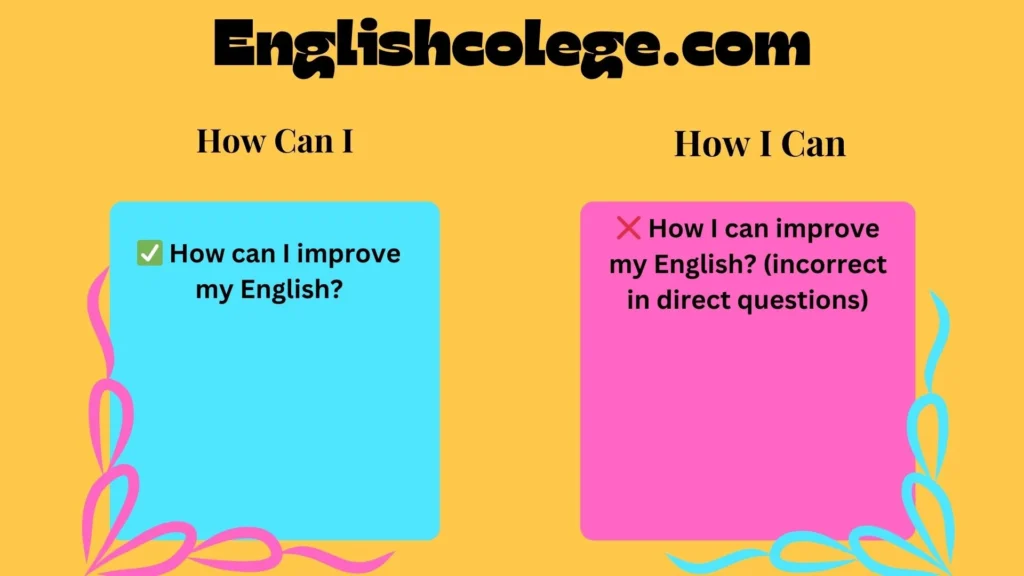
- ✅ How can I improve my English?
- ✅ When will the meeting start?
- ❌ How I can improve my English? (incorrect in direct questions)
Key Components of Direct Questions:
- Question Words: Who, What, When, Where, Why, How
- Auxiliary Verbs: Can, Do, Will, May, Have
- Subject-Verb Inversion: The auxiliary verb comes before the subject
Direct questions are clear and assertive. They are the backbone of fluent English communication.
Question Words in Detail
Question words are the “tools” that shape the kind of answer you’ll get. Here’s a closer look:
| Question Word | Purpose | Example |
|---|---|---|
| Who | Person | Who can help me? |
| What | Thing/Action | What should I do next? |
| When | Time | When can I meet you? |
| Where | Place | Where can I find the book? |
| Why | Reason | Why can I not access the file? |
| How | Method/Degree | How can I improve my writing? |
Pro Tip: “How” is versatile—it can ask about method, manner, or degree.
Auxiliary Verbs and Subject-Verb Inversion
English questions often confuse learners because of word order. The rule is simple:
Auxiliary + Subject + Main Verb + Rest of Sentence
Examples:
- Correct: How can I help you?
- Incorrect: How I can help you?
Auxiliary verbs signal the tense and possibility of an action, making your questions grammatically accurate and natural.
Indirect Questions: Politeness in English Queries
Indirect questions are used to soften requests or sound more polite. Instead of asking directly, you embed the question inside a larger sentence.
Examples:
- Direct: How can I get there?
- Indirect: Could you tell me how I can get there?
Benefits of Indirect Questions:
- Sound professional and polite
- Reduce pressure on the listener
- Make conversations smoother
Additional Words in Indirect Questions
Words like could, would, may, might add politeness. Placement matters:
- Correct: Could you tell me how I can access the files?
- Incorrect: You could tell me how can I access the files?
Tip: Always keep the question word order inside the indirect question: auxiliary comes after the subject.
Using “How Can I” in Interrogative Sentences
“How can I…” is always used for direct questions.
Structure:
- How + auxiliary verb + subject + main verb
Examples:
- How can I help you today?
- How can I learn English faster?
- How can I fix this error in Excel?
This is the natural and grammatically correct way to ask questions in English.
Deciphering “How I Can” in Statements
While “How can I…” asks a question, “How I can…” usually appears in statements or embedded clauses.
Examples:
- Correct: I want to show you how I can solve this problem.
- Incorrect as question: How I can solve this problem?
Notice the difference in tone and meaning: statements describe ability or method, while questions request information.
Embedded Questions within Larger Sentences
Embedded questions combine a question with a statement or another question. They follow the statement word order instead of question inversion.
Examples:
- I’m curious how I can improve my pronunciation.
- She asked me when I can submit the report.
- He wants to know why he can’t access the account.
Tip: Always use the subject before the auxiliary in embedded questions.
Expanding Knowledge with Examples of “How Can I”
Here are practical examples you can use daily:
- Asking for help: How can I assist you today?
- Seeking permission: How can I access the restricted files?
- Problem-solving: How can I fix the software error?
- Learning new skills: How can I improve my public speaking?
Case Study:
A student asked: “How can I get better at writing essays?”
- Direct approach: Teacher suggested: “How can I help you organize your ideas?”
- Indirect approach: Student emailed politely: “Could you tell me how I can structure my essay more effectively?”
Both forms are correct, but the indirect approach is more formal and polite.
Variations: “Why Can I” and “When Can I”
Other question words like why and when follow the same rules:
Direct Questions:
- Why can I not log in?
- When can I submit my assignment?
Indirect Questions:
- Could you explain why I can’t log in?
- I wonder when I can submit my assignment.
Table of Comparison:
| Question Type | Direct | Indirect |
|---|---|---|
| How | How can I help? | Can you tell me how I can help? |
| Why | Why can I not do this? | Could you explain why I cannot do this? |
| When | When can I join? | I’d like to know when I can join. |
Importance of Word Order in English Questions
Word order mistakes are very common in English learners. Always remember:
Direct Question: Auxiliary comes before the subject
- ✅ How can I help you?
- ❌ How I can help you?
Indirect Question: Subject comes before the auxiliary
- ✅ Could you tell me how I can help?
- ❌ Could you tell me how can I help?
Present Perfect Simple vs Continuous in Questions

Using perfect tenses in questions can confuse learners:
- Present Perfect Simple: How long have I studied English? (focus on completion)
- Present Perfect Continuous: How long have I been studying English? (focus on duration of activity)
Both are correct but convey slightly different meanings.
Polite Expressions and Variations
Politeness matters in English, especially in professional or formal contexts.
| Expression | Usage | Example |
|---|---|---|
| Sorry to bother you | Standard polite phrase | Sorry to bother you, could you check this email? |
| Sorry for bothering you | Slightly informal | Sorry for bothering you, I forgot to send the file. |
| How may I help you? | Formal, professional | How may I help you with your account? |
| How can I help you? | Standard conversational | How can I help you today? |
Pro Tip: “How may I help you?” sounds more formal and polite than “How can I help you?”
Sentence Fragments and Common Errors
A sentence fragment is an incomplete sentence that often confuses meaning.
Examples:
- Fragment: How can I improve? (ok in spoken English)
- Fragment: Because I want to learn English. (needs a main clause)
- Corrected: I want to learn English because I want to improve my skills.
Fragments often appear when learners omit subjects or verbs. Watch out for them in both questions and statements.
Denotation in Language
Denotation is the literal meaning of a word, which is key to asking precise questions.
Example:
- Literal: How can I open the door? (specific action)
- Figurative: How can I open the conversation? (metaphorical)
Understanding denotation ensures your questions are clear and unambiguous.
Practical Phrases for Everyday English
Here are some everyday examples that incorporate correct question structures:
- ✅ Thank you, everyone, for coming today.
- ✅ Could you tell me how I can join the meeting?
- ✅ I wonder when I can submit my report.
- ✅ How can I help you with this task?
Mini Cheat Sheet:
- Direct questions: Auxiliary before subject
- Indirect questions: Subject before auxiliary
- Statements with embedded questions: Subject + auxiliary order
Two-Minute English Tips
Want quick wins for forming proper questions?
- Memorize: How can I…?, Why can I…?, When can I…?
- Practice converting direct questions to indirect for polite requests
- Pay attention to word order: auxiliary before subject in questions
- Use polite words like could, may, would in emails and formal speech
- Check tense: present perfect simple vs continuous for clarity
FAQs
What is the difference between “How can I” and “How I can”?
- How can I is a direct question; How I can is used in statements or embedded clauses.
Can I use “How I can” in a question?
- No, it’s incorrect in direct questions. Use it only in statements: I’ll show you how I can do it.
How do I make indirect questions polite?
- Add words like could, would, may and keep subject + auxiliary order correct.
When should I use “How may I help you”?
- Use in formal or professional settings; it’s more polite than How can I help you?
How do I avoid word order mistakes in English questions?
- Remember: Direct questions → auxiliary before subject; Indirect questions → subject before auxiliary.

I’m Sameer — a passionate English enthusiast who loves exploring words, grammar, and the art of effective communication. ✍️