
Understanding the difference between headed and heading sounds simple at first. Both come from the same verb. Both appear everywhere in spoken and written English. Yet people mix them up constantly.
You’ve probably seen sentences like:
- I’m headed to the store.
- I’m heading to the store.
They look almost identical. Still, they don’t always mean the same thing.
This guide clears up the confusion once and for all. You’ll learn how headed or heading work, when each one fits best, and how native speakers actually use them in real life.
By the end, choosing the right word will feel natural instead of stressful.
Why “Headed or Heading” Confuses So Many People
The confusion starts because English lets verbs do double duty. The verb head can show movement, direction, intention, or outcome. Add tense changes into the mix, and things get messy fast.
Here’s the core problem:
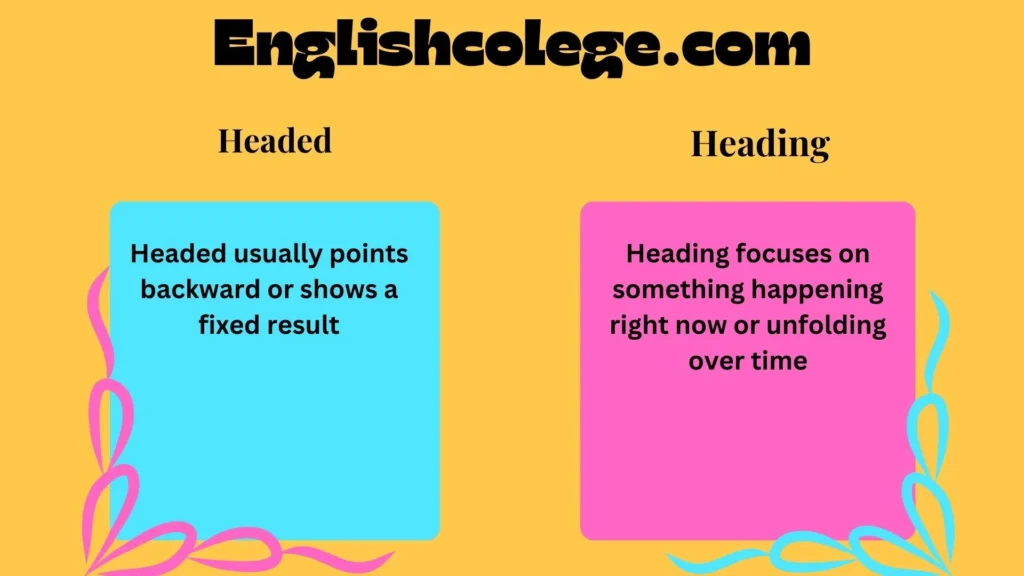
- Headed usually points backward or shows a fixed result
- Heading focuses on something happening right now or unfolding over time
However, everyday speech blurs those lines. People shorten sentences. They drop helping verbs. Context takes over.
That’s why grammar rules alone don’t solve this issue. You need context, timing, and intent working together.
The Root Verb “Head”: What It Really Means
Before comparing headed or heading, you need to understand the base verb head.
At its core, to head means:
- To move toward a place
- To aim in a direction
- To lead toward an outcome
It’s flexible. That flexibility causes confusion.
Common meanings of “head”
- Physical movement
- She headed north.
- Planned movement
- They’re heading home.
- Direction or fate
- The company is headed for growth.
The verb doesn’t always mean literal travel. Sometimes, it describes where things are going, not where they physically move.
What Does “Heading” Mean in English Grammar?
Heading is the present participle of head. It usually appears with a helping verb like am, is, are, was, or were.
What “heading” focuses on
- Action in progress
- Movement currently happening
- Plans already set in motion
Think of heading as a moving arrow. It hasn’t arrived yet. It’s still traveling.
Typical sentence patterns
- I’m heading to class.
- They’re heading toward a decision.
- She was heading out when the phone rang.
In each case, the action is ongoing.
When to Use “Heading” Correctly
Use heading when the movement or direction hasn’t finished yet.
Situations where “heading” works best
- Travel updates
- Real-time plans
- Actions unfolding right now
- Situations that may still change
Real-life examples
- I’m heading to the airport now.
- We’re heading into a busy season.
- He’s heading back after lunch.
Notice how these sentences feel alive. Something is happening in the moment.
What Does “Headed” Mean?
Headed is the past tense or past participle of head. It often signals completion, certainty, or a known direction.
What “headed” emphasizes
- Action already completed
- A settled direction
- A likely or unavoidable outcome
Unlike heading, headed often sounds more final.
Common examples
- We headed home early.
- She’s headed toward a leadership role.
- They were headed for trouble.
Even when paired with is or are, headed can sound firm and decided.
The Two Meanings of “Headed” Most Writers Miss
Many people think headed only refers to past movement. That’s only half the story.
Literal meaning
This refers to actual movement that already happened.
- They headed south last night.
- I headed to bed early.
Figurative meaning
This refers to direction, outcome, or fate.
- The project is headed for success.
- That plan was headed nowhere.
In figurative use, headed often replaces longer explanations.
Headed or Heading: Side-by-Side Comparison
Here’s a clear breakdown to help you decide fast.
| Feature | Headed | Heading |
|---|---|---|
| Tense | Past or fixed | Present, ongoing |
| Timing | Completed or certain | In progress |
| Flexibility | Less flexible | More flexible |
| Common tone | Firm, settled | Casual, immediate |
| Typical use | Outcomes, past travel | Real-time plans |
If the action feels alive, choose heading.
If it feels settled, choose headed.
Real-World Examples That Make the Difference Clear
Let’s look at how context changes everything.
Casual conversation
- I’m heading to the store.
→ You’re on your way right now. - I’m headed to the store.
→ You’ve decided and might already be moving.
Professional writing
- The company is heading into expansion.
→ Growth is beginning. - The company is headed for expansion.
→ Growth looks inevitable.
Text messages
- Heading home now.
- Headed home already.
Short messages favor heading because it sounds immediate.
Common Mistakes With “Headed or Heading”
Mistakes usually happen when people ignore timing.
Frequent errors
- Using headed for actions still happening
- Using heading for events already finished
- Mixing tense with intention
How to avoid them
Ask yourself one question:
Is this action still unfolding, or is it already decided?
That answer points to the right word.
Spoken English vs Written English
Spoken English plays by looser rules.
People say:
- I’m headed out.
- I’m heading out.
Both sound natural. Context fills in the gaps.
Written English demands more precision. Formal writing often prefers headed for outcomes and heading for movement.
Quick tip
- Speech favors comfort
- Writing favors clarity
How Usage Has Changed Over Time
Modern English leans toward heading in casual speech. Social media, texting, and fast conversations encourage present-focused language.
Older styles favored headed for direction and fate. That influence still appears in journalism and formal analysis.
Neither is wrong. They serve different tones.
What Grammar Experts Agree On

Across grammar guides, one principle stays consistent:
Choose the word that matches the timeline.
Grammar experts also agree that clarity beats strict rules. If both forms make sense, choose the one your audience understands instantly.
Quick Decision Guide
Use this fast checklist:
- Is it happening right now? → Heading
- Is it already done? → Headed
- Is the outcome certain? → Headed
- Is the situation still developing? → Heading
Simple. Reliable. Effective.
Mini Case Studies
Case Study One: Travel Update
- I’m heading to New York tomorrow.
→ Travel is planned. - I headed to New York yesterday.
→ Travel is complete.
Case Study Two: Business Context
- The startup is heading toward profitability.
→ Growth is in progress. - The startup is headed for profitability.
→ Success looks likely.
Small word changes. Big meaning shifts.
Helpful Idioms Using “Headed”
English loves idioms.
- Headed for disaster
- Level-headed
- Two-headed problem
These expressions always use headed. Changing them breaks the idiom.
FAQs About Headed or Heading
### Is “I’m headed to work” grammatically correct?
Yes. It’s informal but widely accepted in modern English.
### Is “heading” always present tense?
Not exactly. It’s a participle that works with helping verbs to show ongoing action.
### Which sounds more natural in conversation?
“Heading” usually sounds more casual and immediate.
### Can “headed” describe the future?
Yes. When talking about outcomes, headed often points forward.
### Should formal writing avoid “heading”?
No. Use it when describing active or developing situations.
Final Thoughts on Headed or Heading
Choosing between headed or heading isn’t about memorizing rules. It’s about understanding time, movement, and certainty.
If the action feels alive, use heading.
If the direction feels set, use headed.
Once you tune into that difference, your writing sounds clearer and more confident. No overthinking required.

I’m Sameer — a passionate English enthusiast who loves exploring words, grammar, and the art of effective communication. ✍️