
Every Easter morning, churches around the world echo with the joyful proclamation: “He is risen!” It’s a phrase filled with power, history, and meaning. Yet for many, a subtle question lingers — isn’t it supposed to be “He has risen”?
The difference might seem small, but it opens the door to a fascinating look at language, faith, and tradition.
Understanding this phrase means exploring not only English grammar but also centuries of Christian heritage and translation choices that shaped how believers speak of the Resurrection.
By the end of this article, you’ll know which phrase is grammatically correct, which one carries deeper meaning, and when to use each.
Understanding the Phrase “He Is Risen”
At its core, the phrase “He is risen” declares that Jesus Christ has risen from the dead. It appears in the Gospel of Matthew 28:6 (KJV):
“He is not here: for he is risen, as he said. Come, see the place where the Lord lay.”
The verb “risen” is the past participle of rise. In modern English, we’d normally use the auxiliary verb has before a past participle — as in He has risen. So why does Scripture say He is risen?
The answer lies in historical grammar. In Early Modern English (the form spoken between 1500–1700), the verb “to be” was often used to form perfect tenses of intransitive verbs of motion or change, such as go, come, rise, fall, and depart.
For example:
- He is come. (modern: He has come.)
- They are gone. (modern: They have gone.)
- Christ is risen. (modern: Christ has risen.)
So “He is risen” was once perfectly grammatical. Today, it sounds archaic but remains theologically powerful because it emphasizes an ongoing state — Christ is risen and continues to be alive.
Grammar Breakdown: “He Is Risen” vs. “He Has Risen”
Let’s break this down grammatically.
| Phrase | Verb Used | Grammatical Construction | Modern Meaning |
|---|---|---|---|
| He is risen | “is” (linking verb) + past participle “risen” | Archaic perfect tense using be | Christ has risen and remains alive |
| He has risen | “has” (auxiliary verb) + past participle “risen” | Modern present perfect tense | Christ rose from the dead (completed action) |
The Older Form: “Be” as the Auxiliary
In older English, “be” acted as the auxiliary verb for verbs that described movement or transformation — to rise, to go, to fall, etc. This structure reflected an older Germanic influence still visible in languages like German and French today.
Examples from early English texts:
- He is come to save us.
- The sun is set.
- Our Savior is born this day.
Over time, English simplified its grammar, replacing be with have for most verbs, including rise. Thus, He has risen became the standard form.
Modern Usage: “Have” for Perfect Tense
Today’s English favors have for forming the present perfect tense, expressing an action that occurred recently or continues to affect the present. So, grammatically, “He has risen” fits modern norms.
However, grammar alone doesn’t determine the lasting power of a phrase. That’s where tradition and theology step in.
Language Evolution: From Early English to Modern Usage
The phrase “He is risen” dates back over 400 years, yet it persists unchanged in Christian worship. Why?
Because it’s more than grammar — it’s heritage.
A Snapshot of English Grammar Then and Now
| Century | Common Perfect Auxiliary | Example |
|---|---|---|
| 14th–16th | be for verbs of motion | He is come |
| 17th | Transition period (be and have both used) | He is/has risen |
| 18th–21st | have dominates | He has risen |
The King James Bible (1611) played a massive role in preserving “He is risen.” At that time, both is risen and has risen were acceptable, but is risen sounded more elevated and reverent — fitting for scripture.
Why It Survives Today
Even as English changed, religious language often preserved older grammatical forms. That’s why phrases like:
- Peace be with you.
- Thy will be done.
- He is risen.
still appear in worship.
These forms carry a sense of timelessness and holiness that modern phrasing sometimes loses.
Scriptural and Translational Evidence
Different Bible translations handle this phrase in distinct ways. Let’s compare how Matthew 28:6 and Luke 24:6 render it.
Comparison Table: Bible Translations
| Translation | Matthew 28:6 | Luke 24:6 |
|---|---|---|
| King James Version (KJV) | He is not here: for he is risen | He is not here, but is risen |
| New International Version (NIV) | He is not here; he has risen | He is not here; he has risen! |
| English Standard Version (ESV) | He is not here, for he has risen | He is not here, but has risen |
| New Living Translation (NLT) | He isn’t here! He is risen from the dead | He isn’t here! He is risen from the dead! |
This comparison highlights that modern translations replace is with has to align with current grammar.
But traditional versions like the KJV keep is risen because of its historical and liturgical weight.
Theological Weight of the Phrase
Language aside, the theological difference between “He is risen” and “He has risen” runs deep.
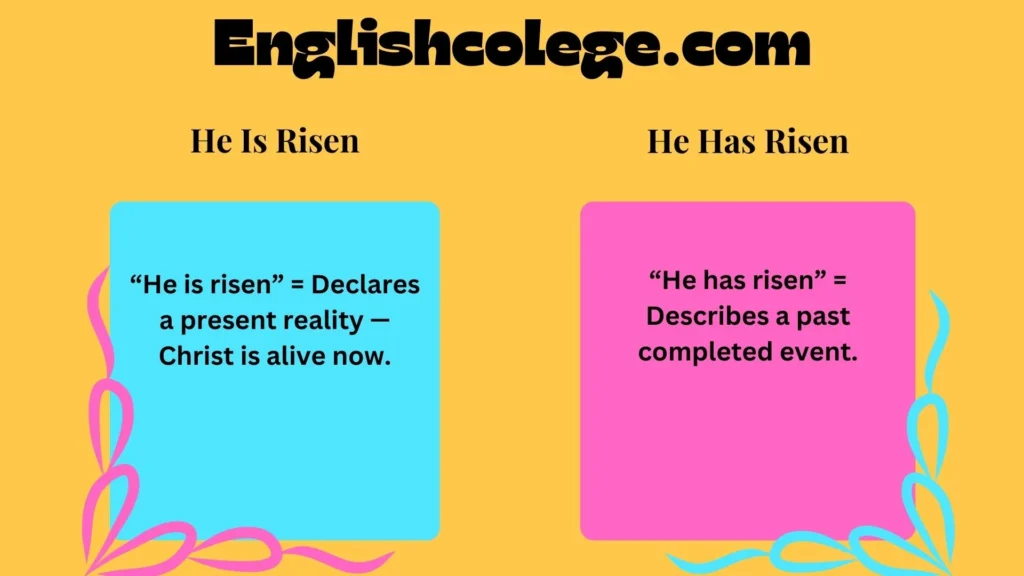
- “He has risen” = Describes a past completed event.
- “He is risen” = Declares a present reality — Christ is alive now.
As theologian N.T. Wright once noted:
“The Resurrection is not just an event in the past; it is a reality that shapes the present.”
That’s why “He is risen” remains the preferred liturgical proclamation. It’s not only about what happened — it’s about what is true now.
Symbolism in Grammar
The word is in “He is risen” captures ongoing life. It affirms that Jesus didn’t merely rise once but remains risen forever.
In contrast, has risen could feel more historical or descriptive. So while grammatically modern, it lacks the poetic power of is risen when used in worship.
“He Is Risen” in Hymns, Liturgy, and Everyday Faith
The phrase “He is risen” has transcended language to become a universal Christian greeting and symbol of victory.
Examples in Worship
- Easter Greeting:
- “He is risen!”
- “He is risen indeed!”
This exchange dates back centuries and remains central in Easter liturgies worldwide.
- Hymns:
- “Christ the Lord Is Risen Today” (Charles Wesley, 1739)
- “He Is Risen! He Is Risen!” (Cecil F. Alexander, 1846)
Both cemented the phrase into Christian music and memory.
Cultural Continuity
Even modern believers continue to use “He is risen” in conversation, cards, and sermons. The phrase connects them to 2,000 years of Christian tradition, bridging language evolution with eternal truth.
When to Use Each Phrase Correctly
Both phrases are correct — the choice depends on context.
Use “He Is Risen” When:
- Referring to religious celebrations, especially Easter.
- Quoting or referencing scripture (especially the KJV).
- You want a liturgical or traditional tone.
- Writing hymns, sermons, or devotional materials.
Example:
On Easter morning, Christians proclaim, “He is risen!” as a joyful statement of faith.
Use “He Has Risen” When:
- Writing in modern academic or grammatical contexts.
- Translating scripture for clarity in contemporary English.
- Discussing the event of resurrection from a linguistic standpoint.
Example:
The Gospel writers record that Jesus has risen from the dead, fulfilling prophecy.
Both are acceptable. The difference lies in tone and purpose — one is timeless, the other modern.
Common Language Questions Related to This Topic
To help you strengthen your overall grammar understanding, here are related questions often searched with this topic.
Can You Start a Sentence with a Conjunction?
Yes. Starting sentences with and, but, or so is perfectly acceptable in modern English — when done sparingly. It helps create rhythm and flow.
What Are Contractions? Definition and Examples
Contractions combine two words into one by omitting letters (e.g., don’t, isn’t, you’ll). They make writing conversational and natural.
Is It Correct to Say “So True”?
Yes. “So true” is an informal affirmation meaning “absolutely right.” It’s common in spoken English and casual writing.
Inspired BY or FROM – Which Is Correct?
Use “inspired by” when something influences you (a film inspired by true events).
Use “inspired from” rarely, and mostly in poetic contexts.
Is It Correct to Say “Feel Bad”?
Yes. “I feel bad” is grammatically correct to describe emotion.
“I feel badly” means your sense of touch isn’t working well — a different meaning.

Frequently Asked Questions (FAQs)
Why do people still say “He is risen”?
Because it’s part of Christian tradition and conveys a living truth — Jesus is alive, not just was resurrected.
Which Bible translations use “He has risen”?
Modern translations like NIV, ESV, and NLT use has risen to reflect contemporary grammar.
Is “He is risen” grammatically wrong today?
Not wrong — just archaic. It’s still correct in historical, poetic, or religious contexts.
Did older English really use “is” instead of “has”?
Yes. Early Modern English used be as the auxiliary for verbs of motion and change, following older Germanic grammar.
Which should I use in everyday writing?
Use “He has risen” for everyday or academic writing, but “He is risen” when quoting scripture or discussing Easter.
Summary
The choice between “He is risen” and “He has risen” reveals more than grammar — it tells a story of language evolution and enduring faith.
- “He is risen” reflects Early Modern English and the living nature of Christ’s resurrection.
- “He has risen” fits modern English and describes the completed event of resurrection.
Both are valid, but one belongs to the heart of worship, the other to the classroom of language.
“He is risen” endures because it isn’t just about what happened — it’s about what still is.

I’m Sameer — a passionate English enthusiast who loves exploring words, grammar, and the art of effective communication. ✍️