

English learners often stumble over small but mighty words like “hasn’t” and “haven’t.” They look and sound similar, yet using the wrong one can change the entire meaning of your sentence.
Let’s clear that confusion once and for all. In this guide, you’ll learn exactly when to use “hasn’t” or “haven’t,” how contractions work, and why this small detail matters so much in everyday English.
By the end, you’ll be able to use both forms confidently—without second-guessing yourself.
The Core Difference in a Nutshell
Before diving into grammar theory, here’s the quick takeaway:
| Subject Type | Contraction | Full Form | Example |
|---|---|---|---|
| Singular (He, She, It, John) | Hasn’t | has not | She hasn’t eaten breakfast. |
| Plural (I, You, We, They) | Haven’t | have not | They haven’t called yet. |
👉 In short:
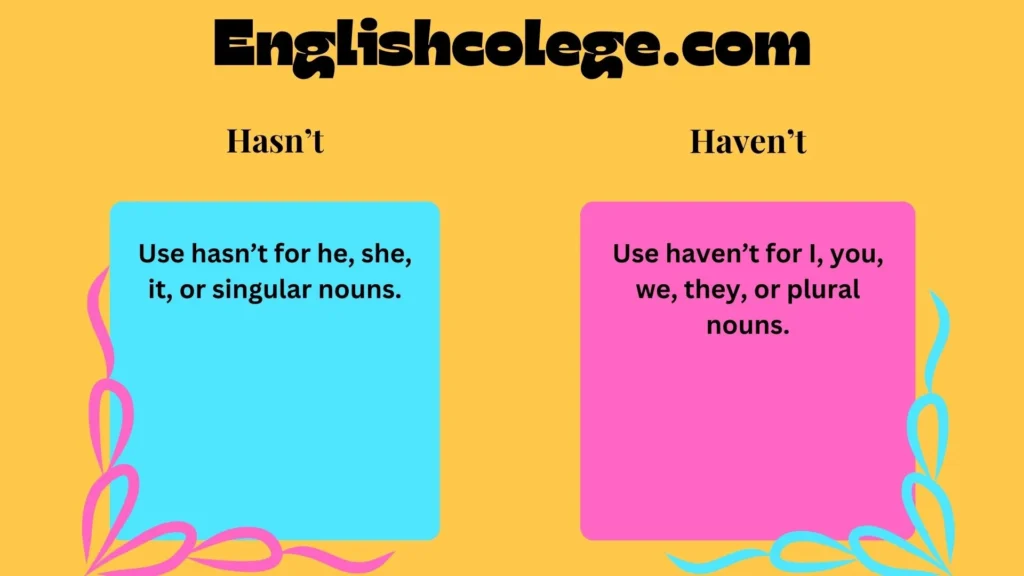
- Use hasn’t for he, she, it, or singular nouns.
- Use haven’t for I, you, we, they, or plural nouns.
Simple, right? Let’s unpack why this works.
Understanding Grammar Foundations
Singular vs. Plural Subjects
Every sentence revolves around its subject, and English verbs change form depending on whether the subject is singular or plural.
- Singular: He, she, it, the car, the teacher
- Plural: They, we, you, the students
When you use the verb “to have” in the present perfect tense, it takes different forms:
- Singular → has
- Plural → have
So, when we make the negative form:
- “has not” → hasn’t
- “have not” → haven’t
Examples:
- She hasn’t finished her homework. ✅
- They haven’t finished their homework. ✅
If you switch them:
- She haven’t finished. ❌
- They hasn’t finished. ❌
That’s the grammatical root of this difference.
The Role of “Has” and “Have” in Verb Tenses
Both “has” and “have” come from the same root verb “to have.”
They’re auxiliary (helping) verbs used to form the present perfect tense — a tense that connects past actions to the present moment.
Structure:
Subject + has/have + past participle
Examples:
- She has eaten her lunch.
- They have eaten their lunch.
Now, for negative sentences:
- She hasn’t eaten yet.
- They haven’t eaten yet.
This tense expresses actions that are completed at some point before now or experiences relevant to the present.
Quote: “Grammar is not just about rules—it’s about rhythm. Once you feel how subjects and verbs ‘agree,’ English starts to flow naturally.”
Contractions in English: Why We Use Them
English speakers love shortcuts. Instead of saying “has not”, we say “hasn’t.”
Instead of “have not,” we say “haven’t.”
These shortened forms, known as contractions, make English sound more natural and conversational.
Common Contractions You Already Use:

| Full Form | Contraction |
|---|---|
| Do not | Don’t |
| Cannot | Can’t |
| Is not | Isn’t |
| Has not | Hasn’t |
| Have not | Haven’t |
You’ll hear contractions in almost every conversation, TV show, or song. They make speech smoother and less formal.
Example in dialogue:
- “She hasn’t told me yet.”
- “They haven’t decided.”
Notice how much more natural it sounds than the stiff versions “She has not told me yet.” or “They have not decided.”
Using “Hasn’t” Correctly
“Hasn’t” = has not.
Use it when your subject is singular or refers to he, she, it, or a singular noun.
Examples:
- He hasn’t cleaned his room.
- She hasn’t replied to your text.
- It hasn’t stopped raining all day.
- The company hasn’t launched the product yet.
Check for Correctness:
If you’re unsure, replace the contraction with the full form:
- “He hasn’t finished” → “He has not finished.” ✔
- “He haven’t finished” → “He have not finished.” ❌
Tip: Remember that “hasn’t” always pairs with a single subject that’s not “I” or “you.”
Using “Haven’t” Correctly
“Haven’t” = have not.
It pairs with I, you, we, they, or any plural noun.
Examples:
- I haven’t seen that movie yet.
- You haven’t done your homework.
- We haven’t met before.
- They haven’t finished the project.
- The students haven’t arrived.
Special Case: “I Haven’t”
Even though “I” is singular, it uses have instead of has.
That’s because English treats “I” as an exception in verb agreement.
Example:
- I have gone → I haven’t gone
- Not: I hasn’t gone.
Sentence Patterns and Common Mistakes
Let’s look at the mistakes English learners often make and how to fix them.
Common Errors:
| Incorrect Sentence | Why It’s Wrong | Correct Form |
|---|---|---|
| They hasn’t arrived yet. | “They” is plural → needs “have.” | They haven’t arrived yet. |
| He haven’t seen her. | “He” is singular → needs “has.” | He hasn’t seen her. |
| The teachers hasn’t left. | “Teachers” is plural. | The teachers haven’t left. |
| It haven’t stopped raining. | “It” is singular. | It hasn’t stopped raining. |
How to Double-Check:
Replace contractions with full forms:
- If it sounds right with “has not,” use hasn’t.
- If it sounds right with “have not,” use haven’t.
This quick mental trick prevents 90% of errors.
Advanced Usage Notes
“Hasn’t” and “Haven’t” in Questions
In questions, the word order flips:
| Type | Example |
|---|---|
| Hasn’t | Hasn’t she arrived yet? |
| Haven’t | Haven’t they left already? |
These are negative questions — they often show surprise or expectation.
“Hasn’t he called yet?” (You expected him to call.)
“Haven’t we met before?” (You think you recognize someone.)
Regional and Stylistic Nuances
There’s no real difference between British and American English in using hasn’t and haven’t. Both follow the same grammatical rules.
However, in informal British speech, you might hear ellipsis like:
- “You not finished yet?” instead of “Haven’t you finished yet?”
That’s stylistic, not grammatical.
Quick Reference Table
| Context | Hasn’t | Haven’t |
|---|---|---|
| He, She, It | ✔ | ✗ |
| I, You, We, They | ✗ | ✔ |
| Singular Noun (The cat, The child) | ✔ | ✗ |
| Plural Noun (The cats, The children) | ✗ | ✔ |
| Negative Sentences | ✔ | ✔ |
| Questions | ✔ | ✔ |
Easy Memory Tricks
Grammar can be logical—but memory aids make it faster to recall.
Mnemonics:
- Hasn’t = Singular “S” → He/She/It = Single person/thing.
- Haven’t = Many “Have” more friends! → We/You/They = Plural group.
Analogy:
Think of “hasn’t” and “haven’t” like phone chargers:
- “Hasn’t” fits only one model (singular subjects).
- “Haven’t” works with multiple devices (plural subjects).
Practice Quiz:
Fill in the blanks (answers below):
- She ___ finished her meal.
- I ___ seen that series.
- The dog ___ barked today.
- They ___ told me the news.
Answers: 1️⃣ hasn’t, 2️⃣ haven’t, 3️⃣ hasn’t, 4️⃣ haven’t.
Real-World Case Studies
Case Study 1: Business Email Example
Incorrect: Our team hasn’t submitted the reports yet.
Correct: Our team haven’t submitted the reports yet. (In British English, “team” can be plural if you mean the members.)
Lesson: In British English, collective nouns like team, staff, police can take plural verbs. In American English, they’re usually singular.
Case Study 2: Customer Support Chat
Customer: Haven’t you fixed this issue yet?
Agent: No, it hasn’t been resolved yet.
Notice the subject switch:
- “You” → haven’t
- “It” → hasn’t
Same verb, different subject — different contraction.
Quick Recap
Let’s recap the main points before moving to FAQs:
- “Hasn’t” = has not → used for he, she, it, singular nouns.
- “Haven’t” = have not → used for I, you, we, they, plural nouns.
- Always check the subject before choosing.
- Replace contractions with full forms to test correctness.
- Use contractions in everyday English for a smoother tone.
Frequently Asked Questions (FAQs)
What is the difference between “hasn’t” and “haven’t”?
“Hasn’t” is used with singular third-person subjects (he, she, it). “Haven’t” is used with plural subjects (we, you, they) and with “I.”
Can I use “haven’t” with “he” or “she”?
No. “He” and “she” take “hasn’t.”
Example: He hasn’t called today. not He haven’t called today.
Why do we say “I haven’t” and not “I hasn’t”?
Because “I” always pairs with “have,” not “has.” It’s a unique rule of English subject–verb agreement.
Is there a difference between British and American usage of “hasn’t” and “haven’t”?
The rules are the same, but British English sometimes treats collective nouns (like team or government) as plural: The team haven’t won yet.
Can “hasn’t” and “haven’t” be used in questions?
Yes.
- Hasn’t she arrived yet?
- Haven’t they finished the work?
These are negative questions often showing surprise or emphasis.
Conclusion
The confusion between hasn’t and haven’t disappears once you focus on the subject of the sentence.
Think of it like matching puzzle pieces — singular subjects connect with hasn’t, while plural ones (plus I and you) connect with haven’t.
Mastering this simple pattern makes your English sound smoother and more natural. Whether you’re writing emails, speaking in meetings, or chatting online, you’ll now choose the right contraction every time.
So next time you pause before typing, ask yourself: “Who’s doing the action?” The answer will instantly guide you to either hasn’t or haven’t.

I’m Sameer — a passionate English enthusiast who loves exploring words, grammar, and the art of effective communication. ✍️