
English can be tricky sometimes, especially when two words sound identical but carry different meanings. One common confusion revolves around “gases” and “gasses.”
At first glance, you might think they’re just spelling variations of the same word. But the truth is—each has its own distinct grammatical role and context of use.
If you’ve ever second-guessed yourself typing gases or gasses, this guide breaks it all down with clear examples, grammar insights, historical roots, and simple memory tricks to help you never mix them up again.
Why This Common Confusion Exists
The confusion between “gases” and “gasses” is easy to understand. Both words:
- Sound exactly the same (homophones).
- Look nearly identical.
- Originate from the same root word — gas.
However, their uses diverge sharply depending on whether you’re describing a substance or an action.
Here’s a quick preview:
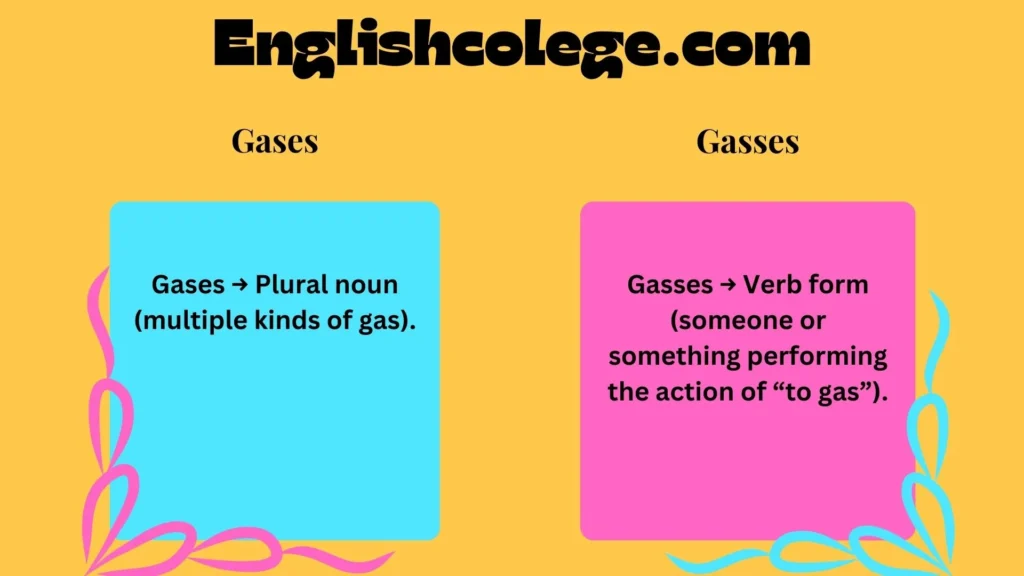
- Gases → Plural noun (multiple kinds of gas).
- Gasses → Verb form (someone or something performing the action of “to gas”).
Let’s dig into these differences more deeply.
Understanding the Core Difference
At the heart of it, “gases” refers to things, while “gasses” refers to actions.
To make that clearer, here’s a simple side-by-side comparison:
| Word | Part of Speech | Meaning | Example |
|---|---|---|---|
| Gases | Noun | Plural of gas (a substance in a gaseous state) | The lab measured several gases emitted from the engine. |
| Gasses | Verb | Third-person singular or plural of to gas (to supply, expose to, or fill with gas) | The plant gasses the samples before packaging. |
Think of it this way:
- If you can count them (oxygen, nitrogen, etc.), use “gases.”
- If something is doing the action (like filling up or releasing gas), use “gasses.”
When to Use “Gases”
“Gases” is the only correct plural of the noun “gas.”
It’s used in science, chemistry, and everyday speech when referring to multiple types of gaseous substances.
In Science and Chemistry
In scientific writing, gases is common when discussing states of matter or chemical behavior.
Examples:
- The atmosphere contains several gases, including nitrogen and oxygen.
- Carbon dioxide and methane are greenhouse gases contributing to global warming.
In physics or chemistry, the term often appears when discussing pressure, temperature, and volume (the ideal gas law: PV = nRT).
In Daily Life
Outside the lab, you’ll see gases in everyday contexts:
- Natural gases are used for cooking and heating.
- Poisonous gases leaked during the experiment.
Scientific Fact
The Earth’s atmosphere is made of approximately:
- 78% nitrogen
- 21% oxygen
- 1% argon, carbon dioxide, and other trace gases
That’s why scientists always write “gases”—never “gasses”—when discussing the composition of air.
When to Use “Gasses”
“Gasses” is a verb, not a noun.
It’s the third-person singular or plural present tense of to gas.
It means:
- To fill or expose something to gas
- To give off gas
- To poison with gas (in historical or military contexts)
Examples:
- The car gasses up before the road trip.
- The machine gasses the chamber with nitrogen to preserve freshness.
- He accidentally gasses the room while welding.
Real-World Uses
You’ll often find “gasses” in:
- Automotive contexts: “She gasses up her car every Friday.”
- Industrial applications: “The plant gasses the bottles to sterilize them.”
- Historical references: “Soldiers were gassed during World War I.”
Note: In British English, some older texts used “gasses” as a plural noun. But modern dictionaries like Merriam-Webster and Oxford now recommend using “gases” exclusively for the noun form.
Grammar Behind the Double “S”
Why does the word sometimes double the “s”?
It all comes down to a spelling rule in English.
Doubling Consonants Rule
When a single-syllable word ends in a vowel + consonant, you double the consonant before adding a suffix like -ed, -es, or -ing.
Example patterns:
- Run → running
- Plan → planned
- Gas → gasses (verb)
This doubling helps preserve the original short vowel sound and maintain correct pronunciation.
However, nouns don’t follow that rule when pluralized. That’s why:
- Noun: gas → gases
- Verb: gas → gasses → gassed
Quick Comparison Table
| Word | Function | Correct? | Example |
|---|---|---|---|
| Gas → Gases | Noun (plural) | ✅ Correct | Different gases mix in the atmosphere. |
| Gas → Gasses | Verb | ✅ Correct | The machine gasses the container. |
| Gas → Gasses (noun) | ❌ Incorrect | The scientist studied various gasses. ❌ |

Historical Origins and Etymology
The word “gas” has fascinating roots dating back to the 17th century.
It was coined by Jan Baptist van Helmont, a Flemish chemist and alchemist. He derived gas from the Greek word “chaos”, meaning “void” or “formless substance.”
Over time, “gas” became a key scientific term referring to matter that expands to fill any container.
Early Spelling Variations
During the 1700s and 1800s, both “gases” and “gasses” appeared in print. Eventually, “gases” became the standard plural form as English spelling rules became formalized.
Notable Linguistic Milestones:
- 1650s: “Gas” introduced by van Helmont.
- 1800s: Chemists adopted “gases” as plural.
- Modern era: Dictionaries universally recognize “gases” for plural noun use and “gasses” only as verb forms.
“Gasses” in Real-World Contexts
1. Automotive Use
- “The driver gasses up before a long drive.”
Here, “gasses” means to fill a vehicle with fuel.
2. Industrial Use
- “The packaging system gasses the food containers with nitrogen.”
This prevents spoilage by removing oxygen—an essential process in food preservation industries.
3. Environmental and Energy Context
- “The plant gasses the waste before disposal.”
Used to describe industrial emissions or chemical treatments involving gases.
4. Military History
- “Soldiers were gassed during World War I.”
A chilling reminder of how the verb form is tied to warfare, where poisonous gases were weaponized.
Caution: Because of this dark historical association, use “gasses” carefully in sensitive contexts.
Practical Tips to Remember the Difference
Learning small tricks can make remembering the difference effortless.
Mnemonics
- “Two S’s = Action.”
Gasses has two S’s → it’s doing something (verb). - “E for Element.”
Gases ends in “-es” → refers to substances (nouns).
Memory Trick
Ask yourself:
- Am I talking about a thing? → use gases.
- Am I talking about an action? → use gasses.
Quick Checklist
✅ Talking about matter → gases
✅ Talking about doing something → gasses
❌ Mixing them up → Confusing your readers!
Examples in Sentences
Here’s how both appear correctly in real sentences:
| Sentence | Correct Form | Explanation |
|---|---|---|
| The scientist measured the gases emitted from the volcano. | ✅ Gases | Refers to multiple types of gas. |
| The mechanic gasses up his truck every morning. | ✅ Gasses | Refers to the action of filling with fuel. |
| The experiment involved heating various gases. | ✅ Gases | Noun, plural. |
| The factory gasses the bottles to remove oxygen. | ✅ Gasses | Verb, action. |
| The researcher identified several harmful gases in the air. | ✅ Gases | Scientific noun. |
Case Study: NASA’s Use of “Gases” vs “Gasses”
NASA scientists are extremely precise about language.
In their documentation:
- “Gases” is used to describe atmospheric substances or engine exhaust (e.g., “combustion gases”).
- “Gasses” is used only when describing active processes, such as when a system releases or fills something with gas.
This distinction ensures clarity, especially in technical manuals where confusion could affect interpretation or safety.
Key Takeaways
Let’s simplify everything you’ve learned:
| Rule | Correct Word | Example |
|---|---|---|
| Talking about multiple gases | Gases | Carbon dioxide and nitrogen are gases. |
| Describing an action involving gas | Gasses | The welder gasses the chamber. |
| Referring to the noun form | Gases | Oxygen and helium are gases. |
| Using as a verb (to emit, fill, or fuel) | Gasses | He gasses up his motorcycle. |
In short:
- Gases = things (plural noun)
- Gasses = actions (verb)
FAQs
Is “gasses” ever used as a plural noun?
Rarely, and mostly in older British English. Modern usage strictly prefers “gases.”
Why do some people double the “s”?
The double “s” follows the rule for verbs ending in a short vowel + consonant (gas → gasses). It’s not applied to the plural noun form.
Are “gases” and “gas” pronounced differently?
No. Both “gases” and “gasses” are pronounced the same: /ˈɡæsɪz/.
Which is correct: “greenhouse gases” or “greenhouse gasses”?
Always “greenhouse gases.” It refers to substances (CO₂, CH₄, N₂O), not an action.
Can “gassed” and “gasses” mean the same thing?
Not quite. Gassed is past tense (“He gassed the room”), while gasses is present tense (“He gasses the room”).
Conclusion
The confusion between “gases” and “gasses” boils down to noun vs. verb.
Both share the same origin, but their uses are distinct and rule-based.
Remember:
- “Gases” = plural of the noun gas.
- “Gasses” = present tense of the verb to gas.
If you’re describing substances, use gases.
If you’re describing actions, use gasses.
Mastering this simple distinction will make your writing more accurate, professional, and easy to understand.

I’m Sameer — a passionate English enthusiast who loves exploring words, grammar, and the art of effective communication. ✍️