
You’ve seen both phrases everywhere — on wedding invitations, store sales, and holiday cards.
But have you ever wondered which one is right? Should you say “Family & Friends” or “Friends & Family”?
At first glance, it might seem trivial. Yet, the order of these two words changes how the phrase feels.
Word order affects tone, formality, and even emotional weight. Let’s unpack why people choose one over the other — and what linguistics, culture, and psychology reveal about it.
Family & Friends or Friends & Family — What Goes First? Meaning Explained
Many English learners wonder whether “family & friends” or “friends & family” should come first. In everyday English, both phrases are correct and widely used. The order usually depends on context, emphasis, or personal preference rather than strict grammar rules.
Traditionally, people say “family and friends” because family relationships often come first in social importance. For example, in invitations, speeches, or announcements, you may hear phrases like “I would like to thank my family and friends.” This order reflects the cultural idea that family holds a primary place in a person’s life.
However, “friends and family” is also common. Writers sometimes use this version to create a smoother flow in a sentence or to emphasize friendships first. In casual conversation, both forms sound natural and native speakers use them interchangeably.
In short, there is no strict rule. Choose the phrase that fits the tone and rhythm of your sentence.
Grammar Basics: Is There a Rule?
Grammatically, there’s no official rule dictating which word should come first. Both forms are correct. The English language allows flexibility when connecting nouns with “and.”
Still, linguists have noticed patterns called irreversible binomials — fixed word pairs that naturally appear in one order, like:
- “Salt and pepper” (not “pepper and salt”)
- “Black and white” (not “white and black”)
- “Bread and butter” (not “butter and bread”)
These pairs sound right because of rhythm, familiarity, and flow. “Friends & Family” follows this same natural pattern. It rolls off the tongue more smoothly — one syllable, then two. The rhythm just feels right.
Cultural and Emotional Nuances
Language doesn’t live in a vacuum. Cultural context heavily influences how we use phrases.
In Western cultures, “family” often symbolizes permanence and loyalty, while “friends” represent freedom and choice. So saying “Family & Friends” can sound more traditional or sentimental — something you’d see in a wedding speech or holiday greeting.
On the other hand, “Friends & Family” feels casual, modern, and inclusive. That’s why brands use it for sales and promotions — “Friends & Family Sale” feels welcoming, not stiff.
For example:
- Wedding card → “To our Family & Friends”
- Clothing store promo → “Friends & Family Event”
Same words, different feeling.
The Psychology Behind Word Order
In psychology and linguistics, the first word in a pair carries more cognitive weight. It sets the emotional tone.
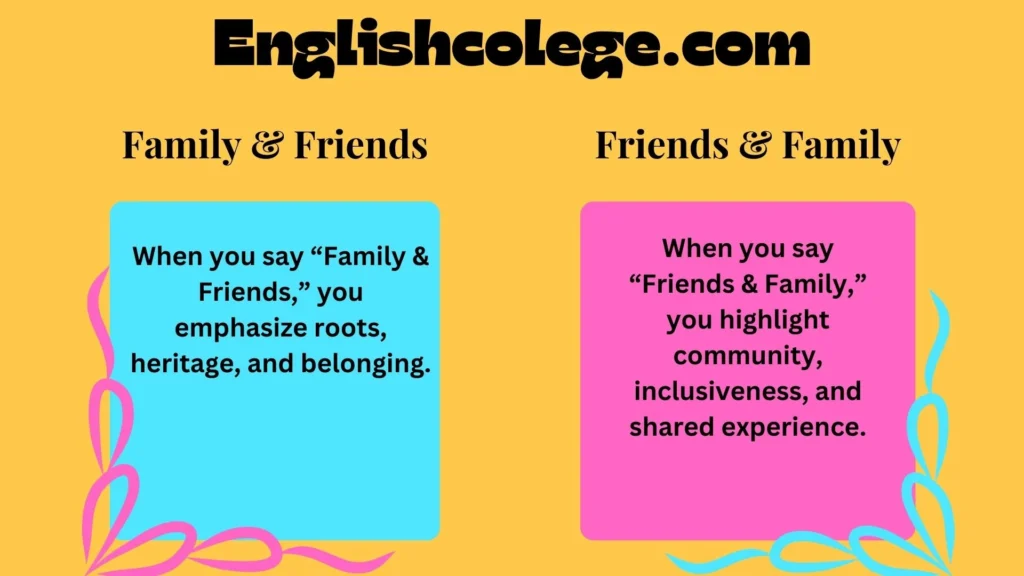
When you say “Family & Friends,” you emphasize roots, heritage, and belonging.
When you say “Friends & Family,” you highlight community, inclusiveness, and shared experience.
Your brain subtly reacts differently to each version. Researchers studying speech rhythm and recall found that earlier words in a phrase tend to be remembered first — shaping how we perceive their importance.
So, choosing the order isn’t random. It’s about what you want to highlight.
Formal Writing and Etiquette
If you’re writing a letter, invitation, or announcement, etiquette matters. Here’s how to use both correctly:
Examples:
- Formal invitation: “Dear Family and Friends,” — polite and respectful.
- Casual email or post: “Hey Friends and Family!” — warm and conversational.
When addressing a mixed audience, “Family & Friends” often feels more appropriate for formal events. It leads with family out of respect, then extends warmth to friends.
In contrast, “Friends & Family” suits marketing campaigns, newsletters, or casual notes where tone and approachability matter more than hierarchy.
Capitalization Rules in Greetings
People often get this part wrong. Here’s the quick fix:
- In letters or invitations, capitalize both nouns: “Dear Family and Friends,”
- In running text, lowercase unless they’re part of a title:
- Correct: We want to thank our family and friends for their love and support.
- Incorrect: We want to thank our Family and Friends…
If the phrase appears as part of a formal title or event name, capitalize it:
“Friends & Family Sale” or “Family & Friends Gathering.”
Consistency is key.
Modern Usage Trends
Over the past decade, “Friends & Family” has overtaken “Family & Friends” in popularity — especially online. A quick search of social media hashtags shows millions of posts under #friendsandfamily, while #familyandfriends trails slightly behind.
Why? Marketing and digital communication favor rhythm and informality. The order “friends and family” feels upbeat and modern. It also fits better in branding — short, snappy, and friendly.
But when it comes to traditional or sentimental contexts, “Family & Friends” still reigns supreme. Think wedding invites, holiday cards, or religious ceremonies.
Similar English Phrases and Word Pair Patterns
English is full of familiar word pairs that always appear in a set order. These are called binomial expressions. They’re everywhere:
| Common Phrase | Uncommon/Incorrect Alternative |
|---|---|
| Bread and butter | Butter and bread |
| Folks | Gentlemen and ladies |
| Peace and quiet | Quiet and peace |
| Law and order | Order and law |
| Friends and family | Family and friends |
Notice the flow? The first word often has fewer syllables, softer consonants, or greater emotional neutrality. That’s why our brains “prefer” it first.
When to Use Each Phrase (Practical Guide)
Here’s a simple table to make the choice easy:
| Context | Preferred Phrase | Reason |
|---|---|---|
| Wedding invitation | Family & Friends | Feels formal and respectful |
| Holiday greeting | Family & Friends | Warm, traditional tone |
| Marketing campaign | Friends & Family | Modern, inclusive, friendly |
| Social media post | Friends & Family | Casual and conversational |
| Corporate email | Friends & Family | Sounds professional yet inviting |
Final Thoughts
There’s no “wrong” choice between “Family & Friends” and “Friends & Family.” Both are correct — they just suit different moods and situations.
If you want warmth, tradition, and respect, lead with Family.
If you want energy, openness, and friendliness, start with Friends.
In the end, language mirrors how you want people to feel. So whether you’re writing a heartfelt card or designing a campaign, remember — the order matters less than the sincerity behind the words.
When you say it with love, both sound perfect.

I’m Sameer — a passionate English enthusiast who loves exploring words, grammar, and the art of effective communication. ✍️