
English can be tricky—especially when one tiny line like a hyphen (-) can change meaning, tone, and even grammar.
One of the most common questions writers face is whether to write “face to face” or “face-to-face.”
You’ve probably seen both versions everywhere: job descriptions, academic papers, business reports, and online articles.
But which one is correct?
Let’s break it down once and for all with clear rules, real examples, and expert-backed insights.
Why “Face to Face” Causes So Much Confusion
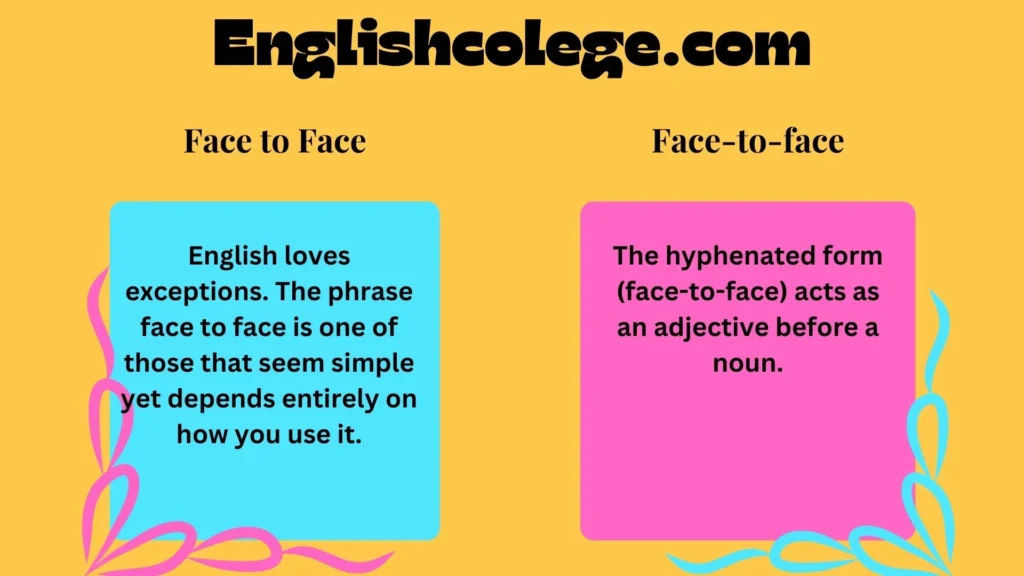
English loves exceptions. The phrase face to face is one of those that seem simple yet depends entirely on how you use it.
- Both forms are correct—but they serve different grammatical purposes.
- The hyphenated form (face-to-face) acts as an adjective before a noun.
- The open form (face to face) functions as an adverb—it modifies a verb or describes how something happened.
Example:
- ✅ We met face to face. → adverb
- ✅ We had a face-to-face meeting. → adjective
In short, the hyphen depends on the word’s role in the sentence. Let’s go deeper.
The Function of Hyphens in American English
Hyphens play an essential role in clarity and readability. In American English, they link words that work together as a single idea.
What a Hyphen Does
A hyphen connects two or more words to form a compound modifier—a description that functions as one unit.
Examples:
- well-known author
- high-quality camera
- full-time job
Without the hyphen, the meaning can change—or the sentence might sound awkward.
Compare:
- small business owner vs. small-business owner
- The first could mean a tiny person who owns a business.
- The second correctly means someone who owns a small business.
The same principle applies to face-to-face.
When used before a noun, face-to-face acts as a compound adjective, describing the noun it modifies.
Example:
“Face-to-face learning helps students build stronger connections.”
Here, face-to-face describes the type of learning.
The Grammar Rule: Adjective vs. Adverb Use
The rule is simple but powerful.
| Function | Form | Example | Explanation |
|---|---|---|---|
| Adjective (modifies a noun) | Hyphenated | A face-to-face interview | The phrase describes interview. |
| Adverb (modifies a verb) | Open | They met face to face. | The phrase describes how they met. |
When you can insert the phrase before a noun, use the hyphenated form.
When it follows the verb, no hyphen.
Why This Rule Exists
Hyphens prevent misreading.
Without the hyphen, readers might momentarily pause or misunderstand what modifies what.
For example:
- ❌ Face to face classes — unclear and grammatically incorrect.
- ✅ Face-to-face classes — clear and standard.
The Chicago Manual of Style and Merriam-Webster both confirm this usage.
Chicago Manual of Style 7.85: Use hyphens in compound modifiers preceding a noun to prevent ambiguity.
So, next time you’re unsure, check if the phrase comes before a noun—that’s your hyphen cue.
Context Matters: Formal, Informal, and Digital Writing
Language changes depending on where you use it. The face-to-face vs. face to face question also depends on context and tone.
In Academic or Professional Writing
Always stick with formal grammar. Use:
- face-to-face meeting
- face-to-face interaction
- face-to-face communication
This maintains credibility and matches professional standards.
In Everyday Writing or Speech
You’ll often see “face to face” without the hyphen—even in casual emails or messages. It’s acceptable as long as it’s used as an adverb.
Example:
“Let’s talk face to face instead of texting.”
In Digital and Informal Communication
Online writing often drops hyphens for speed and readability. Many style guides tolerate it if context is clear. However, when writing blog posts, reports, or educational content, it’s best to retain the hyphen for adjectives—it signals precision and professionalism.
Common Mistakes and Misconceptions
Even experienced writers slip up on this one. Here are the most frequent errors people make:
| Mistake | Why It’s Wrong | Correct Form |
|---|---|---|
| a face to face meeting | Missing hyphen before noun | a face-to-face meeting |
| they met face-to-face | Hyphen used incorrectly after verb | they met face to face |
| face-to-face-to-face | Overhyphenation — unnecessary repetition | Use in-person instead |
Auto-Correct Issues
Many text editors or word processors don’t automatically correct this distinction.
You may need to add it manually—especially in Word or Google Docs.
Tip: Grammarly and ProWritingAid will flag incorrect hyphenation based on context.
Real-World Usage in Reputable Sources
To understand how experts use the phrase, let’s see what top style guides and dictionaries say:
| Source | Adjective Use | Adverb Use | Example |
|---|---|---|---|
| APA | Hyphenate | No hyphen | Face-to-face interview, met face to face |
| Chicago Manual of Style | Hyphenate | No hyphen | Same as above |
| Merriam-Webster | Lists both | Notes functional difference | Face-to-face learning, talk face to face |
| Cambridge Dictionary | Hyphenate | Open form accepted | Face-to-face classes, see someone face to face |
| Oxford English Dictionary | Both forms valid | Depends on grammatical use | — |
Across all reputable sources, the pattern is identical:
- Hyphenated → adjective before noun.
- Open → adverb after verb.
That consistency makes this one of the easier grammar rules to remember.
Practical Tips for Getting It Right
Here’s how to instantly determine which version to use:
Step-by-Step Guide
- Find the word it modifies.
- If it modifies a noun, hyphenate it.
- Check its sentence position.
- Before the noun → face-to-face
- After the verb → face to face
- Apply formal consistency.
- Academic/professional tone → always hyphenate adjectives.
- Avoid redundancy.
- Don’t mix both forms in one phrase.
Quick Reference Diagram
             +------------------------------+
             |  Is it describing a noun?     |
             +--------------+---------------+
                            |
             Yes → Use "face-to-face"
                            |
             No  → Use "face to face"
Mnemonic Trick
“When it faces a noun — use the hyphen.”
This small memory aid ensures you never forget the rule.
Case Studies: Hyphens Changing Meaning
Let’s explore how real-world writing shifts depending on hyphen use.
Case 1: Business Context
- Face-to-face negotiation → emphasizes personal interaction as a quality.
- We negotiated face to face → describes how they negotiated.
Case 2: Education
- Face-to-face learning → instructional method.
- Students met face to face for discussion → physical meeting.
Case 3: Technology
- Face-to-face apps sounds awkward because app is a noun.
Instead: apps for face-to-face communication.
Case 4: Journalism
The candidate participated in a face-to-face debate.
The candidates debated face to face before the election.
Each use is correct within its grammatical context.
Famous Quotes Featuring “Face to Face”
Writers and thinkers often use face to face metaphorically. Here are a few examples:
“True communication happens when we meet face to face.” — Margaret Wheatley
“Every act of kindness is an encounter face to face with the divine.” — Mother Teresa
Notice both use the open form because the phrase modifies the verb “meet” and “is.”
How Context Affects the Use of “Face-to-face”
The phrase’s function has evolved with changing communication styles.
In the Pre-Digital Era
Face-to-face interactions were the default mode—letters and telegraphs were rare exceptions.
In the Digital Era
Now, “face-to-face” contrasts with virtual communication (Zoom, Teams, or email).
It signals authenticity, human connection, and trust.
Example:
“Face-to-face meetings still matter, even in a digital world.”
That’s why businesses and educators often retain the hyphenated form—it highlights personal contact.
Synonyms and Related Expressions
When writing, you can vary your language by using synonyms that carry similar meaning:
| Expression | Usage Example | Notes |
|---|---|---|
| In person | We met in person. | Most common alternative |
| Direct interaction | Direct interaction improves trust. | Formal and professional |
| One-on-one | A one-on-one discussion | Always hyphenated |
| Personal meeting | A personal meeting with the client | Simpler phrasing |
Related Grammar Questions You Might Also Wonder About
English grammar has many phrases that behave like “face-to-face.” Here are some worth knowing:
- “In the East Coast” or “On the East Coast”?
- Use on → on the East Coast.
- Is “Very True” correct?
- Yes. Very is an intensifier modifying true.
- Can you say “to to”?
- Yes, when grammatically needed: I wanted to to go to school is wrong, but I wanted to go to school to learn is right.
- What’s an intensifier?
- A word (like very, so, really) that strengthens an adjective or adverb.
- Is “You Are Most Welcome” correct?
- Yes—commonly used in formal or polite replies.
These connections help boost SEO and internal linking for language-learning readers.
5 Frequently Asked Questions (FAQs)
Is “face to face” always wrong without a hyphen?
No. It’s perfectly correct when used as an adverb (after a verb). The hyphen only appears when the phrase describes a noun.
Which form should I use in academic writing?
Use face-to-face when it functions as an adjective. Style guides like APA and Chicago prefer it for clarity.
Do British and American English differ here?
Not much. Both follow the same rule, but British writing is slightly more flexible with omitting hyphens in informal text.
Can “face-to-face” ever start a sentence?
Yes, but use it carefully.
Example: Face-to-face communication builds trust faster than emails.
Is “in-person” the same as “face-to-face”?
Almost. In-person refers to being physically present, while face-to-face emphasizes direct visual interaction.
Conclusion
When deciding between face to face and face-to-face, remember the rule:
- Before a noun → hyphenate it (face-to-face meeting).
- After a verb → leave it open (met face to face).
Consistency builds credibility. Using correct hyphenation shows attention to detail, a must-have skill for writers, students, and professionals.
“When it faces a noun—use the hyphen.”
That’s your golden rule for clear, confident English.

I’m Sameer — a passionate English enthusiast who loves exploring words, grammar, and the art of effective communication. ✍️