
Choosing between “envolved” and “involved” can trip up even confident English speakers.
These two words look alike, sound similar, and often appear in the same contexts. Yet only one of them is correct.
This article breaks it down simply and deeply — with examples, grammar insights, and real-life usage — so you’ll never second-guess again.
Why This Confusion Happens So Often
English can be tricky. Words like involved, evolved, and the mistaken envolved share similar roots and pronunciation patterns. It’s easy to type “envolved” by accident or think it’s just another valid form.
You might have seen sentences like:
“I was heavily envolved in the project.”
Looks fine at first glance, right? But the correct spelling is involved. The version with “en” simply doesn’t exist in standard English.
This confusion stems from prefix similarity and visual overlap — the “en” prefix does exist in words like enlighten, encourage, or enrich, so it feels natural to apply it elsewhere. Unfortunately, that doesn’t apply here.
Let’s settle the debate once and for all.
The Correct Word: “Involved” ✅
Definition
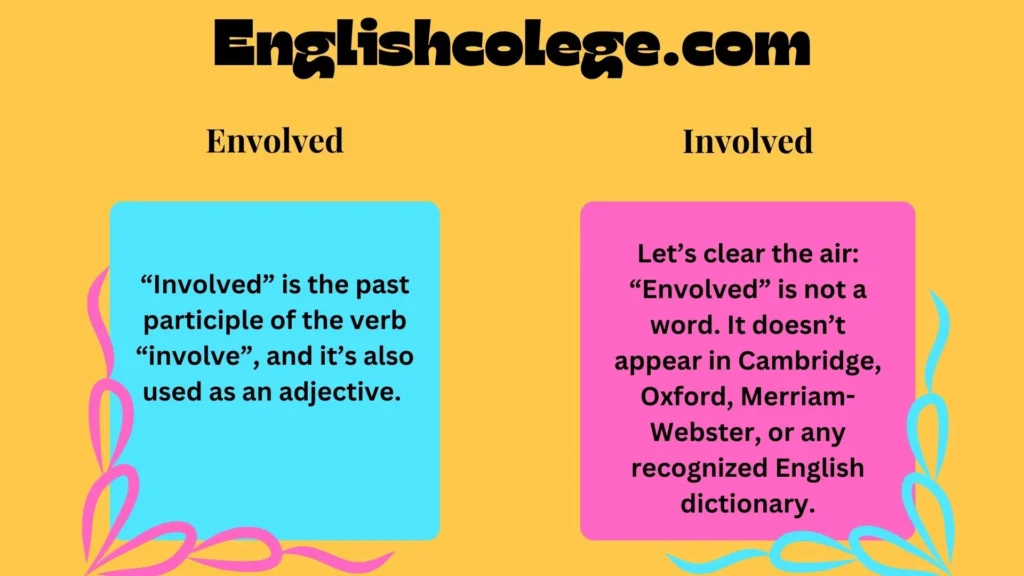
“Involved” is the past participle of the verb “involve”, and it’s also used as an adjective. It means to take part in something, to be connected or engaged, or to be complicated or detailed.
Here’s what Cambridge Dictionary defines it as:
“Being part of something or taking part in an activity or event.”
Common Uses of “Involved”
| Usage Type | Example Sentence | Meaning |
|---|---|---|
| Participation | She’s involved in community service. | Taking part or engaged. |
| Association | The minister was involved in the policy reform. | Connected with an event or issue. |
| Complexity | It’s an involved story with many twists. | Complicated or intricate. |
| Emotional/Romantic | They’re involved with each other. | In a romantic or emotional relationship. |
“Involved” carries richness — it implies connection, effort, and depth.
The Nonexistent Word: “Envolved” ❌
Let’s clear the air: “Envolved” is not a word. It doesn’t appear in Cambridge, Oxford, Merriam-Webster, or any recognized English dictionary.
So why do people still use it?
Reasons Behind the Mistake
- Phonetic Confusion: “Envolved” sounds similar to “involved” when spoken quickly.
- Prefix Confusion: English uses both “en-” and “in-” as prefixes (like enlarge or include), and they can both imply inclusion or connection.
- Autocorrect Errors: Text editors or phones might not always flag “envolved” immediately.
- Confusion with “Evolved”: Since “evolved” is a valid English word, many writers mix them up.
Important: While “envolved” looks believable, it’s 100% incorrect in every grammatical or linguistic context.
Why People Confuse “Envolved” with “Involved” or “Evolved”
To understand this mix-up, let’s break down the differences.
| Word | Part of Speech | Meaning | Correct Example |
|---|---|---|---|
| Involved | Verb/Adjective | Connected, engaged, or complex. | She’s involved in research. |
| Evolved | Verb (past tense) | Developed or changed over time. | The species evolved naturally. |
| Envolved | — | ❌ Not a real word. | — |
Prefix Breakdown
| Prefix | Meaning | Example | Notes |
|---|---|---|---|
| in- | into, within, engaged in | Involved, Include, Invest | The correct form in this context. |
| en- | cause to be, put into | Encourage, Enlighten | Doesn’t apply to “involve.” |
So when people use “envolved,” they’re mistakenly combining the prefix “en” with the word “volve” (meaning “to roll” or “turn”), thinking it follows a pattern like enclose or enrich.
Dictionary and Grammar Authority Clarifications
All major dictionaries agree: “Involved” is the only correct form.
| Source | Entry | Notes |
|---|---|---|
| Cambridge Dictionary | Involved | Defines as taking part or being complicated. |
| Oxford English Dictionary | “Involved” | Lists historical and modern examples. |
| Merriam-Webster | “Involved” | States both adjective and participle usage. |
| Collins Dictionary | “Involved” | Mentions multiple meanings — emotional, professional, and structural. |
If you search for “envolved” in these sources, you’ll find no entry or redirection to “evolved.”
That’s the official verdict: “Involved” is right; “Envolved” doesn’t exist.
The Grammar of “Involved”
“Involved” functions as both:
1. The Past Participle of “Involve”
Used in passive voice or perfect tenses.
- They were involved in the accident.
- We’ve been involved in multiple charity projects.
2. An Adjective
Describes complexity or emotional connection.
- It’s an involved process requiring multiple approvals.
- They’re in an involved relationship.
Grammar Tip:
“Involved” always connects people, actions, or things to a broader context — something participatory or complex.
Shades of Meaning: Different Ways to Use “Involved”
“Involved” isn’t one-dimensional. Its meaning shifts with context. Let’s explore.
Describing Participation or Connection
Use this when referring to active engagement or association.
- I’m involved in environmental activism.
- She became involved with a local theater group.
It implies you’re not just aware — you’re taking part.
Describing Complexity or Detail
Here, “involved” means intricate or detailed.
- The machinery has an involved design.
- It’s an involved explanation that requires patience.
Writers often use this sense when something takes time to understand.
Describing Emotional or Romantic Engagement
“Involved” can also express personal or emotional entanglement.
- They’ve been involved for three years.
- He’s emotionally involved with the project.
This usage highlights depth and attachment.
Real-World Examples: Correct vs. Incorrect Use
| Incorrect | Correct |
|---|---|
| He was deeply envolved in politics. | He was deeply involved in politics. |
| The plan envolved multiple departments. | The plan involved multiple departments. |
| She got envolved in community work. | She got involved in community work. |
| They were envolved in an accident. | They were involved in an accident. |
| The story was too envolved to follow. | The story was too involved to follow. |
Word Usage in Literature and Media
If you scan through English literature or digital databases, “involved” appears hundreds of thousands of times, while “envolved” appears almost never.
Usage Facts:
- “Involved” appears in over 1.5 million English publications since 1800 (Google Books Ngram).
- “Envolved” appears only as typos or misprints.
- Academic papers, novels, and journalism consistently use “involved.”
That proves beyond doubt — “involved” is the standard, accepted, and universal form.
Why Choosing the Right Word Matters
Language precision matters. Whether you’re writing an email, an essay, or a LinkedIn post, using the wrong word can make your writing seem careless.
Here’s Why Accuracy Counts:
- Professionalism: Employers, editors, and teachers notice word choice.
- Credibility: Correct spelling shows attention to detail.
- Clarity: Wrong words cause confusion.
- Search Optimization: Even algorithms prefer correct spelling.
“Good writing isn’t about big words; it’s about the right words.”
So next time you type envolved, pause — and fix it.
Remember: There’s no “en” in “involved.”

Frequently Asked Questions (FAQs)
Is “envolved” ever correct in any dialect of English?
No. “Envolved” is never correct in any form of English — British, American, or otherwise. It’s always a misspelling of “involved.”
Why does ‘envolved’ look like a real word?
Because English has many valid “en-” words like enlightened or enclosed. The visual similarity makes “envolved” look legitimate — but it isn’t.
Can “involved” mean complicated?
Yes. When describing processes, stories, or ideas, “involved” means complex or detailed.
What’s the difference between “involved” and “evolved”?
“Involved” means connected or engaged; “evolved” means developed or changed over time.
How do I remember the difference?
Think: “Involved” has “in” — you’re in it. You can’t be “en it.”
Conclusion
In the battle of envolved vs. involved, there’s only one winner: involved.
It’s the correct spelling, recognized by all dictionaries, and used in every context — personal, academic, or professional. “Envolved” might sneak into emails or online comments, but it has no place in formal writing.
Mastering distinctions like this improves clarity, professionalism, and your overall command of English. So next time you catch yourself typing “envolved,” smile, delete that “en”, and stay involved in getting it right.

I’m Sameer — a passionate English enthusiast who loves exploring words, grammar, and the art of effective communication. ✍️