

Have you ever found yourself confused between suite, sweet, and sweat? Don’t worry—you’re not alone.
These three words sound identical but carry very different meanings. Using the wrong one can change your sentence entirely and even make you look careless.
This guide will help you master the differences with real examples, tips, and easy ways to remember them.
Whether you’re writing professionally, chatting with friends, or just curious about English, understanding these homophones will give your language skills a boost.
Understanding Homophones: Words That Sound Alike
Homophones are words that sound the same but differ in meaning and spelling.
- Example: there, their, they’re
- Example: your, you’re
Homophones can trip up even native speakers, especially in writing. Context is your best tool. If you know what your sentence is about, choosing the right word becomes easier.
Why it matters:
Using “sweet” instead of “suite” could confuse a reader about whether you’re talking about dessert or a luxury hotel room. Small mistakes like these matter in professional writing, emails, and even casual messages.
Exploring ‘Suite’: More Than Just Rooms
The word suite often confuses people because it appears in multiple contexts. But understanding its uses makes it easy to remember.
Definitions and Uses
- Living or Hotel Suites: Luxury rooms in hotels or apartments.
- Example: “The presidential suite had a private balcony and jacuzzi.”
- Musical Suites: A series of connected musical pieces.
- Example: “Bach’s Cello Suite No. 1 is a masterpiece.”
- Furniture Suites: Matching furniture sets designed for one space.
- Example: “We bought a sofa and chair suite for the living room.”
- Software or Business Suites: A set of related programs or services.
- Example: “Microsoft Office is a popular software suite.”
Fun Facts About Suites
- The word “suite” originates from the French word ‘suite’, meaning “sequence” or “following.”
- In hotels, suites are often 2–3 times more expensive than standard rooms because of extra space and amenities.
- Classical music suites often consist of 3–8 movements that follow a theme.
Tips to Remember ‘Suite’
- Luxury, grouping, or sequence.
- Mnemonic: “Suite = a set of rooms or things together.”
Example Table Comparing Suite Uses:
| Context | Meaning | Example Sentence |
|---|---|---|
| Hotel/Apartment | Luxury room arrangement | “They stayed in the top-floor suite.” |
| Music | Connected pieces of music | “She played a piano suite by Debussy.” |
| Furniture | Matching set of furniture | “The dining suite includes table and chairs.” |
| Software | Collection of programs | “Adobe Creative Suite is popular with designers.” |
The Sweetness of Sweet 🍬
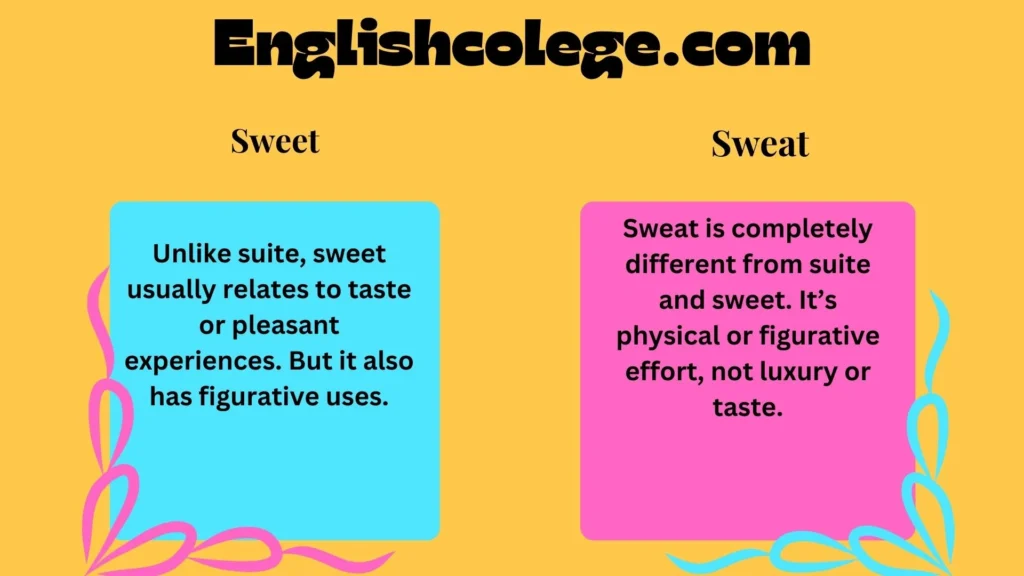
Unlike suite, sweet usually relates to taste or pleasant experiences. But it also has figurative uses.
Definitions and Uses
- Taste: Sugary or pleasant flavors.
- Example: “This chocolate is really sweet.”
- Figurative: Kindness, charm, or something positive.
- Example: “She sent me a sweet note.”
- Pop Culture/Slang: Cool, impressive, or enjoyable.
- Example: “That was a sweet victory!”
Interesting Facts About Sweet
- Sweet taste is one of the five basic human tastes, alongside sour, bitter, salty, and umami.
- The brain releases dopamine when tasting sweet foods, making us feel good.
- Sweet gestures and compliments are psychologically proven to strengthen personal relationships.
Tips to Remember ‘Sweet’
- Linked to taste or positive feelings.
- Mnemonic: “Sweet = sugar or kindness.”
Example Table Comparing Sweet Uses:
| Type | Meaning | Example Sentence |
|---|---|---|
| Taste | Sugary flavor | “Ice cream is sweet and creamy.” |
| Personality | Kind or thoughtful | “He’s a sweet friend.” |
| Slang | Cool or enjoyable | “That skateboard trick was sweet!” |
Clarifying Sweat 💦: Your Body’s Cooling System
Sweat is completely different from suite and sweet. It’s physical or figurative effort, not luxury or taste.
Definitions and Uses
- Biological: Perspiration produced by the body to cool itself.
- Example: “She wiped the sweat from her forehead.”
- Figurative: Effort, hard work, or worry.
- Example: “Don’t sweat the small stuff.”
The Science of Sweating
- How it works: Sweat glands release moisture to cool your body via evaporation.
- Types of sweat glands:
- Eccrine glands: All over the body, mainly water and salts.
- Apocrine glands: Found in armpits and groin, produce thicker sweat, often linked to body odor.
- Sweating can release toxins, regulate temperature, and even signal stress.
Fun Facts About Sweat
- The average human has 2–4 million sweat glands.
- Exercise increases sweat production dramatically; elite athletes can sweat up to 1 liter per hour.
- Sweat can contain trace amounts of pheromones, chemicals that may influence social and sexual behavior.
Tips to Remember ‘Sweat’
- Linked to effort or cooling.
- Mnemonic: “Sweat = water + hard work.”
Common Mix-Ups: How to Avoid Mistakes
Even native speakers confuse suite, sweet, and sweat. The key is context.
Quick Comparison Table
| Word | Meaning | Example Sentence | Tip to Remember |
|---|---|---|---|
| Suite | Room, set, music sequence | “The hotel suite was spacious.” | Luxury or grouping |
| Sweet | Sugar, kind, pleasant | “She gave me a sweet smile.” | Taste or kindness |
| Sweat | Perspiration, effort | “He broke a sweat during practice.” | Effort or water from the body |
Pro Tips
- Suite: Think luxury or sequence.
- Sweet: Think sugar or positivity.
- Sweat: Think effort, exercise, or cooling.
- Always read the sentence aloud—your ears often catch errors faster than your eyes.
Other Commonly Confused Words
Since you’re already decoding homophones, here are a few more English words that trip people up:
- Appetizer vs Appetiser: American English favors appetizer; British English can use appetiser.
- Speak to vs Speak with: Both are correct, but speak with implies a conversation; speak to can be more formal.
- Wholistic vs Holistic: Holistic is correct; wholistic is outdated.
- Sharable vs Shareable: Shareable is standard; sharable is informal.
- Patron vs Benefactor: Patron supports generally (like a restaurant patron); benefactor gives significant financial or material support.
- Acronyms like IDK: Means I don’t know.
Case Study: Avoiding Homophone Mistakes in Writing
Imagine a hotel marketing team writing a brochure. If they wrote:
“Enjoy the sweet with stunning city views.”
Instead of:
“Enjoy the suite with stunning city views.”
It would confuse customers. Small mistakes like this can cost credibility and even business.
Similarly, using “sweet” in a financial report instead of “suite” would seem unprofessional. Homophones matter in every type of writing.
Interactive Table for Quick Reference
| Word | Think Of | Common Contexts | Memory Tip |
|---|---|---|---|
| Suite | Luxury / Sequence | Hotel rooms, software, music, furniture | Suite = set of rooms or things together |
| Sweet | Sugar / Kindness | Taste, gestures, slang | Sweet = sugar or kind |
| Sweat | Effort / Perspiration | Exercise, work, stress | Sweat = water + effort |
Practical Tips for Remembering
- When writing about rooms or music, choose suite.
- When talking about taste, kindness, or something positive, use sweet.
- When referring to effort or perspiration, use sweat.
Quick mnemonic: Luxury, sugar, effort = suite, sweet, sweat.
FAQs About Suite, Sweet, and Sweat
What is the easiest way to remember the difference between suite, sweet, and sweat?
Think Luxury, Sugar, Effort. Suite = rooms or sets, Sweet = taste or kindness, Sweat = work or perspiration.
Can ‘sweet’ refer to anything besides food?
Yes! It can describe kindness, charm, or something positive. Example: “That was a sweet gesture.”
Is sweating always linked to exercise?
No, sweating occurs due to heat, stress, illness, or even spicy foods—not just physical activity.
Are hotel suites always expensive?
Generally, yes. Suites usually cost 2–3 times more than standard rooms due to extra space and amenities.
Can ‘suite’ and ‘sweet’ ever be used interchangeably?
No, they have entirely different meanings. Using them interchangeably can confuse readers.
Conclusion
Mastering suite, sweet, and sweat is easier than it seems once you understand their meanings, context, and mnemonic tricks. Remember:
- Suite = luxury, music, sets
- Sweet = sugar, kindness, positivity
- Sweat = effort, perspiration
Using them correctly enhances your writing, improves clarity, and shows attention to detail.
Next time you write, take a moment to choose the right word. Your readers—and maybe your boss—will notice the difference.

I’m Sameer — a passionate English enthusiast who loves exploring words, grammar, and the art of effective communication. ✍️