Communication isn’t just about speaking — it’s about being understood. Few phrases capture this better than “Copy that” and “Roger that.”
These two short acknowledgments have traveled from military radios to movie scripts to everyday speech.
But while people often use them interchangeably, they don’t actually mean the same thing. Each carries its own history, nuance, and purpose.
Let’s decode where they come from, what they really mean, and how to use them correctly.
Why These Phrases Still Matter
You’ve probably heard “Copy that” shouted through walkie-talkies in movies or by gamers online. Or maybe a coworker said “Roger that” during a team chat.
They sound cool, crisp, and confident — but their roots go deep into the language of radio and military communication.
In high-stakes situations like aviation, combat, or law enforcement, clarity can save lives. A misunderstood order could cause chaos. That’s why the military developed a strict, standardized way to acknowledge messages.
Understanding these phrases helps you appreciate how language evolves through necessity, precision, and culture.
The Birth of Radio Communication Language
The 20th century introduced something revolutionary: long-distance voice communication.
During early radio transmissions, static, noise, and poor signal quality made speech hard to understand. The military and aviation industries needed a reliable way to confirm messages without confusion.
That’s where radio procedure language was born — a simplified, efficient system of speaking designed to ensure every word counted.
Why Simplicity Was Life or Death
Imagine a pilot in the 1940s hearing a garbled command. Static, gunfire, or engine noise could distort key words. One wrong interpretation could cost lives.
So instead of long sentences, operators used short, standardized confirmations like:
- “Roger” → “Message received.”
- “Wilco” → “Will comply.”
- “Over” → “Your turn to speak.”
- “Out” → “End of transmission.”
This code-like clarity became the backbone of safe, fast communication.
“Roger That”: The Original Signal of Receipt
“Roger” is older than most people think. Its origins date back to World War II when aviation radios relied on the phonetic alphabet.
From ‘R’ to ‘Roger’
Before “Romeo” represented the letter R (as it does today), the U.S. military phonetic alphabet used “Roger” for R. The letter R stood for “Received.”
So when someone said “Roger,” they literally meant, “I’ve received your message.”
Adding “That” for Clarity
Over time, operators began saying “Roger that” — meaning “I received that specific message.”
It added precision and emphasized full acknowledgment, especially during fast-paced radio exchanges.
Quote from U.S. Army Signal Corps manual (1943):
“Use ‘Roger’ to indicate receipt of a message. Use ‘Roger that’ when confirming the specific content.”
Modern Meaning
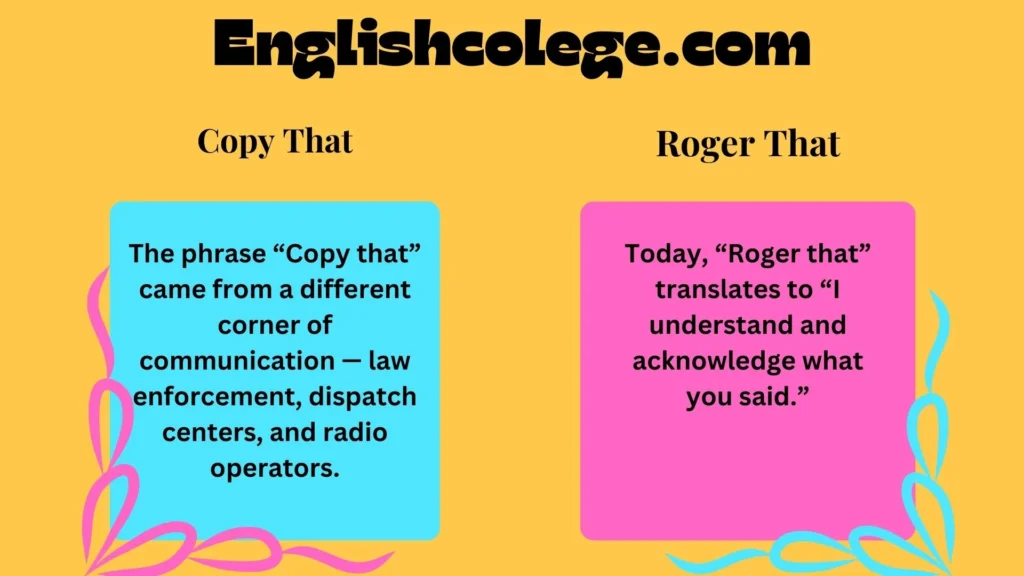
Today, “Roger that” translates to “I understand and acknowledge what you said.”
But it doesn’t imply agreement or intent to act — just comprehension.
Example:
- Pilot: “Maintain heading 210.”
- Co-pilot: “Roger that.” (Meaning: I understood your command.)
“Copy That”: From Radio Rooms to Everyday Speech
The phrase “Copy that” came from a different corner of communication — law enforcement, dispatch centers, and radio operators.
The Original Meaning of “Copy”
To copy a message meant to write it down or record it accurately. Radio operators would log every transmission in notebooks, known as radio logs.
When one said “Copy that,” it meant:
“I heard your message clearly and have recorded it for action.”
This term carried more than acknowledgment. It implied understanding and readiness.
Example:
- Dispatcher: “Unit 12, respond to 5th and Main.”
- Officer: “Copy that.” (Meaning: I heard, understood, and will respond.)
Why It Spread
As radios became common in emergency services, “Copy that” entered movies, police dramas, and television. From there, it crossed into everyday speech — a crisp, no-nonsense way to say, “Got it.”
Key Difference Between “Copy That” and “Roger That”
Here’s a breakdown showing how these phrases differ in origin, meaning, and tone:
| Phrase | Origin | Literal Meaning | Implied Action | Common Context |
|---|---|---|---|---|
| Roger That | Military / Aviation | Message received and understood | Acknowledgment only | Aviation, military, radio |
| Copy That | Radio / Law Enforcement | Message heard and recorded | Acknowledgment + Readiness to act | Dispatch, police, everyday |
In short:
- “Roger that” = I understood you.
- “Copy that” = I understood and will act accordingly.
That small nuance makes a big difference in professional communication.
Common Misconceptions and Modern Usage
Today, both phrases appear in conversations, memes, and online gaming. However, the original military intent often gets blurred.
Misconception #1: They Mean “Yes”
Neither phrase means agreement. Saying “Roger that” doesn’t mean “I’ll do it,” only that you heard and understood.
If you want to agree or promise action, you’d say “Wilco” — short for “Will comply.”
Misconception #2: They’re Completely Interchangeable
While you can use both casually, their tone differs:
- “Roger that” sounds more formal and military.
- “Copy that” feels more modern and action-oriented.
Misconception #3: They’re Just Slang
Both phrases come from decades of disciplined radio procedure. Their continued use in business, tech, and gaming shows how effective military language can be in any environment.
Pop Culture Influence: From Cockpits to Call of Duty
Pop culture turned these phrases into icons.
Movies and TV
From Top Gun to Die Hard, Hollywood loves military-sounding communication. The confident “Roger that” became shorthand for cool professionalism.
Examples:
- Top Gun (1986): “Maverick, you’re cleared for takeoff.” → “Roger that.”
- Apollo 13 (1995): “Houston, we have a problem.” → “Roger that, copy.”
Video Games and Streaming
Games like Call of Duty and Battlefield have popularized radio chatter among players. Saying “Copy that” or “Roger that” adds realism and camaraderie.
Cultural Shift
These phrases now carry a psychological tone of control and decisiveness. That’s why professionals, gamers, and even office teams use them — they sound assertive yet respectful.
Beyond the Battlefield: Everyday Adoption
Today, phrases born from war rooms echo in workplaces, emails, and group chats.
Corporate and Tech Environments
In fast-paced industries like logistics, aviation, or tech support, people still prefer concise confirmations:
- “Copy that, I’ll update the report.”
- “Roger that, meeting moved to 3 PM.”
They’re direct, polite, and sound proactive — qualities valued in communication.
Why They Work
- Brevity: They save time.
- Clarity: No room for confusion.
- Tone: They convey calm confidence.
These phrases turn everyday exchanges into smoother, more efficient conversations.
When to Use Each Phrase (With Real Examples)
| Situation | Use “Roger That” | Use “Copy That” |
|---|---|---|
| Confirming you understood a command | ✅ | ❌ |
| Confirming and preparing to act | ❌ | ✅ |
| In aviation or military language | ✅ | ✅ |
| In police or dispatch communication | ❌ | ✅ |
| In casual or workplace talk | ✅ | ✅ |
Practical Scenarios
- At Work:
- Boss: “Please update the spreadsheet by noon.”
- You: “Copy that.” (Acknowledges and confirms action.)
- In Conversation:
- Friend: “I’ll meet you at 8.”
- You: “Roger that.” (Acknowledges understanding, not necessarily action.)
Knowing the subtle difference adds professionalism to how you communicate.
Linguistic Evolution and Cultural Staying Power
Language reflects technology and culture. “Copy that” and “Roger that” survived because they’re:
- Short and clear
- Action-oriented
- Emotionally neutral
In modern communication, where brevity rules (texts, Slack, social media), these phrases still fit perfectly.
Modern Equivalents
Here’s how they compare to today’s casual alternatives:
| Traditional Phrase | Modern Equivalent | Context |
|---|---|---|
| Roger that | Got it / Understood | Casual acknowledgment |
| Copy that | Noted / On it | Confirming readiness |
| Wilco | Will do / Sure thing | Confirming compliance |
The same clarity that once guided pilots now powers text conversations.
Summary
Both “Copy that” and “Roger that” mean you’ve received information — but their tones and implications differ.
- “Roger that” = I heard and understood you.
- “Copy that” = I heard, understood, and am ready to act.
These phrases embody the discipline of precision that shaped military communication. Over time, they evolved from radio static to social language, proof that the best words survive by being useful.
Takeaway:
“Roger that” confirms understanding.
“Copy that” confirms readiness.
Both continue to serve the same mission — keeping messages clear, concise, and human.
FAQs: “Copy That” vs “Roger That”
What does “Roger that” mean exactly?
It means “I received and understood your message.” It’s acknowledgment, not agreement.
Is “Copy that” more modern than “Roger that”?
Yes. “Copy that” became popular with law enforcement and dispatch after WWII, while “Roger that” dates back to early aviation.
Can I use “Copy that” in casual conversation?
Absolutely. It’s now common in workplaces and casual talk as a confident “Got it.”
Does “Roger that” mean I’ll do it?
No. It means you understood the message, not that you’ll take action. For that, use “Wilco.”
Why do people still use these phrases today?
Because they’re short, clear, and effective — traits that never go out of style.

I’m Sameer — a passionate English enthusiast who loves exploring words, grammar, and the art of effective communication. ✍️