

We often use concurrent and simultaneous as if they mean the same thing.
They sound alike, both hint at “things happening together,” and often show up in similar contexts — from multitasking at work to computer processing.
But here’s the truth: they don’t mean the same thing.
This article breaks down the subtle (yet crucial) difference between concurrent and simultaneous, how they apply in everyday language, science, and technology, and when to use each term correctly.
Understanding the Basics: Concurrent and Simultaneous Defined
Language thrives on precision. To use words well, you must understand their roots and scope.
What “Concurrent” Really Means
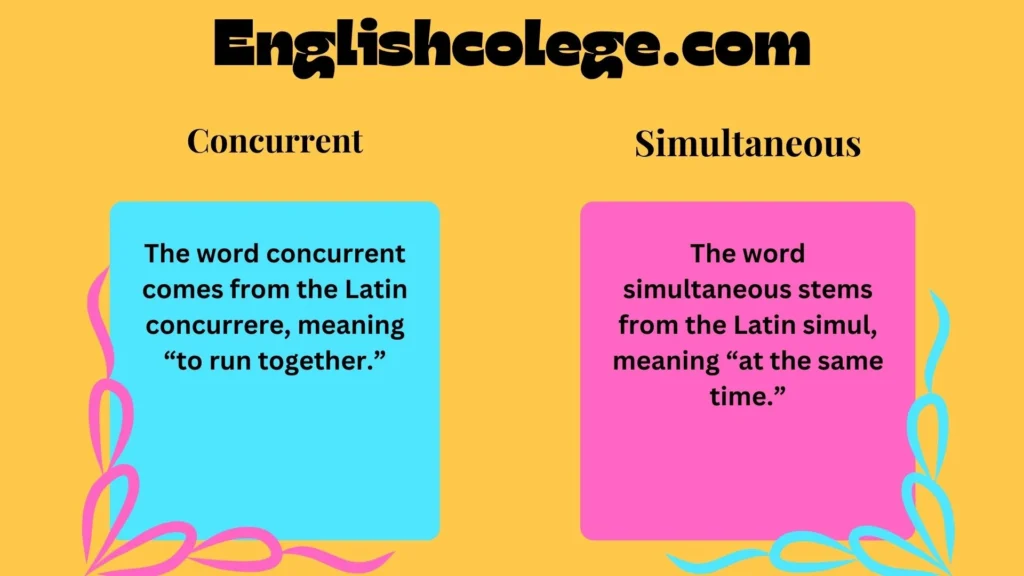
The word concurrent comes from the Latin concurrere, meaning “to run together.”
That’s exactly what it means today — things that happen or exist during the same period, though not necessarily at the same instant.
Key idea:
Concurrent events overlap in time, but they don’t have to start or finish together.
Examples:
- Two university courses running during the same semester are concurrent.
- Multiple browser tabs open while you switch between them.
- Two court sentences served concurrently (meaning at the same time, not one after another).
In short, concurrent implies overlap, not exact simultaneity.
What “Simultaneous” Really Means
The word simultaneous stems from the Latin simul, meaning “at the same time.”
It refers to events occurring at precisely the same instant.
Key idea:
Simultaneous events start, progress, and end at exactly the same moment.
Examples:
- Two athletes crossing the finish line at the same split second.
- A thunderclap and lightning flash happening together (as perceived).
- Two computers executing a command at the exact same millisecond.
So, while concurrent allows for overlapping timelines, simultaneous demands perfect timing alignment.
The Core Difference at a Glance
Here’s a quick reference table summarizing the distinction:
| Aspect | Concurrent | Simultaneous |
|---|---|---|
| Timing | Overlapping in time | Occurring at the exact same instant |
| Start/End | Can begin or end separately | Begin and end together |
| Dependency | May depend or run independently | Always tied to one moment |
| Example | Multiple tasks handled at once by a system | Two actions executed at the same microsecond |
| Analogy | Cars driving side by side on parallel lanes | Cars colliding at the same intersection |
Real-Life Usage: How We Use Each Word
In Everyday Life
You might not even notice, but you already use both words — often incorrectly.
Concurrent examples:
- “I’m working and studying concurrently.”
- “Two events are happening concurrently in different parts of the city.”
- “She served two terms concurrently.”
Simultaneous examples:
- “They spoke simultaneously during the meeting.”
- “The phones rang simultaneously.”
In daily language, concurrent fits situations where multiple things coexist, while simultaneous fits when they collide in time.
In Science and Academia
Both terms appear frequently in technical disciplines — but their meanings stay consistent.
In Physics:
- Concurrent forces: Different forces acting through the same point (not necessarily at the same time).
- Simultaneous events: Two occurrences sharing the exact same timestamp in a frame of reference.
In Law:
- Concurrent sentences: Multiple punishments served during the same period.
- Simultaneous rulings: Court decisions issued at the same instant.
So even in complex contexts, the overlap vs. exact timing rule holds firm.
In Technology: Concurrent vs Simultaneous Explained
Modern computing thrives on both concurrency and simultaneity — yet they mean different things in programming, networking, and performance testing.
Concurrent vs Simultaneous in Computing
Concurrent computing means multiple tasks appear to run at the same time but actually share resources — like CPU time.
They may pause, switch, and resume, but collectively, they overlap.
Simultaneous computing (also called parallel computing) happens when multiple tasks truly run at the same time — often across multiple processors or cores.
Here’s how it looks conceptually:
Time →
Concurrent:  [Task A•••|pause|•••resume]
             [•••Task B•••running•••]
Simultaneous: [Task A•••••••]
              [Task B•••••••]
Case Study:
A web server handles thousands of requests concurrently, not simultaneously.
Each user request overlaps in time, but the CPU processes them in micro-slices — giving the illusion of simultaneity.
However, if you have multi-core processors, tasks can execute simultaneously, each on a separate core.
In Software and System Performance
Performance testers often measure concurrent users and simultaneous users, but they’re not identical.
| Metric | Concurrent Users | Simultaneous Users |
|---|---|---|
| Definition | Users connected and active at the same time | Users performing the same action at the same instant |
| Example | 500 users browsing a website | 500 users clicking “Buy Now” together |
| Measurement | Ongoing activity over a timeframe | Instant snapshot of identical activity |
| Use Case | Load testing, scalability | Stress testing, peak load analysis |
In short:
- Concurrent users measure system capacity.
- Simultaneous users measure system synchronization and load tolerance.
How Context Affects Word Choice
Context changes meaning subtly. The right word depends on what you want to emphasize.
When to use “concurrent”:
- Focus on overlapping duration.
- You’re describing events, tasks, or operations that coexist.
- Examples:
- “Concurrent sessions in a conference.”
- “Concurrent upload and download processes.”
When to use “simultaneous”:
- Focus on exact timing or synchrony.
- You’re emphasizing precision or identical timing.
- Examples:
- “Simultaneous translation during a live event.”
- “Simultaneous data replication.”
Quick Tip:
If you can draw a timeline with overlaps, it’s concurrent.
If both lines start and end together, it’s simultaneous.
Usage in Modern English
Google Ngram Insights
A glance at Google’s Ngram Viewer shows how both terms have evolved.
Since the 1900s, “concurrent” gained traction in law, technology, and engineering, while “simultaneous” remained steady in science and communication.
Although usage overlaps, “concurrent” dominates professional and technical writing, while “simultaneous” appears more in everyday and descriptive language.
Media and Literature Examples
Concurrent:
“The investigation ran concurrently with the criminal proceedings.” — The Guardian
Simultaneous:
“The explosions were almost simultaneous, shaking the city from two sides.” — BBC News
Writers often choose concurrent for overlapping timelines and simultaneous for tightly linked actions.
Quick Reference Guide
Here’s a cheat sheet to remember the distinction:
| Context | Concurrent Example | Simultaneous Example |
|---|---|---|
| Everyday | Two meetings happening at the same hour | Two alarms ringing at the same instant |
| Technology | Server handling multiple tasks | CPU cores executing in parallel |
| Law | Serving two sentences concurrently | Two verdicts announced together |
| Science | Overlapping experiments | Identical reactions starting together |
Mnemonic:
“Concurrent = overlap”
“Simultaneous = snapshot”
Case Study: Concurrency in Real Systems
Let’s explore a real-world example that ties both terms together.
Case: Amazon Web Services (AWS) Load Handling
- AWS Lambda can run concurrent executions, meaning multiple function instances operate during the same period.
- However, simultaneous execution would mean every instance starts and ends at the exact same millisecond — which rarely happens in practice.
Result:
Concurrency optimizes performance. Simultaneity is ideal but impractical except in tightly synchronized systems (like parallel GPU processing).
Famous Quotes to Illustrate the Difference
“Concurrency is about dealing with lots of things at once.
Parallelism is about doing lots of things at once.”
— Rob Pike (Go Programming Language designer)
“Time is not simultaneous for all observers.”
— Albert Einstein
Even Einstein drew a line between overlapping and identical timing.
FAQs About Concurrent vs Simultaneous
What’s the simplest way to remember the difference?
Concurrent = overlapping; Simultaneous = identical timing.
If two things happen during the same period but not together, they’re concurrent.
Can two tasks be concurrent but not simultaneous?
Yes. Your computer may download a file and stream music concurrently, but not simultaneously on one processor core.
Is “concurrent” only used in technology or law?
No. It’s common in general English — “concurrent storms,” “concurrent growth,” or “concurrent discussions.”
Are “simultaneous” and “synchronous” the same?
Not quite. Synchronous means actions are coordinated or in rhythm, while simultaneous means happening at the exact same time.
Can I use both words in one sentence?
Absolutely. Example:
“The two servers handled concurrent requests that triggered simultaneous updates.”
Here, concurrency describes ongoing overlap, while simultaneity marks exact synchronization.
Conclusion: Use Each Word Precisely
To sum it up:
- Concurrent emphasizes overlapping timeframes.
- Simultaneous stresses identical timing.
The difference may sound small, but it changes meaning dramatically in law, science, and computing.
Whenever you’re describing duration, go with concurrent.
When you’re highlighting exact timing, choose simultaneous.
Being precise in language reflects being precise in thought — and that’s the key to clear communication.

I’m Sameer — a passionate English enthusiast who loves exploring words, grammar, and the art of effective communication. ✍️