

Ever stared at a sentence thinking, “Should I say ‘complete’ or ‘completed’?” You’re not alone. Many English learners (and even native speakers) mix them up.
Both words share the same root, yet their roles in grammar differ sharply. Understanding when to use each can sharpen your writing, make your speech clearer, and help you sound more confident in any context—from workplace emails to academic papers.
Let’s dive in and unpack the real difference between “complete” and “completed” with examples, tables, and clear rules.
Understanding the Core Difference: “Complete” vs “Completed”
At the heart of the confusion lies one simple rule:
| Word | Part of Speech | Core Function | Example |
|---|---|---|---|
| Complete | Verb / Adjective | To make whole, or describe something that’s whole | “Please complete the survey.” / “The project is complete.” |
| Completed | Verb (Past Participle) | Indicates something has been finished | “The report was completed yesterday.” |
Quick takeaway:
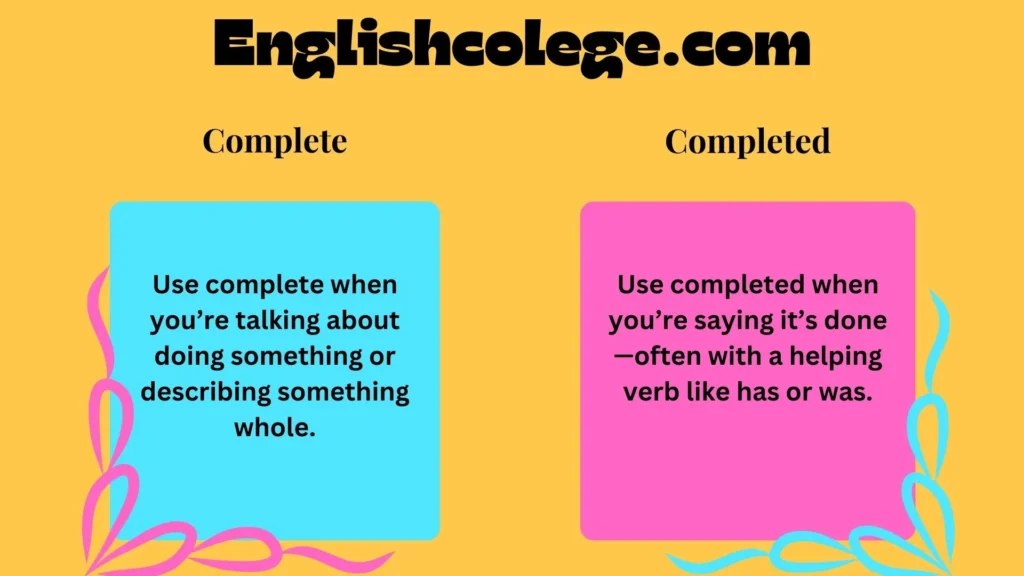
- Use complete when you’re talking about doing something or describing something whole.
- Use completed when you’re saying it’s done—often with a helping verb like has or was.
“Complete” as a Verb
When complete acts as a verb, it means to finish, to make whole, or to bring something to its end.
Examples
- “You must complete the online form before submission.”
- “They will complete the bridge construction next year.”
- “The artist completed her latest painting last week.”
Here, “complete” is about taking action. You can use it in different tenses:
| Tense | Example |
|---|---|
| Present | “I complete my reports on Fridays.” |
| Past | “I completed my training last month.” |
| Future | “I will complete the task tomorrow.” |
| Present Continuous | “I am completing the checklist now.” |
Pro Tip
Think of “complete” as the action that leads to something being “completed.”
“You complete a task → The task is completed.”
“Complete” as an Adjective
As an adjective, complete describes something whole, entire, or lacking nothing.
Examples
- “The design is complete.”
- “She gave a complete answer.”
- “This guide provides complete coverage of the topic.”
Key Characteristics
- Used after verbs like is, looks, seems, appears.
- Describes a state of being, not an action.
- Implies nothing is missing.
Mini Case Study
Case: A company’s software upgrade
- Before upgrade: “The software isn’t complete; features are missing.”
- After upgrade: “The software is now complete and fully functional.”
This simple shift from incomplete to complete reflects a change of state, not an action.
“Completed” as a Verb Form (Past Participle)
Completed shows that an action has been done or finished. It’s commonly used in perfect or passive constructions.
Examples
- “The report has been completed.”
- “The project was completed in June.”
- “All assignments must be completed by tomorrow.”
Structure Breakdown
| Tense | Example | Explanation |
|---|---|---|
| Present Perfect | “The task has been completed.” | Action done recently or relevant now. |
| Past Simple | “They completed the task yesterday.” | Action finished in the past. |
| Passive Voice | “The document was completed on time.” | Focus on the result, not who did it. |
Quick Note
“Completed” often sounds formal, used in business, academic, or professional settings.
“The audit was completed successfully.” sounds more polished than “The audit is done.”
Grammar and Tense Connection
Understanding the tense can help you choose between “complete” and “completed” correctly.
| Tense | Structure | Correct Form | Example |
|---|---|---|---|
| Simple Present | is/are + adjective | complete | “The document is complete.” |
| Simple Past | subject + verb + object | completed | “She completed the task.” |
| Present Perfect | has/have + past participle | completed | “The task has been completed.” |
| Future | will + verb | complete | “I will complete the assignment.” |
Example Comparison
| Sentence | Meaning |
|---|---|
| “The form is complete.” | Describes a finished state. |
| “The form was completed.” | Describes the action of finishing it. |
Choosing Between “Complete” and “Completed”
Here’s how to decide quickly:
| Situation | Use | Example |
|---|---|---|
| Describing something as whole | Complete | “The course is complete.” |
| Talking about finishing an action | Completed | “I completed the course.” |
| Giving an instruction | Complete | “Complete the registration form.” |
| Reporting results | Completed | “The registration was completed yesterday.” |
Quick Checklist
✅ Does it describe a state? → Use complete.
✅ Does it describe an action done? → Use completed.
Real-World Usage Examples
Let’s see how both words appear in different contexts.
In Professional Settings
- Email: “The report is complete and ready for submission.”
- Project update: “Phase one has been completed successfully.”
In Academic Writing
- “The study is complete after two years of research.”
- “Data collection was completed in January.”
In Everyday Conversation
- “I’m complete with my checklist!” (informal, rare)
- “I completed the workout this morning.” (natural)
- “The meal is complete with dessert.”
Real Case Example
Scenario: A construction firm updates a client
“The initial design phase is complete. All structural work was completed last week.”
The first clause describes status, the second describes action—both correct and distinct.
Common Mistakes and Misconceptions
Even advanced speakers slip up with “complete” and “completed.” Here’s what to avoid:
❌ Saying “The project completed.”
→ Incorrect because “complete” needs a subject or helping verb.
✅ “The project is complete.”
✅ “The project was completed.”
❌ Mixing up state and action
→ “She is completed with her work.” (awkward)
✅ “She has completed her work.”
❌ Overusing “completed”
→ “The process was completed completedly.” (incorrect redundancy)
✅ “The process was completed.”
Quick Tip
If the sentence already has a helping verb (is, was, has), use completed.
If it stands alone describing something’s state, use complete.
“Complete” vs “Finished”: Subtle but Important
Many learners also confuse complete with finished. They’re close, but not identical.
| Word | Focus | Example | Meaning |
|---|---|---|---|
| Complete | Whole or lacking nothing | “The document is complete.” | It’s entire and all parts exist. |
| Finished | Process ended | “The document is finished.” | It’s done; you’re not working on it anymore. |
Key Insight
All things finished are complete, but not everything complete is finished.
Example: “The cake recipe is complete” (has all ingredients listed).
“The cake is finished” (it’s baked and ready to eat).
Practical Grammar Tips
Quick Summary Rules
- Use complete when describing something’s state.
- Use completed when referring to the act of finishing something.
- Avoid mixing forms within one sentence.
Helpful Visual: Complete vs Completed
| Use Case | Correct Form | Example |
|---|---|---|
| State | Complete | “The form is complete.” |
| Action | Completed | “I completed the form.” |
| Instruction | Complete | “Please complete the form.” |
| Passive Voice | Completed | “The form was completed yesterday.” |
Mini Quiz
Try choosing the right form:
- The project ____ last week.
- The report is ____.
- Please ____ your homework before dinner.
Answers:
- was completed
- complete
- complete
Related Confusing Word Pairs
Improve your grammar by understanding other tricky pairs:
- Inane vs outrageous– Silly vs mentally unsound.
- Dimly Lighted vs Dimly Lit – Both correct, but “lit” is more common today.
- Will Resume vs Will Be Resumed – Active vs passive forms.
- Thus vs Hence – “Thus” = result, “Hence” = reason.
- Threw vs Through – Action vs direction.
Each pair highlights how small shifts in form change meaning.
FAQs
What’s the main difference between “complete” and “completed”?
“Complete” can be a verb or adjective; “completed” is the past form of the verb. Use “complete” for states or commands, “completed” for finished actions.
Can I say “The project completed”?
No. That’s grammatically wrong. Say “The project is complete” or “The project was completed.”
Is “has been completed” the same as “is complete”?
Not exactly. “Has been completed” focuses on the action done; “is complete” describes the current state.
Which is more formal—“complete” or “completed”?
“Completed” often sounds more formal and is used in business or academic writing.
How do I know which one to use in a sentence?
Ask yourself: Am I describing or reporting? Describing = “complete.” Reporting = “completed.”
Conclusion
Choosing between “complete” and “completed” isn’t about memorizing rules—it’s about recognizing intent. Use complete when something is whole or when giving a command. Use completed when describing what’s already been done.
In short: Something is complete when it’s whole; it’s completed when someone finished it.
By mastering this subtle difference, your English becomes sharper, more professional, and far more natural.

I’m Sameer — a passionate English enthusiast who loves exploring words, grammar, and the art of effective communication. ✍️