

Ever caught yourself wondering whether it’s combating or combatting? You’re not alone.
Writers, students, and professionals stumble on this subtle spelling conflict all the time.
One tiny extra “t” has sparked a surprisingly big debate across English dialects.
This guide unpacks the confusion once and for all.
We’ll explore where each spelling comes from, how American and British English handle it differently, and which version you should confidently use in your writing.
The Core Difference: Combating vs. Combatting
At first glance, both spellings look fine — and you might’ve seen combatting online or in older books. But grammatically speaking, only one is standard today.
✅ Correct form: Combating
❌ Nonstandard variant: Combatting
Here’s why:
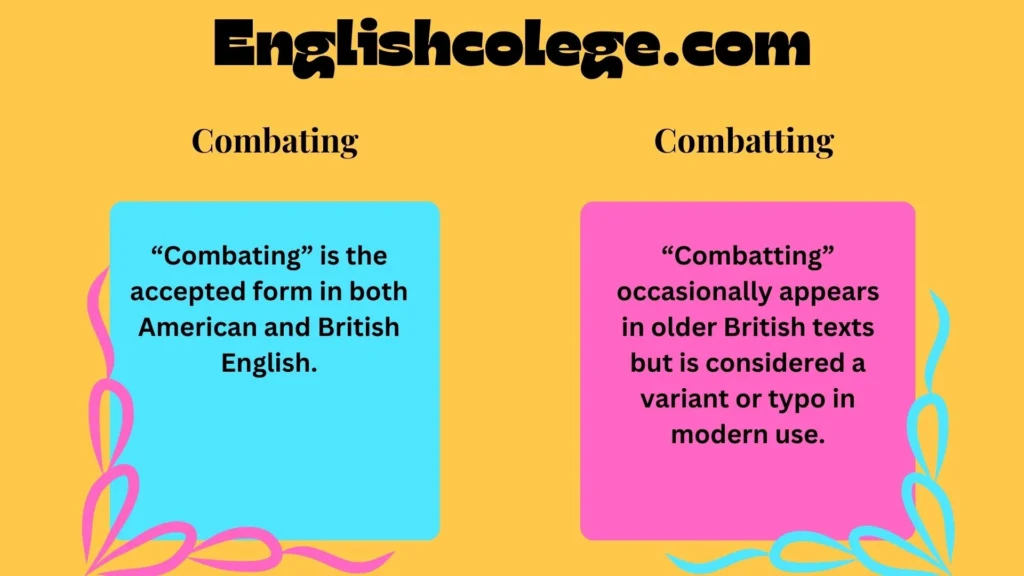
- “Combating” is the accepted form in both American and British English.
- “Combatting” occasionally appears in older British texts but is considered a variant or typo in modern use.
Let’s see what the world’s leading dictionaries say:
| Source | Preferred Spelling | Notes |
|---|---|---|
| Merriam-Webster | Combating | Only one T |
| Oxford English Dictionary | Combating | Lists combatting as rare |
| Cambridge Dictionary | Combating | No double T |
| Collins Dictionary | Combating | Same as US usage |
So if you’re writing a report, essay, or article — combating is your safe bet.
American English and the Rule of Consonant Doubling
To understand why combatting isn’t standard, we need to talk about how English doubles consonants when adding suffixes like -ing or -ed.
The Rule
In American English, you double the final consonant only when:
- The word is one syllable, or
- The stress is on the last syllable.
Otherwise, the consonant stays single.
Here’s a quick reference table to make it clear:
| Base Verb | Stress Pattern | -ing Form | Correct? |
|---|---|---|---|
| combat | 1st syllable (COM-bat) | combating | ✅ |
| permit | 2nd syllable (per-MIT) | permitting | ✅ |
| open | 1st syllable (O-pen) | opening | ✅ |
| begin | 2nd syllable (be-GIN) | beginning | ✅ |
| travel | 1st syllable (TRA-vel) | traveling (US) | ✅ |
Because combat is stressed on the first syllable, the final consonant is not doubled before adding -ing. Hence:
“Combating misinformation” ✅
“Combatting misinformation” ❌
British English: Sometimes Two Ts, Sometimes Not
British spelling loves its doubled consonants — travelling, labelling, cancelled. So you might assume combatting fits the pattern. But that’s not the case here.
Why? Because British English also follows the stress rule for verbs like combat. The stress lands on the first syllable, so doubling doesn’t happen even in the UK.
However, some older British publications (especially from the 19th or early 20th century) show combatting occasionally. These are historical quirks, not modern standards.
Here’s a quick comparison:
| Form | American English | British English |
|---|---|---|
| Combating | ✅ Correct | ✅ Correct |
| Combatting | ❌ Incorrect | ⚠️ Rare, archaic |
So whether your readers are in New York, London, or Sydney — combating is still the version to use.
Historical Roots and Evolution of “Combat”
Every spelling oddity in English has a history. Combat is no exception.
The word comes from the Latin “combattere”, which means to fight together. It entered Old French as combattre, then crossed into Middle English as combatten.
Over centuries, English spelling simplified. Double consonants dropped in many cases — part of a broader trend toward cleaner orthography.
Here’s a mini timeline of its evolution:
| Era | Form | Language | Meaning |
|---|---|---|---|
| Latin | combattere | Latin | to fight |
| Old French | combattre | French | to fight or struggle |
| Middle English | combatten | English | to fight or battle |
| Modern English | combat / combating | English | to fight against |
So the modern combating reflects English’s move toward simplified spelling — keeping one “t” consistent with pronunciation and stress.
Grammar Function: “Combat” as a Verb and Gerund
You’ll see combating used in two main grammatical ways — as a present participle and as a gerund.
As a Present Participle
Used with “be” verbs to describe ongoing action:
- “They are combating climate change.”
- “The organization is combating hunger.”
As a Gerund (Verb Acting as a Noun)
Used to describe the activity itself:
- “Combating misinformation requires teamwork.”
- “Effective combating of fraud depends on policy enforcement.”
Both uses are correct and common. The form doesn’t change — it’s always combating, never combatting.

Practical Rule: Which Should You Use?
Let’s make this crystal clear:
- Use combating in academic, professional, and formal writing.
- Use combatting only if quoting historical or British texts where it originally appeared.
Here’s a quick checklist for choosing correctly:
✅ Use “combating”
- In resumes, essays, and reports
- In all American English contexts
- For international publications
- In journalism and media
❌ Avoid “combatting”
- It’s nonstandard
- It may trigger grammar or spell-check errors
- It looks outdated and inconsistent
Even style guides like the Chicago Manual of Style and Associated Press (AP) recommend the single “t” version.
Real-World Usage Examples
Let’s look at real examples to cement this rule.
| Context | Correct Usage | Incorrect Usage |
|---|---|---|
| Environmental Policy | “Nations are combating climate change.” | “Nations are combatting climate change.” |
| Health | “The WHO is combating misinformation about vaccines.” | “The WHO is combatting misinformation about vaccines.” |
| Business | “Firms are combating inflation with innovation.” | “Firms are combatting inflation with innovation.” |
| Social Media | “Platforms are combating hate speech.” | “Platforms are combatting hate speech.” |
As you can see, the single “t” works naturally in every scenario.
Audience and Style: Consistency Matters
When you write for an international audience, consistency beats everything. Switching between combating and combatting makes your content look sloppy and confusing.
Always stick to one spelling system throughout your piece — preferably American English if your audience is global.
Why? Because American English is now the dominant standard in business, tech, and online writing. Even many UK publications favor streamlined spellings for readability.
Tip: Before publishing, run your text through a tool like Grammarly or Microsoft Word’s language settings. Choose “English (US)” or “English (UK)” and ensure your entire document follows one spelling system.
A Historical Case Study: The Shift Toward “Combating”
Let’s look at a brief case study from print history.
In early 1900s British newspapers, such as The Times of London, combatting occasionally appeared in editorials about war or politics. But by the mid-20th century, linguistic reform and dictionary standardization replaced those older spellings.
By the 1970s, combating was already the default in both educational and government materials.
A quick analysis of the Google Books Ngram Viewer (which tracks word frequency over time) shows that combatting peaked in the early 1900s and then declined sharply — while combating surged and stayed dominant.
This historical shift proves how spelling evolves to match linguistic simplicity.
Common Confusion: Why People Still Write “Combatting”
Here’s why you might still see it around:
- Analogy with similar verbs: Writers assume if “setting” or “getting” double their consonants, “combatting” should too.
- British influence: Some non-native speakers learn from UK sources where doubling is more frequent.
- Autocorrect quirks: Outdated or regional spellcheck settings sometimes miss it.
- Old habits: Writers who learned from older textbooks may still use combatting unknowingly.
The easiest fix? Memorize this phrase:
“If the stress isn’t on the end, don’t double the friend.”
That little rhyme applies to hundreds of English verbs.
Related Words and Variations
The root “combat” also appears in nouns and adjectives:
| Part of Speech | Example | Note |
|---|---|---|
| Noun | “The combat lasted two hours.” | Refers to the fight itself |
| Verb | “They will combat the issue.” | To fight or resist |
| Adjective | “A combat-ready team.” | Prepared for battle |
| Gerund | “They focus on combating fraud.” | Ongoing action |
Remember: no version of these forms uses combatting. The single “t” carries through every case.
Quick Reference Table: When to Double the Final Consonant
This guide helps you apply the same rule to other words:
| Base Verb | Correct -ing Form | Rule |
|---|---|---|
| stop | stopping | One syllable → double consonant |
| admit | admitting | Stress on last syllable → double |
| combat | combating | Stress on first syllable → no double |
| open | opening | Two syllables, first stressed → no double |
| regret | regretting | Stress on last → double |
| benefit | benefiting | Stress on first → no double |
By recognizing stress patterns, you can confidently form correct -ing verbs every time.
Quotes From Language Experts
“English spelling often seems illogical, but it follows sound-based rules more than people realize.” – David Crystal, linguist and author.
“Standardization exists to make written language predictable. One ‘t’ is enough to combat confusion.” – Grammarphobia Blog, usage experts.
“Even in British English, combatting with two Ts is largely obsolete.” – Oxford Lexico Editorial Team
Final Verdict: The Right Way to Spell It
After all the analysis, here’s the final takeaway:
- ✅ Combating = correct, modern, and universally accepted.
- ❌ Combatting = outdated, rare, and discouraged.
Stick with combating whether you’re writing an essay, email, or editorial. You’ll sound polished, professional, and grammatically accurate every time.
Mnemonic: “One T to fight confusion, two Ts lose the battle.”
FAQs
Is “combatting” ever acceptable in British English?
Rarely. It appears in older British texts, but modern dictionaries list combating as the preferred form.
Why do some people double the “t” in combatting?
They assume it follows patterns like “getting” or “running,” but those words have stress on the last syllable. Combat doesn’t.
Does grammar-check software flag “combatting”?
Yes. Most programs, including Grammarly and Word, mark combatting as a misspelling.
Can “combatting” appear in quotes or titles?
Yes, only if you’re quoting historical or original material where it appeared.
How can I remember the correct spelling?
Use this tip: If the stress isn’t at the end, don’t double it, my friend!
Conclusion
English can feel like a battlefield of spelling rules — and combating vs. combatting is a perfect example. Yet once you know the stress rule, the fight is over.
Combating wins every time. It’s clean, modern, and universally recognized by dictionaries worldwide.
So the next time you’re writing about combating misinformation, combating inequality, or combating disease, you can do it with confidence — and one victorious “t.”

I’m Sameer — a passionate English enthusiast who loves exploring words, grammar, and the art of effective communication. ✍️