

Language can be tricky. Small spelling differences often change meanings entirely—and one of the most common examples is “cacoon” vs. “cocoon.”
At first glance, both seem right. But in English, only one is correct in most contexts.
In this comprehensive guide, you’ll discover:
- What a cocoon really is and how it functions
- Why “cacoon” isn’t always a typo
- The difference between a cocoon and a chrysalis
- How to use cocoon as a noun and a verb
- Synonyms, origins, and figurative meanings
- Clear examples, tables, and a short FAQ section
Let’s unwrap the mystery—thread by thread.
Understanding What a Cocoon Really Is
A cocoon is a silken protective case that certain insect larvae, particularly moths, spin around themselves before entering the pupal stage. It’s like nature’s sleeping bag for transformation.
In biological terms, a cocoon serves as a barrier against predators, weather, and parasites while the insect undergoes metamorphosis.
Key Facts About Cocoons:
- Made by: Moths, silkworms, and some other insects
- Material: Fine silk threads produced from salivary glands
- Purpose: Protection during metamorphosis
- Duration: Can last days to months depending on species
Here’s a visual comparison:
| Aspect | Cocoon | Chrysalis |
|---|---|---|
| Type of insect | Moths | Butterflies |
| Made of | Silk spun by larva | Hard exoskeleton |
| Function | Protective covering for pupa | Pupal casing itself |
| Example | Silkworm cocoon | Monarch butterfly chrysalis |
The term cocoon comes from the French cocon, meaning “shell” or “protective covering.”
From Larva to Moth: The Cocoon’s Role in Metamorphosis
Metamorphosis is one of nature’s most remarkable transformations. A moth doesn’t simply grow wings overnight. It undergoes a multi-stage process inside its cocoon.
The Life Cycle of a Moth:
- Egg: The female moth lays eggs on leaves.
- Larva (Caterpillar): The caterpillar hatches and feeds voraciously.
- Pupa (Inside Cocoon): The caterpillar spins a silk casing and becomes a pupa.
- Adult Moth: The fully formed moth emerges from the cocoon.
During the pupal stage, the insect’s body reorganizes completely. It digests its old form and rebuilds itself into a winged adult. Without the cocoon’s protection, predators or harsh conditions could destroy this delicate process.
“Within a simple silk casing, nature hides one of the most profound transformations known to science.”
Cocoon vs. Chrysalis: Clearing Up a Common Misconception
Many people use cocoon and chrysalis interchangeably—but they’re not the same.
- Cocoons belong to moths.
- Chrysalises belong to butterflies.
A cocoon is an external shelter spun from silk. A chrysalis is an internal casing formed from the caterpillar’s own skin.
Easy Way to Remember:
Moths make cocoons. Butterflies make chrysalises.
Here’s a simple diagram you can visualize:
Caterpillar 🐛 → [Cocoon/Chrysalis Stage] 🏠 → Adult Moth or Butterfly 🦋
Spelling Breakdown: “Cacoon” vs. “Cocoon”
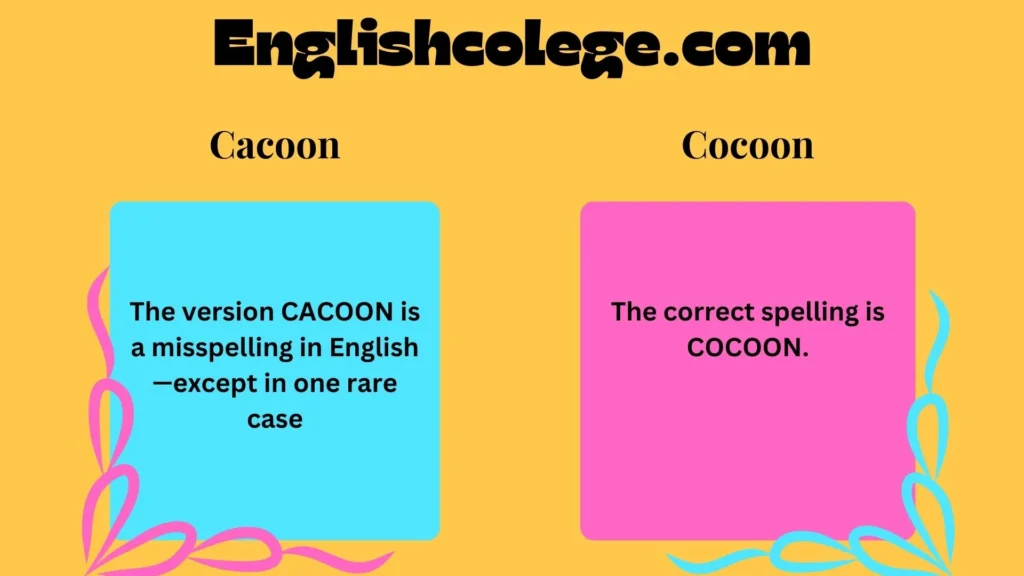
The correct spelling is COCOON. The version CACOON is a misspelling in English—except in one rare case (as you’ll see later).
Why People Mistype It:
- Both cacoon and cocoon sound the same when spoken.
- Double “o” patterns like “balloon,” “spoon,” or “moon” make cacoon seem plausible.
- The letter “a” feels natural after “c,” leading to confusion.
However, only “cocoon” appears in standard English dictionaries like Merriam-Webster and Oxford English Dictionary.
Example Sentences:
- ✅ The silkworm spun a cocoon around itself.
- ❌ The silkworm spun a cacoon around itself.
Quick Trick to Remember:
Think “COzy COCOON.” Both words start with CO, and both suggest comfort.
The Word “Cocoon” Beyond Biology
The word cocoon isn’t just for insects—it’s deeply rooted in human emotion and lifestyle too.
Figurative Meanings:
- Safety: A private, protected space (emotional or physical).
- Comfort: Being wrapped or enclosed in warmth.
- Isolation: Choosing seclusion for peace or self-care.
Examples:
- After a stressful week, she cocooned herself in a blanket with a book.
- The startup operated in a cocoon of innovation before launching publicly.
Cultural Usage: “Cocooning”
Coined in the 1980s by trend forecaster Faith Popcorn, cocooning describes the behavior of staying home and insulating oneself from the outside world for safety or comfort.
Today, it’s common to hear phrases like:
- Digital cocooning (immersing in online environments)
- Emotional cocooning (protecting oneself from stress or conflict)
“Cacoon” Has Another Meaning — A Tropical Bean
While cacoon is a misspelling of cocoon in English, it’s also a real word in certain regions.
In the Caribbean and parts of Africa, “Cacoon” refers to the Entada rheedii vine, known as the monkey ladder or sea heart plant.
Facts About the Cacoon Plant:
- Scientific name: Entada rheedii
- Native regions: Tropical Africa, Asia, and the Caribbean
- Seed pods: Large, flat, and brown; the seeds can float across oceans
- Traditional uses: Herbal medicine for muscle pain, inflammation, and cleansing
Example:
In Jamaica, “cacoon” tea is made from the vine’s dried seeds and used as a natural remedy.
So while cacoon is not the correct spelling for the insect shelter, it does exist in another context—just not the one most English speakers mean.
Related Words and Synonyms for “Cocoon”
Language thrives on variety. You can use several other terms depending on context—scientific or metaphorical.
| Word | Meaning | Use Case | Example |
|---|---|---|---|
| Cocoon | Silk covering spun by larvae | Moths, silkworms | The larva spun a cocoon. |
| Chrysalis | Hard pupal casing | Butterflies | The butterfly emerged from its chrysalis. |
| Pupa | Transitional stage of an insect | General biology | The insect stayed in the pupa stage. |
| Pod | Protective shell or case | Plants/insects | The seed pod burst open. |
| Wrap | To enclose or cover | Figurative | She wrapped herself in a cocoon of silence. |
| Swaddle | To wrap tightly | Infants, metaphor | The baby was swaddled snugly. |
Linguistic Origins and Historical Evolution
The story of cocoon traces back centuries.
- Origin: From French cocon (“shell”)
- Root word: Latin coccum (“berry” or “shell”)
- First recorded in English: Around the 16th century
Originally, it described the silky envelope of the silkworm. Over time, its meaning broadened to symbolize comfort, seclusion, and transformation.
Today, it’s one of the most vivid metaphors in English—used in psychology, design, and pop culture to express protection and change.
Real-World Examples of “Cocoon” in Sentences
To master usage, see how cocoon fits naturally into sentences.
Scientific:
The silkworm’s cocoon contains nearly a kilometer of silk thread.
Figurative:
After her breakup, Mia cocooned herself from the world to heal.
Business:
The company’s team operated in a creative cocoon before unveiling their new product.
Pop Culture:
The 1985 film “Cocoon” explored themes of aging and rejuvenation.
How to Use “Cocoon” as a Verb
You can use cocoon as a verb too—it means to enclose, protect, or wrap up.
Verb Forms:
- Base: cocoon
- Past: cocooned
- Continuous: cocooning
Examples:
- The baby was cocooned in a soft blanket.
- He cocooned himself from social media to recharge.
- Snow cocooned the cabin in silence.
Synonyms:
- Encase
- Enclose
- Wrap up
- Shelter
- Insulate
Choosing the Right Word Every Time
Here’s a quick checklist to avoid confusion:
✅ Use “cocoon” when referring to insect silk coverings or metaphorical protection.
✅ Use “cacoon” only when referring to the tropical vine (Entada rheedii).
❌ Don’t use “cacoon” as an alternative spelling for “cocoon.”
Quick Recap Table:
| Scenario | Correct Word | Example |
|---|---|---|
| Moth’s silk case | Cocoon | The moth emerged from its cocoon. |
| Butterfly’s pupa | Chrysalis | The chrysalis hung from a leaf. |
| Herbal plant | Cacoon | “Cacoon tea” is made from tropical vines. |
| Figurative meaning | Cocoon | She cocooned herself in comfort. |
FAQs About “Cacoon” vs. “Cocoon”
What’s the correct spelling—cacoon or cocoon?
Cocoon is the correct spelling in English. Cacoon is a common misspelling but also refers to a tropical vine in some regions.
Are cocoons and chrysalises the same thing?
No. Moths spin cocoons, while butterflies form chrysalises.
Can I use “cocoon” as a verb?
Yes. It means to wrap, enclose, or protect—like She cocooned herself in blankets.
What is the origin of the word “cocoon”?
It comes from French cocon, derived from Latin coccum, meaning “shell” or “berry.”
Is “cacoon tea” real?
Yes. In the Caribbean, cacoon tea made from Entada rheedii seeds is used in herbal medicine.
Conclusion
Both words—“cacoon” and “cocoon”—may sound alike, but their meanings differ greatly. Cocoon is the correct spelling for the silk shelter spun by insects and its many figurative uses. Cacoon, on the other hand, names a tropical plant unrelated to metamorphosis.
Language evolves, but accuracy matters. Whether you’re writing a scientific report or describing a cozy night in, use cocoon when you want to express protection, comfort, or transformation.
“Every great change begins in a cocoon—quiet, hidden, and full of potential.”

I’m Sameer — a passionate English enthusiast who loves exploring words, grammar, and the art of effective communication. ✍️