
Ever found yourself typing “I need an assistance” when you really meant “I need an assistant”? You’re not alone.
These two words—assistance and assistants—look similar, sound similar, and even share the same root. Yet their meanings couldn’t be more different.
In this guide, you’ll learn exactly how to use each one, how to avoid common mistakes, and how to remember the difference forever.
By the end, you’ll not only master the words—you’ll understand the thinking behind them.
Understanding the Core Difference Between Assistance and Assistants
The difference between assistance and assistants comes down to what and who.
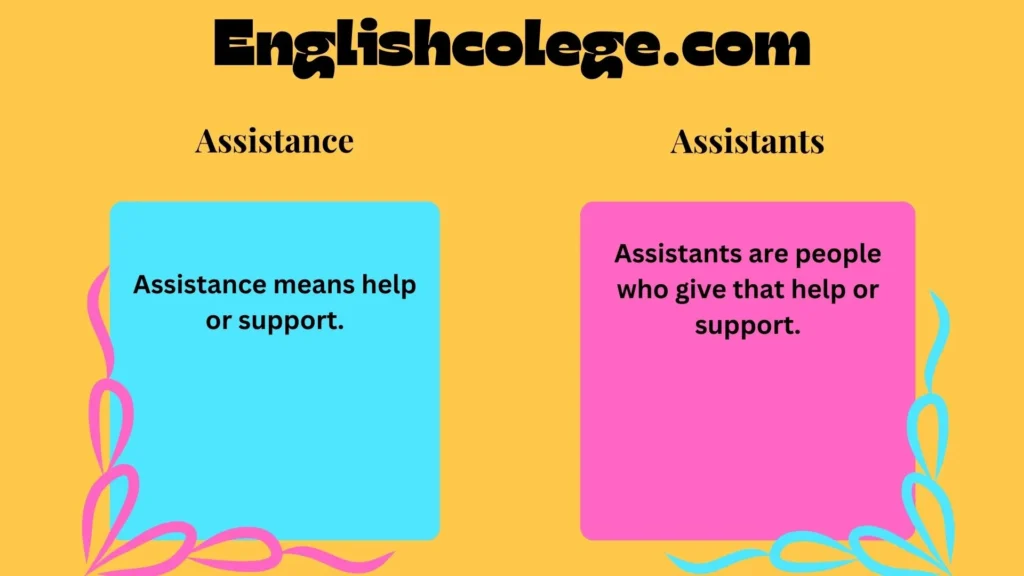
- Assistance means help or support.
- Assistants are people who give that help or support.
Think of it this way: an assistant gives assistance.
Here’s a quick breakdown:
| Word | Part of Speech | Meaning | Example |
|---|---|---|---|
| Assistance | Noun (uncountable) | Help, aid, or support | “She offered her assistance.” |
| Assistant | Noun (countable) | A person who helps | “She’s my assistant.” |
So the next time you’re unsure, ask yourself—am I talking about help itself or the helper?
The Origins: How Each Word Came to Be
Both words share the same Latin ancestor: assistere, meaning “to stand by or near.”
Over time, English evolved two distinct forms:
- Assistance (from Old French assistence) came to mean the act of helping.
- Assistant (from assistantem) referred to someone who stands by to help.
The etymology makes perfect sense. Assistance is the action, while an assistant is the actor.
Understanding this root meaning helps you use each word more precisely, especially in writing or professional contexts.
The Meaning of “Assistance” Explained
Assistance is an abstract noun describing the act of helping or supporting someone. It’s commonly used in formal or professional contexts.
Common Types of Assistance
- Technical assistance – support with equipment or software.
- Financial assistance – help with money or funding.
- Medical assistance – healthcare or emergency aid.
- Legal assistance – professional advice or representation.
- Humanitarian assistance – relief efforts for communities in crisis.
Grammar Tip
“Assistance” is uncountable. You can’t say “an assistance” or “many assistances.”
Instead, use words like some, a lot of, or a bit of to describe quantity.
Examples:
- ✅ “She provided assistance.”
- ✅ “We need some assistance with this report.”
- ❌ “She gave me an assistance.”
Offering and Asking for Assistance
In many workplaces, especially formal settings, “assistance” sounds more polite or professional than “help.”
How to Offer Assistance
Use these polite phrases to show readiness to help:
- “Can I be of any assistance?”
- “Would you like some assistance with that?”
- “I’m happy to offer my assistance if needed.”
How to Ask for Assistance
When requesting help, vary your tone depending on the situation:
- Formal: “I require assistance with this task.”
- Neutral: “Could you provide some assistance?”
- Informal: “Can you help me out?”
Real-Life Example: Workplace Scenario
Case Study:
Sarah, a new employee, struggles with an unfamiliar software tool. Instead of saying, “Can someone help me?”, she asks, “Can someone provide me with technical assistance?”
Her phrasing sounds polite and professional, making her request appropriate for a corporate environment.
Takeaway:
Use assistance when you want to sound formal, respectful, or businesslike.

Understanding “Assistants”: The People Behind the Help
Now let’s look at assistants—the humans (or sometimes programs) who provide that assistance.
What Is an Assistant?
An assistant is a person who helps another, usually in a professional setting. Assistants can be part-time, full-time, human, or even virtual.
Here are common types:
Administrative Assistants
- Handle office tasks like scheduling, document preparation, and communication.
- Often serve as the backbone of efficient organizations.
- Example: “The administrative assistant coordinated the entire event flawlessly.”
Personal Assistants
- Support individuals in managing personal and professional tasks.
- Duties can include travel planning, email management, or even errands.
- Example: “His personal assistant handles his daily calendar.”
Specialized Assistants
- Research assistants help scholars gather and analyze data.
- Technical assistants work with engineers or IT professionals.
- Medical assistants assist doctors in clinical settings.
Virtual Assistants
- Provide remote support through online tools.
- Example tasks: email management, social media updates, scheduling, and data entry.
- The rise of AI assistants like ChatGPT or Siri shows how technology mirrors human help.
Common Confusions and Grammar Mistakes
Even fluent English speakers often confuse assistance and assistants.
Let’s fix that once and for all.
Frequent Errors and How to Correct Them
| Incorrect | Correct | Explanation |
|---|---|---|
| “I need an assistance.” | “I need assistance.” | “Assistance” is uncountable. |
| “She gave me many assistances.” | “She gave me a lot of assistance.” | Never pluralize “assistance.” |
| “He is my assistance.” | “He is my assistant.” | The helper is an “assistant.” |
| “She gave her assistant.” | “She gave her assistance.” | The meaning changes completely! |
Quick Memory Tip
👉 If it’s a person, it ends with “-ant.”
👉 If it’s an act, it ends with “-ance.”
Related Vocabulary: Expanding Your Word Power
To communicate precisely, it helps to know related terms and synonyms. Here’s how to expand your vocabulary.
Synonyms for “Assistance”
| Context | Synonyms | Example |
|---|---|---|
| General | help, aid, support | “He offered help during the project.” |
| Financial | funding, subsidy, grant | “The government provided financial aid.” |
| Technical | guidance, troubleshooting | “Call for technical support.” |
Synonyms for “Assistant”
| Context | Synonyms | Example |
|---|---|---|
| General | helper, aide, associate | “She’s my aide during the campaign.” |
| Business | deputy, secretary | “The deputy handled the paperwork.” |
| Tech | AI assistant, bot, virtual helper | “A virtual assistant scheduled the meeting.” |
Tip: Using varied synonyms improves writing quality and clarity. But choose context-appropriate words—“aide” works in politics, while “assistant” fits general use.
When to Use “Assistance” vs. “Assistant”
Confused about which to use? Follow this quick decision guide:
| Situation | Word to Use | Example |
|---|---|---|
| You’re talking about help or support | Assistance | “We received financial assistance.” |
| You’re referring to a person who helps | Assistant | “My assistant prepared the report.” |
Quick Flowchart
Need help → Use "assistance"
Need a helper → Use "assistant"
Real-Life Examples
- Correct: “The manager provided assistance during the training.”
- Correct: “The manager’s assistant arranged the meeting.”
- Incorrect: “The manager’s assistance arranged the meeting.” (The “help” can’t arrange anything!)
Practical Usage Review
Let’s put everything into context with a few side-by-side examples:
| Sentence with “Assistance” | Sentence with “Assistant” |
|---|---|
| “The teacher offered assistance to the struggling student.” | “The teacher’s assistant graded the papers.” |
| “He sought medical assistance immediately.” | “His medical assistant prepared the patient.” |
| “They provided humanitarian assistance after the storm.” | “Relief assistants distributed food and water.” |
Key takeaway:
Both words connect to helping, but one is abstract help while the other is a helper.
Case Study: Assistance and Assistants in Action
Scenario:
In a hospital, medical assistants support doctors by performing routine tasks—checking vitals, preparing patients, managing records. Their assistance ensures doctors can focus on diagnoses and treatment.
Analysis:
Without assistants, the doctors would be overwhelmed. Without their assistance, tasks wouldn’t flow smoothly.
This shows how both terms describe parts of the same process—people and the help they give.
Common Phrases and Collocations
Knowing how these words appear in real contexts can boost your fluency.
Common Phrases with “Assistance”
- “Provide assistance”
- “Request assistance”
- “Offer assistance”
- “Financial assistance program”
- “Emergency assistance hotline”
Common Phrases with “Assistant”
- “Administrative assistant”
- “Teaching assistant”
- “Shop assistant”
- “Assistant manager”
- “Virtual assistant”
Quick Recap: Assistance vs. Assistant
| Feature | Assistance | Assistant |
|---|---|---|
| Type | Abstract noun | Concrete noun |
| Meaning | The act of helping | The person who helps |
| Countability | Uncountable | Countable |
| Example | “I need assistance with this issue.” | “I’ll ask my assistant to handle it.” |
Mnemonic Trick:
“An assistant provides assistance.”
That one sentence summarizes everything.
FAQs
What is the plural of “assistant”?
The plural is assistants. Example: “Three assistants work in that office.”
Can we say “assistances”?
No. “Assistance” is uncountable, so it never takes an “s.” Say “some assistance” instead.
Which is more formal: help or assistance?
Assistance is more formal. It’s often used in business, academic, or official contexts.
Can “assistant” refer to software or technology?
Yes. Virtual assistants like Alexa, Siri, or Google Assistant are AI-based helpers designed to assist users digitally.
How can I remember the difference easily?
Think: “Assistant” ends with -ant, like an ant—small, busy, helpful. That’s a person.
“Assistance” ends with -ance, describing the act of helping.
Final Thoughts
The difference between assistance and assistants might be just a few letters, but it changes the meaning completely.
Assistance is the help you receive, while assistants are the people (or systems) that give it.
Whether you’re writing a business email, crafting an essay, or speaking formally, using the right term shows precision and professionalism.
Remember: You can ask for assistance from an assistant—but not the other way around.

I’m Sameer — a passionate English enthusiast who loves exploring words, grammar, and the art of effective communication. ✍️