
Understanding when to use “are” and “were” is one of those grammar challenges that can trip up even fluent English speakers.
Both come from the same root — the verb “to be” — but they serve different grammatical purposes.
Once you understand the tense, subject, and context, the difference becomes crystal clear.
In this guide, you’ll learn everything about how and when to use are and were, why they matter, and how to use them naturally like a native English speaker.
Why “Are” and “Were” Confuse So Many Learners
It’s easy to mix up “are” and “were” because both seem to describe similar states of being. The real difference lies in time and context.
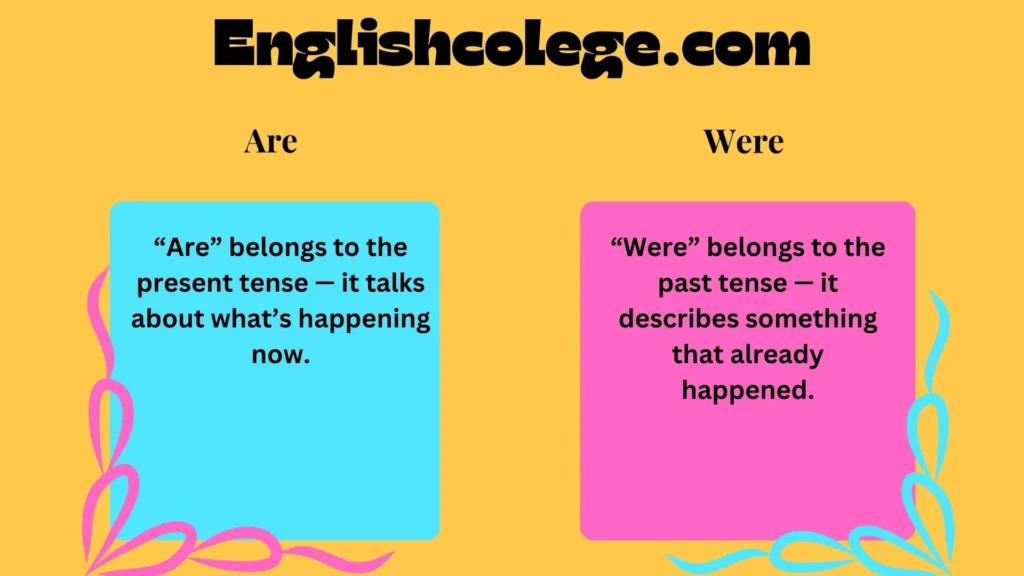
- “Are” belongs to the present tense — it talks about what’s happening now.
- “Were” belongs to the past tense — it describes something that already happened.
Example:
You are tired today.
You were tired yesterday.
Simple, right? Yet the confusion often grows when the subjunctive mood (used for wishes or hypothetical situations) enters the mix — like “If I were you.”
We’ll break it all down step by step.
Understanding the Verb “To Be”: The Core of English Grammar
The verb “to be” is one of the most important — and irregular — verbs in the English language. It serves as both a main verb and an auxiliary (helping) verb.
It connects a subject to its state or condition.
Example:
She is happy.
They are students.
I was tired.
We were late.
Here’s a quick overview of all forms of “to be.”
| Tense | Singular | Plural |
|---|---|---|
| Present | I am / He is / She is / It is | You are / We are / They are |
| Past | I was / He was / She was / It was | You were / We were / They were |
| Future | I will be / He will be | You will be / We will be / They will be |
The key takeaway?
👉 “Are” = present tense; “Were” = past tense.
The Present Tense: When to Use “Are”
The word “are” represents the present plural form of “to be”, and it’s also used with the second person (you) — whether singular or plural.
You use “are” when:
- Talking about what’s happening now.
- Describing current conditions or states.
- Referring to you, we, or they.
Subject-Verb Agreement with “Are”
| Subject | Verb | Example |
|---|---|---|
| You | are | You are smart. |
| We | are | We are friends. |
| They | are | They are playing outside. |
Examples of “Are” in Everyday Sentences
You’ll hear and use “are” constantly in conversation. Here’s how it works in different sentence types:
Affirmative:
- You are learning English quickly.
- They are great dancers.
Negative:
- We aren’t late.
- You aren’t wrong about that.
Questions:
- Are they ready?
- Are we meeting today?
Contraction Tip:
“You are” = you’re
“They are” = they’re
“We are” = we’re
“Are” as an Auxiliary (Helping) Verb
“Are” often helps form progressive (continuous) tenses — showing actions that are happening right now.
Examples:
- They are studying for the exam.
- You are reading this article.
- We are preparing dinner.
It helps emphasize the ongoing action of the main verb.
The Past Tense: When to Use “Were”
Now let’s move to “were.”
“Were” is the past plural form of “to be.” You use it when referring to actions or states that happened in the past.
Subject-Verb Agreement with “Were”
| Subject | Verb | Example |
|---|---|---|
| You | were | You were amazing yesterday. |
| We | were | We were tired after the trip. |
| They | were | They were at school this morning. |
Notice the change in time. “Were” always takes us backward — to something that already happened.
Examples of “Were” in Sentences
Affirmative:
- You were at the meeting.
- They were friends in college.
Negative:
- We weren’t ready to leave.
- You weren’t serious, were you?
Questions:
- Were they surprised?
- Were we supposed to help?
“Were” in the Subjunctive Mood
This is where learners often stumble.
Sometimes “were” doesn’t talk about the past — it talks about an imaginary or hypothetical situation.
Examples:
- If I were you, I’d take the job.
- I wish it were summer again.
- If he were taller, he could join the team.
So why “were” and not “was”?
In subjunctive mood, we use “were” even for singular subjects (I, he, she, it) to express something unreal, unlikely, or hypothetical.
Quick Tip:
If the sentence starts with if or wish, and it’s not real, use were.
Common Confusions Between “Are” and “Were”
Even native speakers sometimes get these mixed up. Let’s clear up the most common mistakes.
1. Mixing Tense and Subject Agreement
❌ Incorrect: They are happy yesterday.
✅ Correct: They were happy yesterday.
❌ Incorrect: We were tired now.
✅ Correct: We are tired now.
Always check:
Is it happening now or did it happen before?
If it’s now, use are.
If it’s then, use were.
2. Using “Were” for Hypotheticals but Forgetting It’s Singular
Many learners incorrectly say “If I was you”.
While it’s common in speech, it’s not grammatically correct in formal writing.
✅ Correct: If I were you, I’d go for it.
Remember:
- Was = past reality
- Were = imaginary situation
Quick Comparison Table
| Situation | Use “Are” | Use “Were” |
|---|---|---|
| Present time | ✅ Yes | ❌ No |
| Past time | ❌ No | ✅ Yes |
| Hypothetical (“If” / “Wish”) | ❌ No | ✅ Yes |
| Continuous tense (helping verb) | ✅ Yes | ❌ No |
| Second person “you” | ✅ You are | ✅ You were |
Practical Memory Tricks and Grammar Tips
Want to instantly recall which one to use? Try these:
- Timeline Trick:
- If it’s now → use are.
- If it’s then → use were.
- Hypothetical Helper:
- If there’s an if or wish → use were.
- Plural Power:
- If the subject is you, we, or they, it’s either are (now) or were (then).
Example Mnemonic:
“When we are in the moment, it’s ARE. When it already happened, it’s WERE.”
Real-Life Context: Speaking and Writing with Confidence
Understanding grammar rules is one thing — using them naturally in conversation is another.
Here’s how are and were appear in real American English.
In Conversations
- “Hey, are you ready?”
- “We were just talking about you.”
- “They are so funny together.”
- “You were amazing at the event!”
In Social Media or Pop Culture
“You are what you believe.”
“If I were rich, I’d buy a cabin in the woods.”
Notice how tone and time shape meaning instantly.
Common Misheard Confusion
- “You’re” (you are) sounds similar to “were.”
- You’re late ≠ You were late.
- The first is present, the second is past.
Related Grammar Lessons You’ll Also Need
Explore these connected grammar topics to strengthen your understanding:
- Active vs Passive Voice
- The Subjunctive Mood in English
- Common Pronoun Mistakes: Me, I, Myself
- Perfect Progressive Tenses Explained
- Thanks for Asking: Grammar Behind Polite Expressions
The “Are vs Were” Cheat Sheet
Here’s your quick grammar reference table:
| Subject | Present (Are) | Past (Were) | Example (Present) | Example (Past) |
|---|---|---|---|---|
| I | am | was | I am tired. | I was tired. |
| You | are | were | You are kind. | You were kind. |
| We | are | were | We are late. | We were late. |
| They | are | were | They are students. | They were students. |
FAQs About “Are vs Were”
What is the main difference between “are” and “were”?
“Are” is used for the present tense, while “were” is used for the past tense or hypothetical situations.
Can I use “were” with “I”?
Yes, but only in subjunctive (imaginary) situations.
Example: If I were taller, I’d play basketball.
Why do people say “If I were you” instead of “If I was you”?
Because it’s a hypothetical situation, and grammar rules require were — not was — after if or wish.
Is “you were” singular or plural?
It can be both. English uses “you” for singular and plural, so “you were” works for both contexts.
Can “are” and “were” ever appear in the same sentence?
Yes, when comparing different times.
Example: You are better now than you were last year.
Conclusion
“Are” and “were” are small words that carry big meaning.
Once you recognize the connection between time and context, you’ll use them naturally without overthinking.
Remember:
- “Are” = now
- “Were” = before
- “Were” (with if or wish) = imaginary
Mastering this one grammar rule makes your English sound smoother, more confident, and unmistakably fluent.
So, next time you catch yourself wondering which to use — just ask: Am I talking about now or then?
💬 “If I were you, I’d bookmark this guide.”

I’m Sameer — a passionate English enthusiast who loves exploring words, grammar, and the art of effective communication. ✍️