
Have you ever hesitated before saying “I appreciate it” or “I appreciated it”? You’re not alone.
These two phrases look almost identical yet carry distinct meanings. Choosing the right one can subtly change how your message sounds—especially in English, where tone and timing matter.
In this guide, you’ll learn everything about “Appreciate It” vs “Appreciated It”—their grammar, meaning, context, and how native speakers use them in real life. By the end, you’ll never second-guess which one to use again.
Why This Common Confusion Matters
Let’s be honest—English tenses can get tricky.
People often mix “appreciate it” and “appreciated it” because both sound polite and grateful. However, their verb tenses—present vs past—change the timing and tone of your gratitude.
Using the wrong one doesn’t make your sentence ungrammatical, but it might sound slightly off or unnatural. For example:
- ❌ “I appreciated it if you could help me.” (Wrong tense)
- ✅ “I appreciate it if you can help me.” (Correct)
Getting this right helps you sound confident, fluent, and polished—especially in professional emails or everyday conversation.
The Core Meaning of “Appreciate”
The verb “appreciate” means to recognize the value of something or someone or to feel grateful for something.
It’s a transitive verb, meaning it always needs an object. That’s why you usually see it followed by “it,” “that,” or a noun phrase:
“I appreciate your honesty.”
“I appreciate it.”
“We appreciate the opportunity.”
Quick Facts About “Appreciate”
- Verb form: appreciate
- Tense options: appreciate (present), appreciated (past), appreciating (continuous), appreciated (past participle)
- Common synonyms: value, respect, acknowledge, cherish
Example Sentences
| Type | Example |
|---|---|
| Gratitude | “I appreciate your help.” |
| Value | “She appreciates fine art.” |
| Emotional recognition | “He appreciates how hard you’ve worked.” |
So far, simple enough. The confusion arises when deciding whether to use present tense (appreciate it) or past tense (appreciated it).
“Appreciate It”: The Present Tense Expression of Gratitude
When you say “I appreciate it,” you’re expressing current or ongoing gratitude. You’re thankful for something happening right now or for a favor that has just been done.
When to Use “Appreciate It”
- You’re currently receiving help or reacting to something recent.
- You’re expressing polite gratitude in real time.
- You want to sound warm, conversational, and professional.
Examples
- “Thanks for your help—I really appreciate it.”
- “I appreciate it when you check on me.”
- “We appreciate it if you can complete the form by Friday.”
This phrase is extremely common in emails, customer service, and face-to-face communication. It’s neutral, polite, and perfectly safe to use in almost any setting.
💡 Tip: If you could replace “appreciate it” with “thank you,” it’s likely the correct choice for the moment.
Common Contexts
| Situation | Example |
|---|---|
| At work | “I appreciate it if you can send the report today.” |
| Everyday conversation | “Thanks for bringing coffee—I appreciate it!” |
| Emails | “I appreciate it if you could confirm the meeting.” |
“Appreciated It”: The Past Tense Form Explained
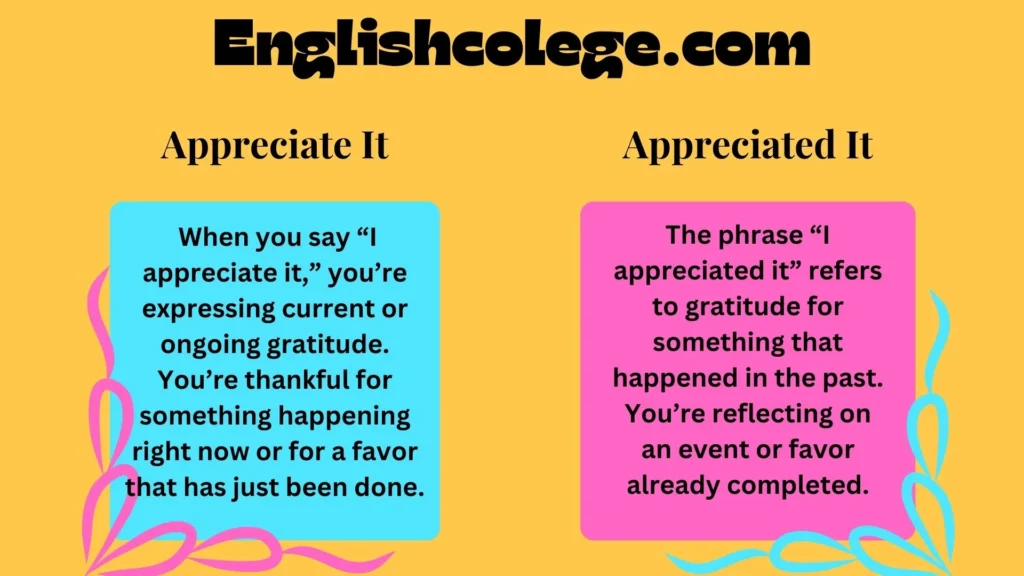
The phrase “I appreciated it” refers to gratitude for something that happened in the past. You’re reflecting on an event or favor already completed.
When to Use “Appreciated It”
- The action is over.
- You’re recalling gratitude after the fact.
- You’re describing an experience or event from before.
Examples
- “I appreciated it when you helped me move last week.”
- “They appreciated it when we sent the flowers.”
- “We really appreciated it that you came to the dinner.”
In essence, “appreciated it” expresses past gratitude, while “appreciate it” conveys present gratitude.
Grammar Breakdown: Choosing Between Present and Past
Let’s compare both forms side by side to understand their grammatical and contextual differences.
| Aspect | “Appreciate It” | “Appreciated It” |
|---|---|---|
| Verb Tense | Present Simple | Past Simple |
| Used For | Ongoing or current situations | Completed past actions |
| Tone | Polite, conversational | Reflective, formal |
| Example | “I appreciate it when you’re honest.” | “I appreciated it when you called.” |
| Time Reference | Now / ongoing | Then / past |
Grammar Insight
- Use “appreciate it” when gratitude exists in the present moment.
- Use “appreciated it” when the moment of gratitude belongs to the past.
Example contrast:
“I appreciate it when people help me.” → general habit.
“I appreciated it when you helped me yesterday.” → past event.
Contextual Nuance: Tone and Timing Matter
Tense doesn’t only change time—it also changes tone.
Tone Differences
- “I appreciate it” feels immediate, sincere, and polite.
- “I appreciated it” feels reflective and formal.
Example Scenarios
Situation: Your colleague just helped you fix a report.
- “Thanks, I appreciate it!” → current gratitude (perfect).
- “I appreciated it.” → sounds distant, like you’re recalling an old event.
Situation: You’re emailing someone after an event.
- “I appreciated it when you spoke at the conference.” → past reflection.
- “I appreciate it when you share your expertise.” → general compliment.
In conversation, native speakers naturally shift tense depending on the timing of the help or favor. Listening to context clues helps you do the same.
Common Mistakes and How to Avoid Them
Even advanced English learners make small errors when choosing between these two. Here are some pitfalls to watch out for:
❌ Mistake 1: Mixing Tenses
“I appreciated it if you could help me.”
This mixes past and present. You’re using a past verb with a present clause.
✅ Correct: “I appreciate it if you can help me.”
❌ Mistake 2: Using “Appreciated It” for Current Situations
“I appreciated it when you send the email.”
This confuses the time reference.
✅ Correct: “I appreciate it when you send the email.”
❌ Mistake 3: Forgetting Context
Tense choice depends entirely on when the gratitude applies.
✅ Tip: Ask yourself, “Is this happening now or did it happen before?”
How Native Speakers Actually Use Them
Native English speakers don’t consciously think about grammar rules when choosing between “appreciate it” and “appreciated it.” They rely on timing and tone.
Here’s how it naturally plays out:
| Context | Common Phrase | Explanation |
|---|---|---|
| Live conversation | “I appreciate it.” | Sounds immediate and polite. |
| After a favor is done | “I appreciated it.” | Reflects gratitude for something past. |
| Business email | “I appreciate your help.” | Common closing line for polite communication. |
| Thank-you note | “We appreciated your attendance.” | Retrospective tone for events. |
Native usage tip:
When unsure, default to “I appreciate it.” It’s always polite and grammatically safe.
Quick Tips to Remember the Difference
- Now = Appreciate It
Use it when gratitude happens in the moment.
Example: “I appreciate it when you listen.” - Then = Appreciated It
Use it when referring to something that already happened.
Example: “I appreciated it when you called yesterday.” - Professional Shortcut
In formal writing, “I appreciate your time” works in nearly every situation. - Emotional Cue
If your gratitude feels fresh, use appreciate it.
If it feels nostalgic, use appreciated it.
Mini Quiz: Test Your Understanding
Choose the correct form.
- “I ______ it when you helped me move.”
- a) appreciate
- b) appreciated
✅ Answer: appreciated
- “Thanks for sending that file—I really ______ it.”
- a) appreciate
- b) appreciated
✅ Answer: appreciate
- “We ______ your presence at our event last week.”
- a) appreciate
- b) appreciated
✅ Answer: appreciated
- “I ______ it when you respond quickly.”
- a) appreciate
- b) appreciated
✅ Answer: appreciate
Related Grammar Guides
For more helpful comparisons, check out these grammar deep-dives:
- Compare To vs Compare With: What’s the Difference?
- Has Been Changed vs Has Changed: Grammatical Differences Explained
- Per Se or Per Say? Which Is Correct?
- Is “Good Day” a Proper Greeting?
FAQs About “Appreciate It” vs “Appreciated It”
Is “I appreciate it” formal or informal?
Both. It works perfectly in professional emails and friendly chats. The tone is polite but neutral.
Can I say “I appreciated it” in an email?
Yes, if you’re referring to a past event. For example, “I appreciated it when you invited me last week.”
What’s more common—“I appreciate it” or “I appreciated it”?
“I appreciate it” is far more common, especially in spoken English and business writing.
Is “I have appreciated it” correct?
Yes, but it’s less common. It’s present perfect tense, used for gratitude that started in the past and continues now.
Example: “I’ve always appreciated your honesty.”
Can I say “Much appreciated”?
Yes! It’s a shorter, informal way to say thank you.
Example: “Thanks for your help—much appreciated!”
Final Takeaway
In short:
| Tense | Phrase | Use When | Example |
|---|---|---|---|
| Present | Appreciate it | Showing gratitude now | “Thanks, I appreciate it.” |
| Past | Appreciated it | Recalling gratitude for something that happened | “I appreciated it when you helped me.” |
Golden rule:
“Use appreciate it for now, appreciated it for before.”
By understanding this simple rule, your English becomes more natural, confident, and fluent—whether you’re writing an email, speaking at work, or just saying thanks.

I’m Sameer — a passionate English enthusiast who loves exploring words, grammar, and the art of effective communication. ✍️