
Words can sound deceptively similar yet carry entirely different meanings. That’s exactly the case with “annunciate” and “enunciate.”
Both trace their roots to Latin and share a link to speech or declaration—but their meanings have diverged in fascinating ways.
This guide dives deep into the origins, differences, real-world uses, and common mistakes between annunciate and enunciate. By the end, you’ll never confuse them again.
Why These Two Words Confuse So Many People
Have you ever heard someone say, “Please annunciate your words clearly”? It sounds right at first—but it’s not. The correct term in that sentence is “enunciate.”
Here’s why this mix-up happens:
- Both words sound nearly identical.
- Both relate to speech or communication.
- Yet, they come from different Latin roots and hold distinct meanings.
Let’s clear up the confusion once and for all.
The Core Difference in a Nutshell
Here’s the simplest way to remember it:
You annunciate a message. You enunciate your words.
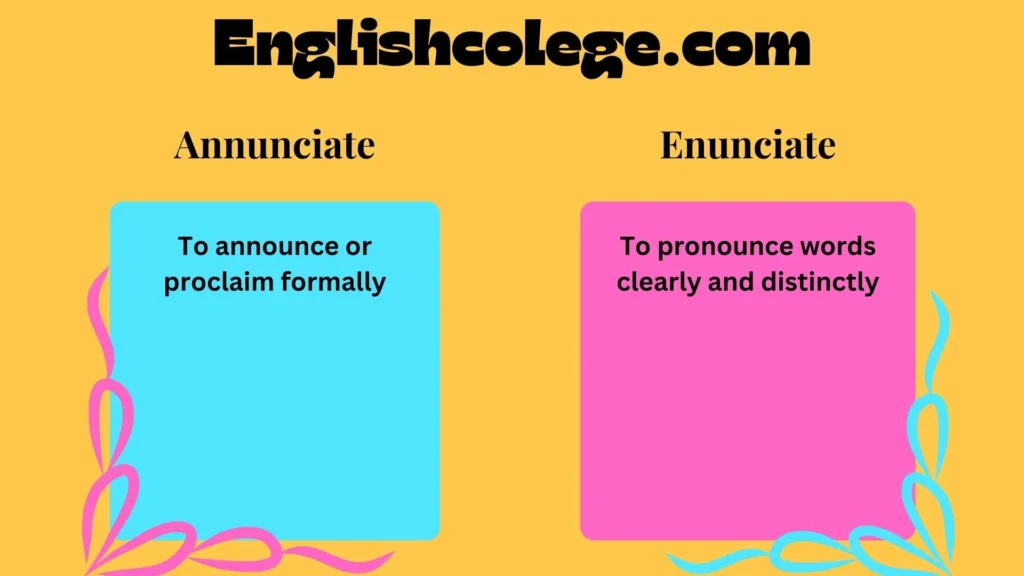
| Word | Meaning | Example Sentence |
|---|---|---|
| Annunciate | To announce or proclaim formally | “The bishop annunciated the arrival of the new priest.” |
| Enunciate | To pronounce words clearly and distinctly | “She enunciates every syllable when teaching English.” |
Annunciate relates to announcement, often formal or religious.
Enunciate relates to speech clarity—how distinctly you articulate words.
Exploring the Origins: Latin Roots and Etymology
Both words share a Latin origin but split paths over time.
- Annunciate comes from annuntiare, meaning “to announce.”
- Prefix “ad-” (to or toward) + “nuntiare” (to declare) → annuntiare
- Over centuries, it evolved into “annunciate,” mostly used in religious contexts.
- Enunciate comes from enuntiare, meaning “to speak out.”
- Prefix “e-” (out) + “nuntiare” (to speak or tell) → enuntiare
- It evolved into “enunciate,” emphasizing speech and pronunciation clarity.
Though both share nuntiare (“to announce or declare”), their prefixes create the distinction:
- an- directs action toward something (announcement).
- e- means outward expression (speaking clearly).
How the Meanings Evolved Over Time
Annunciate began as a general term for formal declarations but narrowed over time to sacred or ceremonial use. Today, you’ll see it mainly in religious texts or formal proclamations.
Example:
- “The angel annunciated the birth of Christ.”
- “The church annunciated the start of Lent.”
Enunciate, however, broadened its role in daily language. It describes how we form and express words. It became popular in speech education, broadcasting, and communication training.
Example:
- “Good speakers enunciate clearly so every word is understood.”
This evolution shows how language adapts—while one word grows specialized, the other becomes practical and universal.
Understanding “Annunciate”: Formal Declarations and Sacred Contexts
Annunciate often carries a spiritual or ceremonial tone. Its most recognized usage appears in Christian theology—The Annunciation, referring to the angel Gabriel announcing to Mary that she would give birth to Jesus.
This sacred association shaped its modern use. Today, annunciate is rare outside religious or highly formal contexts.
Examples:
- “The bishop annunciated the start of the holy season.”
- “The decree was annunciated during the coronation ceremony.”
Quick Facts about Annunciate:
- Part of speech: Verb
- Common forms: annunciated, annunciating, annunciation (noun)
- Context: Formal, religious, ceremonial
Don’t say: “He annunciated the words clearly.”
Do say: “He enunciated the words clearly.”
Understanding “Enunciate”: The Skill of Clear Speech
Enunciate focuses on pronunciation and clarity. It’s what speech coaches, actors, and presenters train to master.
When you enunciate, you articulate every syllable distinctly so your message is easily understood.
Examples:
- “She enunciates beautifully when reading poetry.”
- “Public speakers must enunciate to hold audience attention.”
Practical Importance:
- In teaching, clear enunciation helps non-native speakers learn pronunciation.
- In broadcasting, it ensures clarity across airwaves.
- In leadership, it builds authority and confidence.
Tips to Improve Your Enunciation
- Slow down. Speed causes slurred speech.
- Open your mouth wider. Good airflow improves clarity.
- Record yourself. Hearing playback reveals unclear sounds.
- Practice tongue twisters. Try: “She sells seashells by the seashore.”
Strong enunciation separates confident speakers from unclear communicators.
Pronunciation, Diction, and Everyday Application
Many people use “pronunciation” and “enunciation” interchangeably, but they differ slightly:
| Term | Definition | Focus |
|---|---|---|
| Pronunciation | How a word is spoken or sounded out | Accent, stress, intonation |
| Enunciation | How clearly you express each sound or word | Clarity and precision |
Example:
- Someone might have a British pronunciation, but poor enunciation if they mumble.
Diction Matters Too
Diction refers to word choice and clarity of expression. Together with enunciation, it shapes your communication effectiveness.
Good enunciation + strong diction = impactful speech.
Side-by-Side Examples in Real Sentences
Let’s look at how annunciate and enunciate function differently in real contexts.
| Context | Correct Usage | Incorrect Usage |
|---|---|---|
| Speech clarity | “The actor enunciated each line clearly.” | “The actor annunciated each line clearly.” |
| Formal announcement | “The priest annunciated the new festival.” | “The priest enunciated the new festival.” |
| Everyday conversation | “Please enunciate; I can’t hear you.” | “Please annunciate; I can’t hear you.” |
Memory Trick:
“Annunciate” = Announce (both start with “Ann”).
“Enunciate” = Express clearly (think “Enunciate every word”).
Common Misconceptions and Mistakes
People often mix these two words for three main reasons:
- Phonetic similarity – They sound nearly identical.
- Shared Latin root – Both come from nuntiare.
- Low frequency of use – Annunciate is rare, so speakers default to the more familiar enunciate.
Common Errors
- ❌ “She annunciated the instructions slowly.”
✅ “She enunciated the instructions slowly.” - ❌ “He enunciated the good news to the team.”
✅ “He annunciated the good news to the team.”
Pro Tip
When in doubt, think of the situation:
- If it’s about speech clarity, use enunciate.
- If it’s about announcement or declaration, use annunciate.
When to Use Each: Quick Reference Guide
Here’s a handy guide to keep the difference straight:
| Situation | Correct Word | Example |
|---|---|---|
| Making a formal or religious announcement | Annunciate | “The bishop annunciated the new doctrine.” |
| Speaking clearly | Enunciate | “The teacher enunciated each vowel sound.” |
| Reading aloud distinctly | Enunciate | “He enunciated every syllable with precision.” |
| Declaring news publicly | Annunciate | “The town crier annunciated the royal decree.” |
Key takeaway:
Annunciate = Announce
Enunciate = Articulate
Practical Takeaway: Keeping It Straight
If you remember one sentence from this guide, let it be this:
“You annunciate information, but you enunciate words.”
Both involve communication but in distinct ways:
- Annunciate focuses on what is said—formal declaration.
- Enunciate focuses on how it’s said—clarity and precision.
Mini Exercise:
Try filling in the blanks:
- The news anchor ________ every word for the broadcast.
- The priest ________ the start of Easter celebrations.
Answers:
- Enunciated
- Annunciated
Frequently Asked Questions (FAQs)
What does “Annunciate” mean in religion?
It refers to formal announcements, especially The Annunciation—when the angel Gabriel told Mary she would bear Jesus.
Is “Annunciate” still used in modern English?
Rarely. It’s mainly used in religious or ceremonial contexts, while announce or declare are more common alternatives.
How do I practice enunciation at home?
Read aloud daily, record yourself, and practice tongue twisters. Focus on moving your lips and tongue distinctly with every word.
Is enunciation important for public speaking?
Absolutely. Clear enunciation ensures your message is understood and adds confidence to your delivery.
Can I say “annunciate” instead of “announce”?
Sometimes, but only in very formal or religious settings. In everyday speech, announce is the natural choice.
Conclusion
Language clarity reflects thought clarity. Understanding the distinction between annunciate and enunciate sharpens both your speech and your writing.
- Use annunciate for formal declarations or religious announcements.
- Use enunciate when describing clear pronunciation or articulation.
Mastering nuances like this not only improves your vocabulary but also elevates how people perceive your communication skills. So next time someone says, “Please annunciate clearly,” you’ll know exactly why that doesn’t sound right—and you can politely enunciate the correction.

I’m Sameer — a passionate English enthusiast who loves exploring words, grammar, and the art of effective communication. ✍️