

English can be tricky—even for fluent speakers. One of the most common grammar confusions is between “people do” and “people does.”
You’ve probably heard both forms used in conversation or seen them online, but only one is correct.
In this guide, we’ll break down everything you need to know about using “people do” properly, why “people does” is grammatically wrong, and how to avoid similar mistakes in English.
You might’ve wondered: Is it “people do” or “people does”?
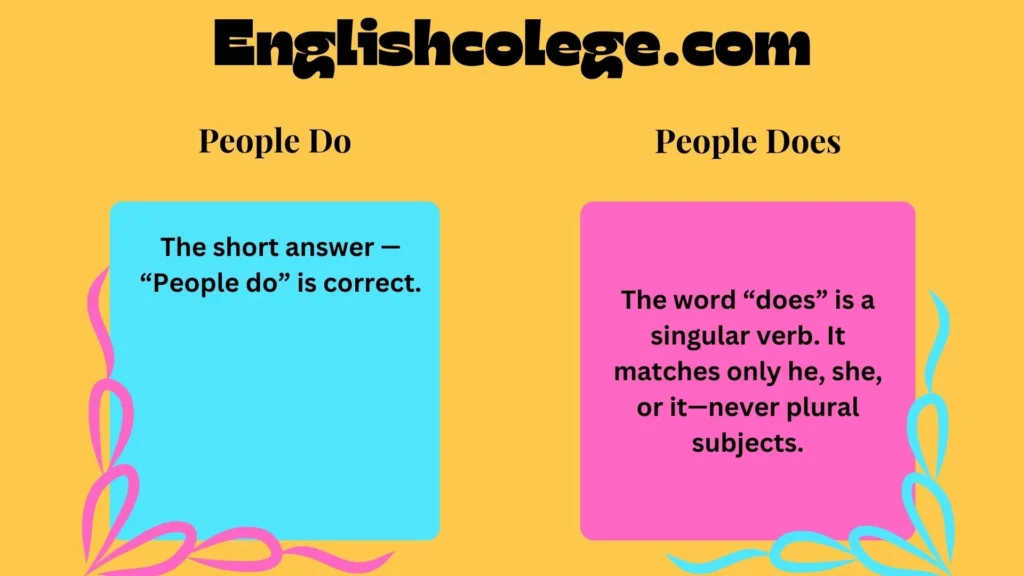
The short answer — “People do” is correct.
But let’s go deeper.
English grammar relies on subject–verb agreement, which means the verb must match the subject in number (singular or plural) and person (first, second, or third).
The word “people” is plural, so it always takes a plural verb, such as “do,” “are,” or “have.”
Here’s a quick comparison:
| Incorrect | Correct | Explanation |
|---|---|---|
| People does understand. | People do understand. | “People” is plural → needs plural verb “do.” |
| People is kind. | People are kind. | “Are” matches the plural subject. |
Understanding why this happens (and how to spot it) is the first step to mastering natural English grammar.
Understanding Subject–Verb Agreement
In English, subject–verb agreement ensures that your sentence sounds natural and grammatically correct. Let’s break it down simply.
- Singular subjects use singular verbs.
Example: She runs fast. - Plural subjects use plural verbs.
Example: They run fast.
Notice the difference?
The subject’s number (singular or plural) directly affects the verb form.
Let’s see a short chart for quick reference:
| Subject | Verb | Example |
|---|---|---|
| I | do | I do my homework. |
| You | do | You do great work. |
| He/She/It | does | She does her best. |
| We | do | We do our part. |
| They | do | They do amazing things. |
| People | do | People do incredible work. |
Key rule:
➡️ If your subject ends in “s,” that doesn’t always mean it’s plural.
But in this case, “people” is already plural—so it goes with “do.”
Why “People” Is Always Treated as Plural
Here’s where it gets interesting.
The noun “people” is actually the plural of “person.”
- Singular: person
- Plural: people
So when you say “People are friendly,” you’re really saying “Persons are friendly.”
However, English also has a rare plural form “peoples” — but it doesn’t mean the same thing.
| Form | Meaning | Example |
|---|---|---|
| People | More than one person | People love music. |
| Peoples | Groups or nations | The peoples of Africa have diverse traditions. |
So remember:
✅ “People” = plural noun (use plural verb).
✅ “Peoples” = plural of plural, used for different ethnic or national groups.
Dissecting the Error: Why “People Does” Is Wrong
Let’s understand the mechanics of why “people does” doesn’t work.
The word “does” is a singular verb. It matches only he, she, or it—never plural subjects.
For example:
- He does his work. ✅
- They does their work. ❌ (Wrong)
- They do their work. ✅ (Correct)
So “people” (being plural) requires “do.”
Here’s a simple comparison table:
| Subject | Correct Verb | Incorrect Verb | Example Sentence |
|---|---|---|---|
| Person | does | — | The person does good work. |
| People | do | does | People do good work. |
Quick tip:
If you can replace “people” with “they,” then “do” is your go-to verb form.
Quote: “Grammar is not about rules—it’s about relationships between words.” — Anonymous
The Correct Usage: “People Do” in Action
Now that we’ve established “people do” is correct, let’s see it in different contexts.
Affirmative Sentences
- People do help each other during hard times.
- People do care about the environment.
Negative Sentences
- People don’t always tell the truth.
- People do not realize how much words matter.
Questions
- Do people still write letters?
- Do people understand how powerful kindness is?
In Different Tenses
| Tense | Example |
|---|---|
| Present | People do their best. |
| Past | People did their best. |
| Future | People will do their best. |
| Perfect | People have done their best. |

Quick Grammar Tips to Remember
Here are a few easy-to-remember tips to avoid confusion:
- “People” = plural → always use “do,” “are,” “have.”
- “Person” = singular → use “does,” “is,” “has.”
| Singular | Plural |
|---|---|
| The person does work. | People do work. |
| The person is ready. | People are ready. |
| The person has hope. | People have hope. |
Mnemonic Tip:
👉 “People” sounds like “they.” If “they” fits, use plural verbs.
Common ESL mix-ups:
- “The team do…” ❌ (depends on meaning; in American English, “team does” ✅)
- “Family do…” ❌ → “Family does…” ✅
- “People does…” ❌ → “People do…” ✅
Broader Connection: Understanding Verb Conjugation
Verb conjugation is the process of changing verbs to fit the subject, tense, and voice.
In English, “do” is one of the most flexible verbs—it appears in questions, negatives, emphasis, and more.
Regular vs. Irregular Verbs
- Regular verbs: add -ed in the past tense (work → worked).
- Irregular verbs: change form completely (do → did, go → went).
| Verb | Present | Past | Past Participle |
|---|---|---|---|
| Do | do / does | did | done |
| Go | go / goes | went | gone |
| Have | have / has | had | had |
Conjugation Tip:
When in doubt, check whether your subject is singular or plural.
That determines whether you use “do” or “does.”
Avoiding Subject–Verb Agreement Mistakes
Here are a few common traps English learners fall into:
- Mistaking collective nouns for plurals
- “The committee is meeting.” (Not “are,” in American English)
- Forgetting that some words look plural but aren’t
- “News is interesting.” (Not “are”)
- Switching subjects mid-sentence
- Wrong: “People likes to learn and enjoys grammar.”
Correct: “People like to learn and enjoy grammar.”
- Wrong: “People likes to learn and enjoys grammar.”
Checklist for Spotting Errors
- ✅ Identify your subject.
- ✅ Check if it’s singular or plural.
- ✅ Match your verb form accordingly.
- ✅ Read aloud to hear if it sounds natural.
Pro Tip: Reading aloud catches 80% of agreement errors instantly.
For Non-Native Speakers: Learning Strategies That Work
If English isn’t your first language, mastering these rules can take time—but it’s completely doable. Here are effective strategies used by advanced ESL learners:
1. Listen Actively
Pay attention to how native speakers form sentences. Watch English shows or listen to podcasts, focusing on verb patterns.
2. Practice Daily
Create sentences with “do” and “does” each day. For example:
- Today, I do my chores.
- She does her best.
- People do amazing things.
3. Use Flashcards
Write “person → does,” “people → do,” and similar pairs. Visual memory helps reinforce grammar.
4. Read Quality Content
Books, blogs, and reputable news sites (like BBC or The New York Times) use proper grammar consistently.
5. Write and Get Feedback
Join online English forums or grammar communities where others can review your writing.
Summary: What You Should Always Remember
Here’s your quick takeaway:
- ✅ “People” = plural → use do, are, have
- ✅ “Person” = singular → use does, is, has
- ❌ “People does” is always incorrect in standard English
- ✅ Think of “people” as “they”—it helps every time
Mini Test:
Choose the correct form.
- (People do / People does) enjoy sunny weather. → ✅ People do
- (Person do / Person does) love learning. → ✅ Person does
- (People is / People are) friendly. → ✅ People are
FAQs About “People Do or People Does”
1. Why do people say “people does” if it’s wrong?
Some speakers mix forms due to local dialects or second-language influence, but in standard English, it’s incorrect.
2. Is “people” ever singular?
Very rarely. In academic or sociological contexts (“A people united…”), it can refer to a group as one entity, but this is uncommon.
3. What’s the plural of “people”?
“Peoples,” used only when referring to groups or nations, e.g., The indigenous peoples of the world.
4. Can we say “people has”?
No. Always use “people have,” because “people” is plural.
5. How can I easily remember when to use “do” or “does”?
If your subject is he, she, it, or one person, use does.
If it’s I, you, we, they, or people, use do.
Conclusion
Understanding the difference between “people do” and “people does” is more than a grammar rule—it’s about communication clarity.
The right verb form signals fluency and confidence. Remember, “people” is always plural, so pair it with plural verbs like “do,” “are,” and “have.”
Keep practicing, reading, and listening. Over time, subject–verb agreement becomes second nature, and your English will sound smoother and more natural.
Final Thought: Grammar isn’t about perfection—it’s about connection. When your words agree, your message shines.
