

Have you ever paused mid-sentence and wondered, “Is it tomatoes or tomatos?” You’re not alone.
Even native English speakers sometimes stumble over this tiny spelling difference. But here’s the truth — only one of them is correct.
In this comprehensive guide, you’ll learn why “tomatoes” is the right plural form, how pluralization works for words ending in -o, and how to remember tricky English spellings once and for all. Let’s settle the tomato vs. tomatos debate for good.
🥗 The Great Tomato Spelling Debate
Language evolves, and spelling rules can feel confusing. You’ll find “tomatos” all over the internet, in recipe blogs, social media captions, and even grocery signs. But popularity doesn’t equal correctness.
“Tomatoes” is the only grammatically correct plural form of the word tomato in both American and British English.
So, why does “tomatos” exist? Mostly due to typing shortcuts, autocorrect errors, or simple confusion about pluralization rules. To understand this, let’s break down the word itself.
🍅 What Does “Tomato” Mean?
At its simplest, “tomato” is a noun that refers to the red, juicy fruit used as a vegetable in cooking.
Grammatically:
- Singular noun: tomato
- Plural noun: tomatoes
- Pronunciation: /təˈmeɪtoʊ/ (American), /təˈmɑːtəʊ/ (British)
Example Sentences:
- “A ripe tomato adds flavor to any sandwich.”
- “Tomatoes are rich in antioxidants and vitamin C.”
While this might seem straightforward, the confusion starts when we look at how English handles words ending in -o.
📘 The Rule: How to Form Plurals of Words Ending in “O”
English loves exceptions — and “tomato” is one of them. Most nouns simply take an -s in the plural form (like “books,” “dogs,” or “tables”). But words ending in -o often play by different rules.
Here’s how it works:
| Rule Type | Example Word | Plural Form | Explanation |
|---|---|---|---|
| Add -es | Tomato | Tomatoes | Ends in a consonant + o |
| Add -es | Potato | Potatoes | Ends in a consonant + o |
| Add -es | Hero | Heroes | Ends in a consonant + o |
| Add -s | Piano | Pianos | Ends in vowel + o |
| Add -s | Photo | Photos | Word borrowed from Greek root |
So, the general rule is:
If a word ends in a consonant + o, add -es to make it plural.
That’s why “tomatoes” and “potatoes” take the extra -es, while “radios” and “pianos” don’t.
✅ Why “Tomatoes” Is the Correct Plural Form
“Tomatoes” is correct because it follows the standard English pluralization rule for nouns ending in a consonant + o.
The word “tomato” ends in the consonant t followed by o. According to English grammar, this pattern requires adding -es to form the plural.
Grammar Breakdown:
- Singular: tomato (ends in “to”)
- Plural: add “es” → tomatoes
Here’s what the experts say:
- Merriam-Webster: lists tomatoes as the only plural form.
- Oxford English Dictionary: confirms tomatoes as the correct plural spelling.
In short:
“Tomatoes” is the only grammatically and lexically accepted plural in modern English.
❌ Why “Tomatos” Is Wrong (and Why It’s Still Common Online)
Even though “tomatos” looks close enough, it’s grammatically incorrect. You’ll often see it used in:
- Social media captions (“I love fresh tomatos!”)
- Old recipe cards or user comments
- Informal online chats
Here’s why it appears:
- Typing errors: People drop the “e” for convenience.
- Autocorrect issues: Some spellcheckers ignore short informal text.
- Non-native writing influence: Learners of English apply the “just add -s” rule to every noun.
But remember — English pluralization isn’t always logical. Words like potatoes, heroes, and echoes all take -es.
Search engines may show both spellings, but “tomatoes” remains the only version recognized in professional and academic writing.
🌍 Origin and Etymology of the Word “Tomato”
The journey of the word tomato tells us why the plural ends in -es.
Etymology Path:
- Nahuatl (Aztec language): tomatl – meaning “swelling fruit.”
- Spanish: tomate – adopted during the Spanish colonization of the Americas.
- English: borrowed the word as tomato in the 1600s.
Because the English version came from Spanish, a language that naturally uses vowel endings and plural -es patterns, the -es carried over.
That’s why you see tomato → tomatoes and potato → potatoes — both share Spanish roots.
🧠 Other Words That Follow the Same Pluralization Rule
To remember the pattern, it helps to look at similar examples.
| Singular | Plural | Why It Adds “-es” |
|---|---|---|
| Potato | Potatoes | Ends with consonant + o |
| Hero | Heroes | Ends with consonant + o |
| Echo | Echoes | Ends with consonant + o |
| Volcano | Volcanoes | Commonly used with -es |
| Buffalo | Buffaloes | Accepted with -es |
| Mosquito | Mosquitoes | Ends with consonant + o |
Exceptions (only add -s):
| Singular | Plural | Why It’s Different |
|---|---|---|
| Piano | Pianos | Derived from Italian, keeps -s |
| Photo | Photos | From Greek root, keeps -s |
| Radio | Radios | Ends in vowel + o |
| Video | Videos | Ends in vowel + o |
Quick Tip:
If the -o follows a vowel (like “io”), just add -s.
If the -o follows a consonant, add -es.
💡 Memory Tricks to Remember the Correct Form
English spelling can be unpredictable, but here are a few tricks to keep “tomatoes” straight in your mind:
1. The “Garden Rule”
If it grows in the ground, add -es.
- Tomato → Tomatoes
- Potato → Potatoes
- Mango → Mangoes
2. The “Hero Rule”
If it ends in a consonant + o, it’s a hero, not a piano.
3. Visual Cue
Imagine the word “tomato” expanding as you add more of them — that extra ‘e’ represents the growth of the plural.
4. Flashcard Memory Hack
Create flashcards pairing similar words:
- Tomato ↔ Tomatoes
- Potato ↔ Potatoes
- Piano ↔ Pianos
Repetition makes recall automatic.
✍️ Example Sentences Using “Tomatoes”
Seeing the word in context helps cement the rule.
Singular:
- “This tomato tastes sweet and juicy.”
- “I bought a fresh tomato for my salad.”
Plural:
- “Tomatoes are essential for making pasta sauce.”
- “Green tomatoes ripen faster in sunlight.”
- “He grew cherry tomatoes in his backyard.”
Incorrect (avoid):
- “I love the flavor of tomatos.” ❌
- “Those tomatos look delicious.” ❌
Always remember — no matter how you pronounce it, the plural has -es.
📜 Quick Grammar Recap: The Takeaway
Here’s everything you need to remember:
| Word | Correct Plural | Rule |
|---|---|---|
| Tomato | Tomatoes | Add -es (ends in consonant + o) |
| Potato | Potatoes | Add -es (same rule) |
| Photo | Photos | Add -s (vowel + o) |
| Piano | Pianos | Add -s (foreign root) |
Key Points:
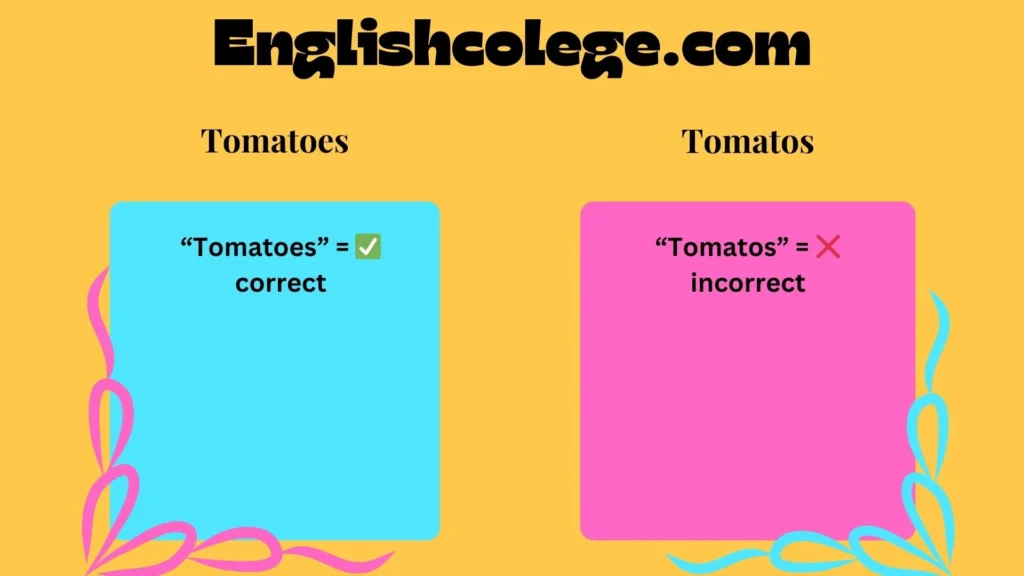
- “Tomatoes” = ✅ correct
- “Tomatos” = ❌ incorrect
- The rule comes from consonant + o endings
- Spanish origin reinforced the -es pluralization
- Always use “tomatoes” in writing and speech
📚 Related Grammar Guides You Might Like
If you enjoyed clearing up tomatoes vs. tomatos, check out these other common spelling confusions:
- Berry vs. Bury – What’s the Difference?
- Sherbet vs. Sherbert – Common Spelling Mistake Explained
- World vs. Whirled – Same Sound, Different Meaning
- Bite vs. Bight – Homophones in English
- Loophole – Meaning, Origin, and Everyday Use
Each one dives into tricky English quirks — just like this one.
🗣️ Case Study: Real-World Grammar Confusion
In 2018, a major supermarket chain in the US accidentally printed “Fresh Tomatos” on thousands of product labels.
The mistake went viral on social media — not because people cared about grammar, but because they noticed.
Result:
- The brand issued a correction and reprinted labels.
- Online engagement spiked by 40% due to the spelling debate.
- Grammar blogs used it as a real-world example of why pluralization matters.
Lesson: Even small spelling differences affect credibility and trust.
If a brand can lose attention over a missing “e,” imagine the impact on professional writing or education.
💬 Famous Quote About Language
“Proper words in proper places make the true definition of style.”
— Jonathan Swift
Accuracy in language isn’t about being pedantic — it’s about clarity, credibility, and connection.
❓ Frequently Asked Questions (FAQs)
Is “tomatos” ever correct in any version of English?
No. Neither American nor British English recognizes “tomatos” as correct. Only “tomatoes” is accepted in formal, academic, and everyday writing.
Why do some people spell it “tomatos”?
Mostly due to typing errors or the false assumption that every plural just adds “s.” It’s a common mistake, especially among English learners.
Do British and American English differ in pluralizing “tomato”?
No difference. Both use “tomatoes” as the plural form. However, pronunciation may vary slightly.
What about compound words like “cherry tomato”?
When pluralizing compound nouns, add “-es” to the main noun:
→ “Cherry tomatoes,” not “cherry tomatos.”
Is there ever a situation where “tomato’s” (with apostrophe) is correct?
Yes, but only to show possession:
→ “The tomato’s color deepened in the sun.”
Never use “tomato’s” for plurals.
🍅 Conclusion
In the end, it’s simple: Tomatoes is the correct plural form of tomato.
The rule follows standard English grammar — add -es when a word ends in a consonant + o.
Whether you’re writing a recipe, labeling a product, or studying English, remember that every extra “e” carries the weight of linguistic history — from Aztec roots to modern grammar books.
So next time someone asks, “Tomatoes or Tomatos?”
You can smile and say:
“Only one’s ripe for grammar perfection — and that’s tomatoes.”
