
Have you ever caught yourself wondering whether to say “listen to music” or “listen to the music”? You’re not alone. Many English learners—and even fluent speakers—get confused about when to use “the.”
Although it looks like a tiny word, “the” completely changes meaning, tone, and context. Understanding this difference helps your English sound natural and precise. Let’s break it down clearly and conversationally.
Why This Subtle Difference Matters
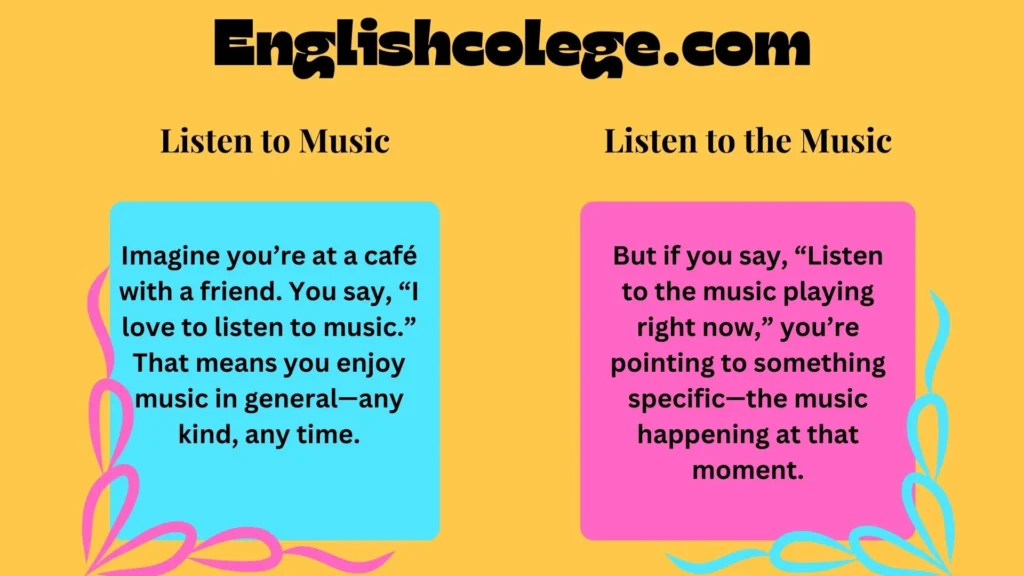
Imagine you’re at a café with a friend. You say, “I love to listen to music.” That means you enjoy music in general—any kind, any time.
But if you say, “Listen to the music playing right now,” you’re pointing to something specific—the music happening at that moment.
See the difference? Both are correct, but they communicate different ideas. Mastering this helps you sound fluent and more expressive.
“In English, small words like ‘the’ often carry the biggest weight.”
— Language Tip of the Day
Understanding the Core: “Music” as an Uncountable Noun
To grasp the difference, let’s start with grammar basics.
Music is an uncountable noun. That means you can’t say “a music” or “two musics.” You can’t count music like apples or books.
Instead, we use it to describe sound in general or a type of art form.
Examples:
- ✅ I love music.
- ✅ She studies classical music.
- 🚫 I love a music.
- 🚫 He bought two musics.
When you refer to music in a general sense, you don’t use an article (“a” or “the”).
However, when you refer to specific music—something known or shared between the speaker and listener—you use “the.”
General Usage: When to Say “Listen to Music”
When you say “listen to music,” you’re talking about the activity or experience in general. You’re not pointing to a particular song, band, or event.
Think of it as referring to the concept of music, not a specific instance of it.
Common Situations:
- Talking about hobbies or habits:
- I listen to music while working out.
- She listens to music every morning.
- Describing preferences:
- He likes to listen to music when it rains.
- Expressing emotions:
- Listening to music helps me relax.
Key Takeaway:
Use “listen to music” when the focus is on the activity or habit of listening, not on a particular piece or song.
Specific Usage: When to Say “Listen to the Music”
Now, “listen to the music” adds specificity. You’re referring to particular music, known to both the speaker and listener, or currently audible.
This phrase narrows the focus—like shining a spotlight.
Examples:
- Listen to the music playing in the background.
- Did you listen to the music she composed?
- Listen to the music—they’re starting the show!
In each case, “the” makes it clear which music you mean. It’s not just any sound—it’s that sound.
Case Study:
During an English lesson, students were shown two sentences:
- “Listen to music to relax.”
- “Listen to the music and tell me what instruments you hear.”
When asked which one refers to a general activity, most chose the first. They were right! The second refers to a specific piece—an observable or discussed example.
Quick Grammar Hint:
If you can point to the sound or identify it, use “the.”
The Grammar Behind It: Articles and Countability
Articles in English—a, an, the—signal whether something is specific or general.
| Article | Meaning | Example |
|---|---|---|
| a / an | one of many, not specific | I saw a dog in the park. |
| the | specific, known, or previously mentioned | The dog followed me home. |
| (no article) | general or abstract idea | Dogs are loyal animals. |
Why “a music” Doesn’t Work
Since “music” is uncountable, you can’t use “a” or “an” directly with it.
Instead, use phrases like:
- a piece of music
- a song
- a melody
- a type of music
| ✅ Correct | 🚫 Incorrect |
|---|---|
| I love listening to music. | I love listening to a music. |
| That’s a beautiful piece of music. | That’s a beautiful music. |
This rule keeps your English grammatically sound and natural.
Contextual Clues: Choosing Between “Music” and “the Music”
How do you know which phrase fits? Context tells you.
Use “listen to music” when:
- Talking about music as a general activity.
- No specific piece is mentioned or implied.
- The sentence focuses on the action, not the source.
Use “listen to the music” when:
- The listener already knows which music you mean.
- The music is currently playing or clearly identified.
- You want to emphasize that particular sound or composition.
Example Comparison:
| Sentence | Meaning |
|---|---|
| I listen to music when I study. | General habit or activity. |
| Listen to the music—it’s starting! | Refers to specific, audible music. |
| She listens to music every night. | Refers to a regular activity. |
| Listen to the music she wrote. | Refers to a specific composition. |
Common Confusions and Related Expressions
“Listening to Music” vs. “Listening to the Radio”
Many learners confuse these two because both involve sound. But the rules differ.
- Music is uncountable, so we say listen to music.
- Radio is countable as a medium or device, so we say listen to the radio.
| Expression | Meaning | Correct Form |
|---|---|---|
| Listen to music | Engage in the activity of hearing music in general | ✅ |
| Listen to the radio | Tune in to a specific medium or broadcast | ✅ |
| Listen to the television | Rare, but possible when referring to sound only | ✅ |
Bonus Tip:
When the noun refers to a device or medium (like radio or podcast), “the” is often needed. When it refers to an art form (music, art, poetry), you usually drop “the” for general statements.
Quick Grammar Tips to Remember
Here are some handy reminders to make choosing easy:
- ✅ Use listen to music for general reference.
- ✅ Use listen to the music for specific or shared reference.
- 🚫 Never say listen to a music.
- ✅ Say a piece of music when referring to one composition.
- ✅ Remember: if you can point to it or hear it now, use “the.”
Mnemonic Trick
“If you can hear or see it, add the.
If you’re talking about it in general, drop the.”
Real-Life Examples in Conversations
Here are some real-life dialogues to show both phrases in action:
Example 1: General Use
A: What do you usually do to relax?
B: I listen to music. It helps me unwind.
Example 2: Specific Use
A: Can you hear that?
B: Yeah, listen to the music—it’s amazing!
Example 3: Formal Setting
Please listen to the music before submitting your review.
Example 4: Classroom Context
Listen to the music and identify the instruments you hear.
Pro Tip:
In daily English, listen to music is far more common, but listen to the music appears when speakers want focus or attention on something audible right then.
Summary: Grasping the Nuance
The key difference lies in specificity.
| Phrase | Meaning | Example |
|---|---|---|
| Listen to music | General, refers to the act or hobby | I listen to music when I study. |
| Listen to the music | Specific, refers to identifiable sound | Listen to the music—it’s starting! |
So, if you’re just describing an activity, use listen to music.
If you’re pointing out something specific, use listen to the music.
Understanding these small details elevates your English from good to natural and fluent.
Related Lessons for Deeper Learning
If you enjoyed this topic, here are a few related grammar lessons to deepen your understanding of subtle English differences:
- Loss vs. Lost – Understanding tense and meaning.
- Eatable vs. Edible – Two words that seem identical but aren’t.
- Consonance vs. Assonance – The music of language.
- Would You Be Available vs. Will You Be Available – Politeness levels in conversation.
- Arose vs. Arisen – Verb forms that confuse even natives.
These concepts reinforce how context, tone, and specificity shape meaning in English.
Frequently Asked Questions
What does “listen to music” mean?
It means engaging in the general act of hearing or enjoying music. It’s not about a specific piece—just the activity itself.
When should I use “listen to the music”?
Use it when the listener and speaker both know which music you’re referring to, such as background music, a concert, or a specific song.
Can I say “listen to a music”?
No. “Music” is uncountable, so you can’t use “a” before it. Instead, say “a piece of music” or “a song.”
Is “listen to music” more common than “listen to the music”?
Yes. “Listen to music” appears far more often in everyday speech because people usually talk about the activity, not specific music.
Why do we say “listen to the radio” but not “listen to the music”?
Because “radio” refers to a specific medium or device, it takes “the.” “Music” is an art form, so it usually appears without “the” unless you’re referring to specific sounds.
Conclusion
The difference between “listen to music” and “listen to the music” might look tiny, but it carries big meaning.
- Listen to music → general activity.
- Listen to the music → specific, identifiable sound.
Knowing when to include or omit “the” helps your English sound smooth, natural, and grammatically accurate.
Next time you’re enjoying your favorite tunes, think about it: are you just listening to music, or are you listening to the music?
Either way—your grammar will now be on point. 🎧
